For decades terraforming Mars was treated as pure science fiction. In 2025 scientists published a serious roadmap for actually assessing whether it's possible, and the honest answer is more interesting than yes or no.
Could We Terraform Mars? The Real Science
◆ In Summary
A 2018 NASA-funded study concluded that the traditional CO₂-based approach to terraforming Mars was not feasible with present-day technology because the planet holds only a few percent of the accessible carbon dioxide needed to rebuild its atmosphere. New research has reopened the question using engineered nanoparticles that trap heat far more efficiently than greenhouse gases, potentially warming Mars within decades. In 2025 scientists published a formal roadmap for assessing whether terraforming is genuinely feasible. Warming the planet is now a serious engineering question, but building a breathable oxygen atmosphere would still take centuries to millennia. Whether we should terraform Mars at all remains an open question, especially if native life survives there.
I first wondered about this after watching Total Recall (the 1990 version starring Arnold Schwarzenegger). The film ends with an ancient alien reactor melting the ice inside Mars and giving the planet a breathable sky in about ninety seconds, and I remember thinking: could that ever actually happen? Could Mars have an atmosphere again? For a long time science's answer was a firm no, and certainly not by the method Arnie's film shows. Carbon dioxide looked like the real candidate for creating liveable conditions, but in 2018 a NASA-funded study went through every reservoir of CO2 on the planet, added it all up, and concluded there wasn't enough to rebuild the atmosphere. The dream died by spreadsheet, and for years that was that.
Could We Terraform Mars? What It Would Actually Require
Start with what Mars is. The atmosphere is about 0.6% of Earth's pressure, thin enough that your blood would boil at body temperature without a suit. The average temperature is around minus 60 degrees Celsius. There's no liquid water on the surface, no ozone layer, and radiation arrives largely unfiltered. It's a dead world by every measure that matters to a human body.
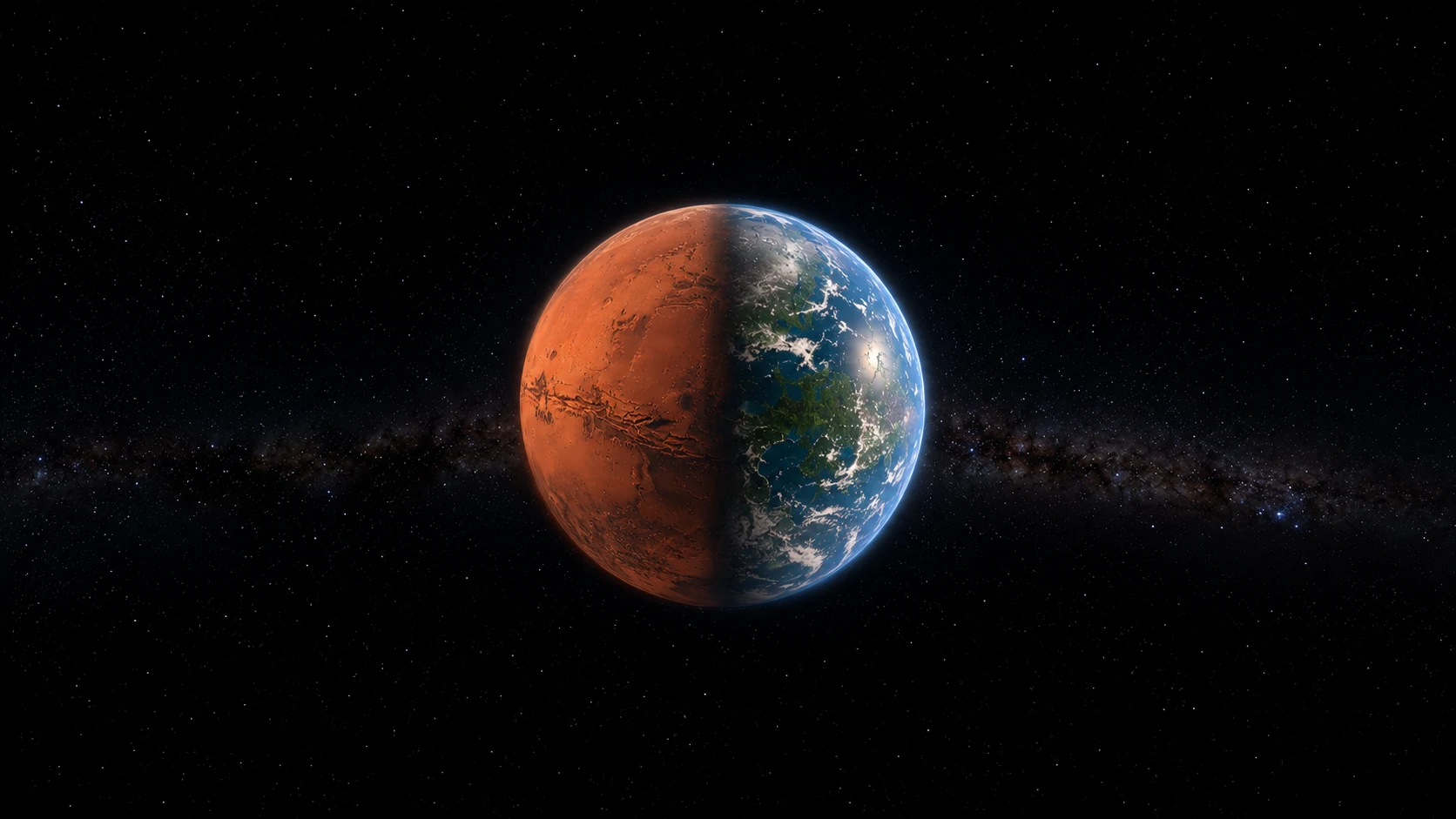
Terraforming means turning Mars into a world with an atmosphere like Earth's, in three stages. First, warm the planet by something like 30 degrees. Second, thicken the atmosphere (this means raising its pressure enough that liquid water can sit on the surface instead of boiling away), which happens as a side effect of the warming: a hotter Mars releases more of its own CO2 and water vapour, both greenhouse gases, so warming and thickening arrive together. Third, fill that atmosphere with enough oxygen to breathe, which turns out to take far longer than either. Warming is an engineering problem, one that may finally have a workable answer. Oxygen is a biology problem, and biology works at its own pace.
Why the Idea Was Declared Dead
To rebuild an atmosphere you need a gas that does two jobs. Any gas provides pressure. What made carbon dioxide the candidate is that it also traps heat. Sunlight comes in, the warmed ground radiates heat back out, and CO2 absorbs some of that heat instead of letting it escape to space. It's the same greenhouse effect we worry about on Earth, pointed at a planet that would benefit from it. Warm Mars enough and liquid water returns, water vapour rises off it, and water vapour is itself a greenhouse gas, so the warming feeds itself. That's why the classic plan was a cascade: release the frozen CO2 at the poles and in the soil, let the warming release more, and ride it up to a thicker world. Mars has frozen water too, but water can't start this. It freezes straight back out. CO2 had to be the trigger.
The 2018 study, by Bruce Jakosky and Christopher Edwards, killed it with arithmetic. They went through every accessible source of CO2 on the planet: polar caps, soil, dust, buried carbonate deposits. Release all of it, every scrap technology could plausibly reach, and you get a few percent of the pressure needed. Not half. Not a promising start. A few percent. The cascade never gets going, because most of the fuel was stripped away billions of years ago, and what's left is locked in rock so deep that mining it would be a bigger job than the terraforming.
Elon Musk's famous suggestion of nuking the poles was this plan at its most direct, and to be fair to him, he has engaged with the objection. When the 2018 study landed he argued the soil holds far more CO2 than the accessible inventory counted, releasable with enough energy. The study's authors conceded the soil point but not the conclusion: extracting it needs technology nobody has, and even then the numbers fall well short. The dispute is real, but it's a dispute about how far short, not about whether it works.
The 2018 result was a disappointing one. But science has a habit of finding a new direction just when a question looks settled, and Mars had one more turn left in it.
What Changed
The case reopened because someone approached the problem from a different direction. The 2018 result assumed warming Mars meant CO2, because CO2 is what nature uses. Then in 2024 a study led by Edwin Kite at the University of Chicago proposed something stranger: aluminium or iron nanorods, each about nine micrometres long, made from minerals already common in Martian dust. Released from pipes extending up into the planet's natural updrafts, at a rate of around 30 litres per second, the rods would be carried into the atmosphere the way Martian dust already is. Unlike a greenhouse gas, which absorbs specific wavelengths as heat tries to escape, the rods are designed to scatter incoming sunlight while reducing the escape of infrared radiation. Computer modelling suggests they could be more than 5,000 times more effective per unit mass than the best greenhouse gases
You'd still need millions of tons of them, and manufacturing the nanorods on the planet at that scale is clearly another huge challenge to overcome. Still, it sidesteps the problems of a CO2-based plan, and the modelling suggests noticeable warming within months, with the full 30-degree effect building over decades. Kite is careful to add that warming alone would not make Mars habitable. It would just, for the first time, make warming Mars look like an engineering problem rather than an impossible one.
That result is why terraforming is back in respectable journals. Workshops followed, bringing scattered post-2024 interest into the open for the first time, and in 2025 the roadmap paper arrived. It isn't a plan to terraform Mars. It's a programme for finding out whether it can be done, what it would cost, and what we'd need to learn first. Nobody serious is saying yes. They're saying the 2018 no was an answer about CO2, and CO2 turned out not to be the only route.
Warm Is Not Breathable
A warm Mars and a habitable Mars are different planets, and this is where we need to be clear what we're talking about. Warming might now be a decades-scale engineering problem. Breathing is not. An oxygen atmosphere has exactly one known manufacturing process, photosynthesis, and on Earth it took cyanobacteria the better part of two billion years. Optimistic Mars estimates, with engineered organisms and a running start, still land in the centuries. The pessimistic ones don't bother with numbers. NASA's Perseverance rover has already made oxygen on Mars, a few grams an hour with its MOXIE experiment, which is a real milestone and also a useful measure of the gap. A few grams an hour, against a planet's worth of atmosphere.
Then there's the magnetic field, or lack of it. The solar wind does strip unprotected atmospheres, and without one, the process never fully stops. But it happens over millions of years. On any timescale humans plan across, decades to centuries, a rebuilt Martian atmosphere isn't leaking fast enough to matter.
Should We Terraform Mars?
There's a question underneath all of this that engineering can't answer. We still don't know whether Mars has life. If anything native survives there, even microbes deep in the brines, terraforming means overwriting a second genesis before we've finished checking it exists. I think that would be vandalism on a scale with nothing else we've done, and I hold that view while also wanting humans on Mars, which is perhaps contradictory. And there's the question of authority. No person, company or country has any recognised right to redesign a planet. I'm not convinced a species that can't agree on carbon emissions at home is ready to decide on an atmosphere for another world. This article is about could, not necessarily should. But within a hundred years, we will probably need to decide what we're doing about Mars.
So Could We Terraform Mars?
Here's the verdict. Could we warm it? Plausibly yes, and that sentence couldn't have been written honestly five years ago. The nanoparticle work moves warming from fantasy to engineering proposal, with real numbers and real researchers checking them. Could we make it Earth-like, with blue skies, open water and breathable air? Not on any timescale that means anything to a person now living. The oxygen problem alone runs to centuries, and nothing on the horizon shortens it. Will it happen? That depends less on physics than on whether anyone sustains the will and the money across generations, and recent history offers a caution there. The most credible interstellar proposal of the century died waiting for a pledge to be honoured. Planets are patient. Funding isn't.
Mars sits in a strange middle distance. Close enough that getting people there is a solvable problem. Harsh enough that living there would be brutal. And just barely, possibly, reshapeable, on timescales that make cathedral-building look impulsive. Whether that adds up to a second home or a permanent outpost on a world we warmed but never finished, I don't know. Nobody does yet. That's what the roadmap is for.
Frequently Asked Questions
How long would it take to terraform Mars?
It depends which part you mean. Warming Mars by the required 30 degrees could take as little as a few decades using engineered nanoparticles, according to research published since 2024. Building a breathable oxygen atmosphere is a different matter entirely: photosynthesis is the only known process that produces oxygen at planetary scale, and even optimistic estimates using engineered organisms run to centuries. A fully Earth-like Mars, if possible at all, is a project measured in hundreds to thousands of years.
Why can't we just nuke the poles like Elon Musk suggested?
Because there isn't enough carbon dioxide there. A 2018 NASA-funded study by Bruce Jakosky and Christopher Edwards inventoried every accessible CO2 reservoir on Mars and found that releasing all of it would produce only a few percent of the atmospheric pressure needed. Musk has argued the soil holds more CO2 than the study counted, and the authors partly conceded that, but extracting it would need technology that doesn't exist, and the total would still fall well short. The plan fails on inventory, not on firepower.
Does Mars need a magnetic field to hold an atmosphere?
Not on human timescales. Mars lacks a global magnetic field, and the solar wind does strip unprotected atmospheres, which is partly how Mars lost its original one. But that process takes millions of years. A rebuilt Martian atmosphere would leak so slowly that the loss would be irrelevant to any civilisation maintaining it. Of all the popular objections to terraforming, the missing magnetic field is the least important in practice.
Is anyone actually working on terraforming Mars?
Yes, though at the research stage rather than the engineering stage. Since 2024, peer-reviewed work has shown that engineered nanoparticles made from Martian dust could warm the planet far more efficiently than releasing CO2. In 2025, researchers published a formal roadmap, drawn from a dedicated scientific workshop, setting out what would need to be studied to establish whether terraforming is feasible at all. Nobody is terraforming anything yet, but for the first time in years it is a live scientific question.
◆ Also In The Stars
◆ Go Deeper
Recommended
The Case for Mars: The Plan to Settle the Red Planet and Why We Must
Amazon ↗
Affiliate links — we may earn a small commission at no cost to you.