The megastructure Star Trek made famous started life as a serious 1960s search strategy for finding alien civilisations, and the hunt for one is still very much alive.
◆ In Summary
A Dyson sphere is a hypothetical megastructure built to harvest a star's total energy output. Astronomers have hunted for its tell-tale infrared glow for years. In July 2026, JWST ruled out two of the seven original Project Hephaistos candidates, finding their infrared excess came from background galaxies. The remaining five have not been confirmed.
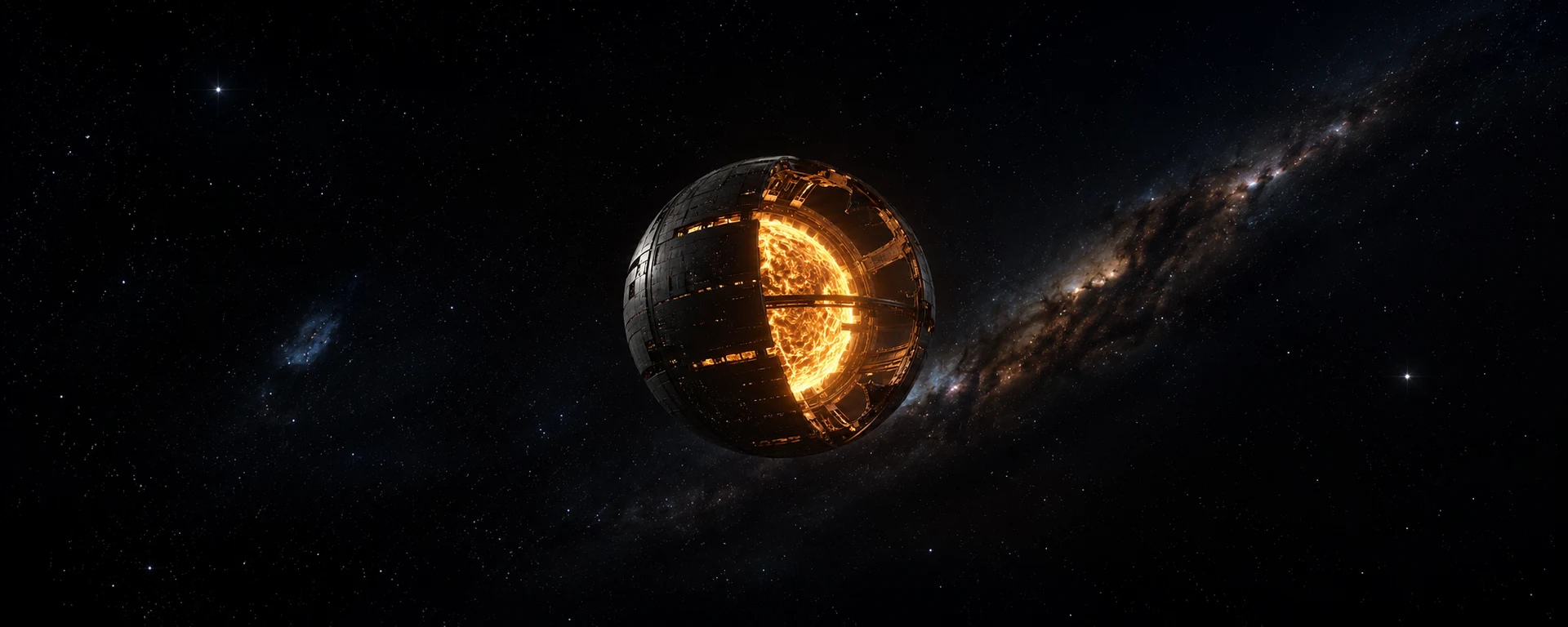
Picture a star wrapped entirely in a shell of collectors. Nothing gets past it. Every photon is captured and used for energy. That's the Dyson sphere, science fiction shorthand for advanced alien engineering for decades. Star Trek used the idea. So did countless video games, novels and thought experiments about what a sufficiently advanced civilisation might eventually build. Like a lot of future tech ideas, this one was dreamed up in a book before serious science ever got hold of it. Today, some astronomers are searching the stars for signs that it's already been built somewhere, by an advanced civilisation elsewhere in our galaxy.
The Dyson sphere: the man behind it
Dyson was a British-born physicist who became an American citizen in 1957, and spent most of his career at Princeton's Institute for Advanced Study, the same institution Einstein once worked from. He never actually finished a PhD, but that didn't stop Cornell making him a professor in his twenties, on the strength of work reconciling competing versions of quantum electrodynamics. He wasn't a narrow specialist either. Nuclear reactor design, solid-state physics, a nuclear-powered spacecraft concept called Project Orion, arms control policy. This wasn't a career built on speculation alone.
Freeman Dyson published the idea in Science in 1960. The paper had a clinical title: "Search for Artificial Stellar Sources of Infrared Radiation." He didn't claim to have invented the concept. Credit went to Olaf Stapledon instead. His 1937 book Star Maker had already imagined civilisations building structures to capture their star's energy directly. Dyson gave him the credit, in a footnote, in the paper itself.
What it would give a civilisation
Earth intercepts less than one billionth of the Sun's total output, and that sliver already runs the entire biosphere, humanity included. A structure capturing a meaningful share of a star's full energy budget represents an increase measured in the billions, not the doubling or tripling usually attached to ambitious engineering projects. What that much energy actually buys is hard to properly get your head around. Megascale computation. Propulsion that doesn't run into the fuel problem making interstellar travel so brutal. A population no longer bounded by a single planet's surface area. It's not just a story about more energy. It's a story about a civilisation supercharged enough to start actually exploring the galaxy, rather than just staring at it.
Civilisation class: the Kardashev scale
In 1964, the Soviet astronomer Nikolai Kardashev proposed classifying civilisations by how much energy they control rather than by anything to do with their technology specifically. A Type I civilisation harnesses all the energy available on its home planet. A Type II harnesses the entire output of its star. A Type III harnesses the output of its galaxy. Humanity isn't Type I yet, for what it's worth; estimates generally put us around 0.7 on the scale. A Dyson sphere, in whatever form it actually takes, is the textbook example of Type II technology. And given we've never confirmed life anywhere beyond Earth, searching for one is just as valid a strategy as scanning for biosignatures on distant planets. It might still be science fiction, but if something like it exists, it's the kind of thing we'd actually be able to see.
The search: candidates so far
Project Hephaistos is an international search effort. It published its first results in 2024. Seven candidate stars, all M dwarfs. Each showed infrared excess consistent with Dyson sphere models. All of them sit within 1,000 light years of Earth. A follow-up paper, Project Hephaistos III, arrived in late July 2026, analysing those original seven alongside three further objects with similar properties.
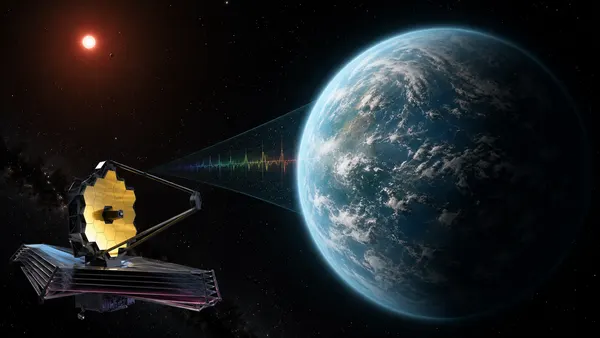
Around the same time, the James Webb Space Telescope closed the file on two of those seven, Candidates D and E. Candidate D was sitting in front of a Hot Dust-Obscured Galaxy. Its supermassive black hole was heating enormous clouds of dust, which is what produced the glow. Candidate E had a similar problem hiding behind it, a dusty starburst galaxy churning out new stars at a furious rate. Both had been flagged because they glowed too brightly in infrared for ordinary stars. Both turned out to be something else, sitting almost perfectly behind a much closer star from Earth's vantage point.
None of the remaining five Hephaistos candidates has been confirmed either. Confirmation is a high bar by design, because ordinary astrophysics produces plenty of infrared excess on its own, and the pattern so far is consistent: a plausible signal, followed by a mundane explanation once someone points a better instrument at it.
There's also a stranger variant of the search that's attracted attention. In June 2025, more than two dozen researchers gathered at MIT, and the guest list alone tells you something about how seriously the idea is taken now: astrophysics, engineering, AI, philosophy, computer science, all in the same room. The question on the table was whether an advanced civilisation might build a Dyson sphere around a black hole instead of a star, since black holes release enormous energy through their accretion disks and jets, and any structure harvesting that would still have to dump the unused portion as detectable heat.
Building a Dyson sphere around a star is one thing. Around a black hole is another level entirely. Still, working out whether the idea even holds up counts as real progress in this field, whatever the answer eventually turns out to be.
Could we build a Dyson sphere?
Assuming we had the backing of governments, the funding to match, and the engineering know-how, which we don't yet have either, the material requirement would still be the immediate problem, and it's the reason this stays firmly in the not-soon category.
Enclosing even a fraction of a star's output requires an enormous surface area of collectors, far more raw material than Earth alone could supply. Dyson's own calculation used Jupiter as the source, roughly 318 times Earth's mass, an illustrative figure from his original thought experiment rather than a demonstrated minimum. Modern swarm concepts could need very different amounts depending on their design. The serious proposals work the same way: dismantling planets, moons or asteroid belts across the whole system rather than relying on any single world, an undertaking that alone would occupy a civilisation for generations, before even accounting for maintaining a structure that scale for the centuries or millennia it would need to operate.
But given the payoff, an almost unbounded increase in the energy available to a civilisation, it's hard to argue it wouldn't be worth building if the capability existed. And there might be a way to actually start, rather than needing the whole problem solved at once. A January 2026 study from the University of Glasgow, led by Colin McInnes, modelled a lighter 'Dyson bubble' version: a dense cloud of small reflectors held in place partly by the star's own light pressure. The modelling suggests that arrangement could, in principle, become passively self-stabilising, without needing constant correction to stop it drifting into the star. It doesn't solve the resource problem. It's a plausible route to actually begin.
None of this settles whether one's actually out there. I like to think there is, somewhere, quietly captured in a JWST image nobody's looked at closely enough yet. Until that changes, I'll make do with the depictions in popular sci-fi.
Frequently Asked Questions
What is a Dyson sphere?
A Dyson sphere is a hypothetical structure, or more accurately a swarm of structures, built to capture the total energy output of a star. Physicist Freeman Dyson proposed the concept in 1960, building on an idea Olaf Stapledon had already sketched out in his 1937 book Star Maker.
Who came up with the idea of a Dyson sphere?
Freeman Dyson published the concept in a 1960 paper in Science. He credited the underlying idea to Olaf Stapledon's 1937 book Star Maker, which had already imagined civilisations building structures to capture their star's energy directly.
Has a Dyson sphere ever been found?
No. Project Hephaistos identified seven candidate stars showing unusual infrared excess. In July 2026, JWST ruled out two of them, Candidates D and E, finding their infrared excess came from background galaxies. The remaining five have not been confirmed.
Could we actually build a Dyson sphere?
Not with current technology. It would require dismantling planets or asteroid belts for raw material, far beyond anything currently achievable. A 2026 study modelled a lighter 'Dyson bubble' design, a dense cloud of small reflectors, and found it could in principle become passively stable without needing constant correction.
◆ Also In The Stars

◆ Go Deeper
Recommended
Affiliate links — we may earn a small commission at no cost to you.