Written in code its first readers understood at once, the Bible's strangest book has spent two thousand years being misread by everyone who came after.
◆ In Summary
The Book of Revelation is the final book of the New Testament and the most argued-over text in the Bible. Written by a man named John on the Greek island of Patmos around 95 AD, it belongs to a specific genre of coded political writing that its original audience would have understood immediately. The Beast is generally understood as Rome. The number 666 most likely refers to Nero. The Four Horsemen are unnamed except for Death. And the dispensationalist reading that gave us the Rapture and Armageddon as a literal battle in northern Israel is largely a nineteenth-century invention with little presence in Christian thought before the 1830s.
The Book of Revelation
The Book of Revelation is the final book of the New Testament, and the one that has probably generated more argument, more art, and more anxiety than any other. It describes a series of visions received by a man named John on the Greek island of Patmos. Cosmic battles, plagues, the fall of empires. The end of history as we know it, or so the argument goes. No book in the Bible has been more debated, or more misread.
Recently, I was involved in developing a screenplay about the Rapture. Not a faith project, exactly, more an attempt to dramatise what it would actually look like if the theology were taken literally. It meant I had to read Revelation properly, not just rely on the popular version, which is vivid but approximate: horsemen, beasts, the number of the beast, seven seals, a dragon, Armageddon. Fire and spectacle. It has fuelled centuries of paintings, heavy metal albums, and disaster films, and it bears a partial but consistently distorted relationship to what the text actually says.
What I found when I sat down with it was stranger than I expected, and considerably more interesting than anything the films had prepared me for.
Who Wrote It?
The author identifies himself only as John, a servant of Jesus exiled to the island of Patmos in the Aegean. He does not call himself an apostle, and does not claim to be the John who walked with Jesus. He says he is a brother to the seven churches of Asia Minor he is writing to, and that he has been sent to Patmos for his faith. That is about as much biography as we get.
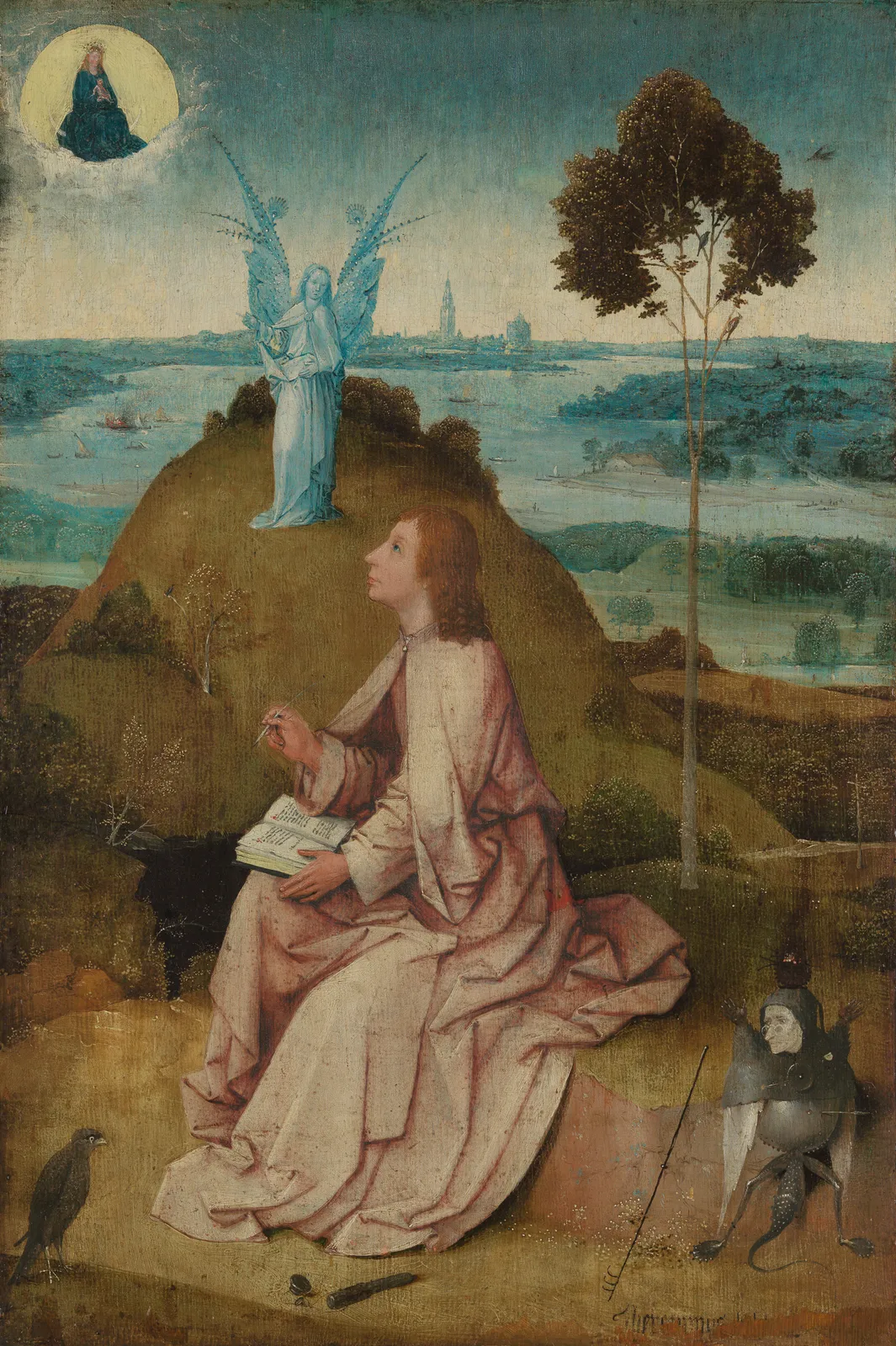
Early church fathers (the influential theologians of the first few centuries of Christianity, whose views on scripture carried canonical weight), Irenaeus among them, assumed this John was the Apostle, the same man who wrote the Gospel of John and the letters. The identification was useful. Apostolic authority gave the text weight in a period when its canonical status was deeply contested. The stakes were real. Revelation scraped into the New Testament canon. Its acceptance in the East lagged well behind the West, which tends to surprise people who assume the Bible arrived fully formed.
Dionysius of Alexandria noticed in the third century that the Greek of Revelation is rough and grammatically peculiar in ways the Gospel of John simply is not. He concluded they could not share an author. The observation was inconvenient, and largely ignored for centuries. Modern scholarship has largely agreed with him anyway. The majority view is that the author was a different John entirely, a Jewish Christian prophet whose name is shared with several other figures in early Christianity.
When Was It Written?
The dating is reasonably settled. Most scholars put it around 95 AD, towards the end of Emperor Domitian's reign. Domitian is relevant here. He had demanded to be addressed as "Lord and God," and Christians who declined to offer the required sacrifices to his divinity found the arrangement did not work in their favour. The text's imagery of persecution, imperial power as cosmic evil, and the urgency of endurance makes most sense against that backdrop.
What Apocalypse Actually Means
Here is the thing that the popular understanding of Revelation consistently misses. It belongs to a specific genre: apocalyptic literature. The word "apocalypse" does not mean catastrophe, though you would not know that from how it gets used. Apokalypsis, in Greek, means unveiling. And apocalyptic writing had conventions as recognisable to its original audience as the conventions of a legal document or a love poem are to us.
Apocalyptic texts used elaborate symbolic language to describe political realities, empires, persecutions and wars in a coded form that protected their authors from the authorities those texts were criticising. Daniel did this in the Hebrew scriptures, writing in coded visions about imperial power while living under it. The Dead Sea Scrolls community did it. John of Patmos did it too, drawing on a tradition his audience would have recognised immediately.
When he writes about a Beast rising from the sea with seven heads and ten horns, he is not describing a creature. He is describing a political situation. One his readers already knew, and did not need explained to them. Rome is what he means. The sea-power that dominates his world, and one his original readers would have identified immediately. The seven heads are almost certainly the seven hills of Rome, or a sequence of emperors, or both. None of this required explanation at the time. It would have been, in the manner of political satire, somewhat obvious.
666
The number is the most famous thing in the Book of Revelation, possibly in the Bible. Most people take it as the number of the devil, which is close but not quite right. Biblical scholars have landed somewhere more specific: Nero. Gematria was a common practice in John's world, a system of assigning numerical values to letters so that a name could be represented as a number. It was both a puzzle and a protection. If you knew what you were looking for, the meaning was clear enough. Everyone else just saw a number.
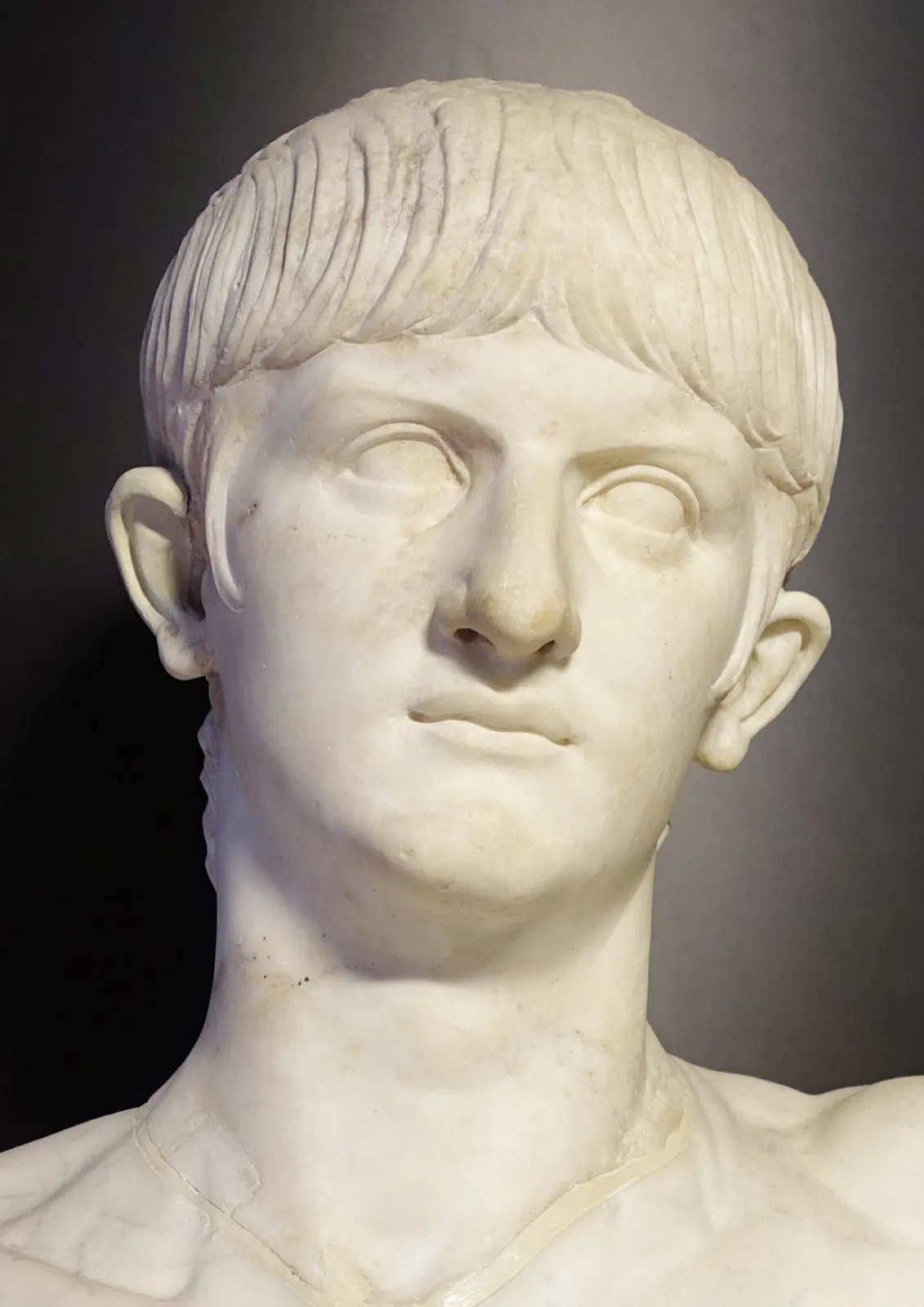
"Neron Caesar" transliterated from Greek into Hebrew letters produces 666. "Nero Caesar" in its Latin spelling produces 616. Both versions appear in early manuscripts, which is itself revealing. It suggests that copyists in different linguistic contexts were adjusting the number to point at the same person. Nero had died in 68 AD. A myth persisted anyway, that he would return from the dead and lead an army from the East. For Christians writing under Domitian, a notoriously Nero-like emperor, the figure of Nero the Beast was a usable one.
None of this is settled with absolute certainty, and there are scholars who argue for symbolic rather than specific readings of 666, six being the number of imperfection, three sixes representing supreme and complete evil. The Nero identification is, at minimum, the most coherent single explanation for a number that the text itself says requires wisdom to calculate.
The Four Horsemen
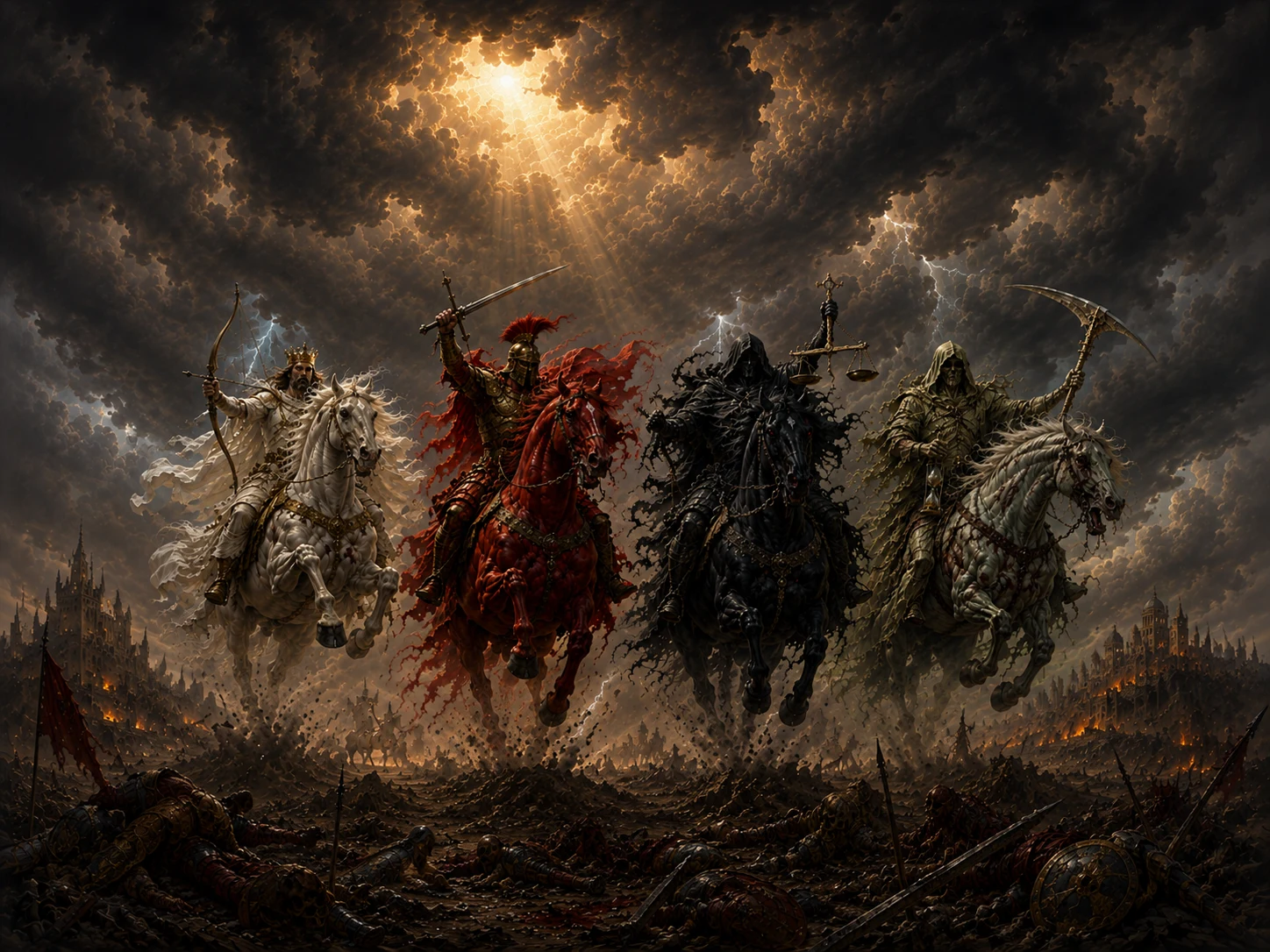
Revelation 6 is where I spent most of my time working on the screenplay, because the horsemen are the images that have the most cultural traction. Four riders. Four horses of different colours. Four calamities released when the Lamb opens the first four seals of a scroll.
The first rides a white horse, carries a bow and receives a crown. He goes out conquering, which sounds straightforward until you try to work out who he is. The second rides a red horse and is given a great sword; he takes peace from the earth. The third is harder to glamorise. He rides a black horse and carries scales; a voice announces the price of grain, a day's wages for a measure of wheat. Famine, in other words, measured out by the ounce. The fourth rides a pale horse (pale in the original Greek is khloros, the same word used for green or sickly) and his name is Death, with Hades following behind him.
The text does not name the first three. It offers no explanation for this, which may itself be the point. It names only the fourth. Conquest, war and famine are interpretations, good ones, but interpretations. The white horseman in particular has generated two thousand years of argument. Some read him as Christ, pointing to a later vision in Revelation where Christ rides a white horse. Others read him as the Antichrist, a parody of Christ. Others read him as conquest plain and simple, the Roman imperial machine. Nobody fully agrees, which is either a flaw in the text or evidence of its depth, depending on your disposition.
The Long Misreading
Every generation finds its own reading of Revelation. Medieval Christians saw it in the Black Death and the collapse of Rome. Reformation-era Protestants applied the Beast to the papacy with considerable enthusiasm, and Catholics returned the favour towards Protestant rulers. The process is not unique to Revelation. Readers have repeatedly done the same thing with Nostradamus, finding contemporary events in texts written centuries earlier. In the twentieth century, Cold War evangelicals found nuclear weapons and the Soviet Union in its pages.
None of that is in the original text. The dispensationalist reading, which gave us the Rapture, the Tribulation, Armageddon as a literal battle in northern Israel, is largely a nineteenth-century invention. John Nelson Darby developed the framework in the 1830s, which is to say, recently. It has almost no presence in Christian thought before that point. The Left Behind novels and the cinematic tradition I was drawing on for the screenplay sit squarely in this tradition, which is a long way from what a first-century Jewish exile writing in coded Greek for persecuted communities in Asia Minor was actually doing.
That gap is what I kept coming back to once I actually read the thing. Not that the Book of Revelation is uninteresting or that its imagery lacks power. It has extraordinary power, which is precisely why it has survived and accumulated so many readings. But there is a difference between a political document written in the shadow of Roman imperial violence, addressed to specific churches in specific cities, using a specific set of coded conventions its audience understood, and a universal timetable for the end of human history applicable to any era that finds itself frightened enough to reach for it.
Both things are real. The text produced both, and two thousand years of argument has not resolved it.
Frequently Asked Questions
What is the Book of Revelation?
The Book of Revelation is the final book of the New Testament, written around 95 AD by a Christian prophet named John on the Greek island of Patmos. It describes a series of visions involving cosmic battles, plagues and the fall of empires, using coded symbolic language drawn from the Jewish apocalyptic tradition.
Who wrote the Book of Revelation?
The author identifies himself only as John, a servant of Jesus exiled to Patmos. Most modern scholars do not think he was the Apostle John who walked with Jesus. The third-century scholar Dionysius of Alexandria noted that the Greek of Revelation is too grammatically rough to share an author with the Gospel of John, and most scholars now agree the two books were written by different people.
What does 666 mean in the Bible?
Most biblical scholars believe 666 refers to the Roman emperor Nero, using a practice called gematria, where letters are assigned numerical values so a name can be represented as a number. "Neron Caesar" transliterated from Greek into Hebrew produces 666. An alternative manuscript tradition gives 616, which corresponds to the Latin spelling "Nero Caesar," suggesting copyists in different regions were pointing at the same person.
Who are the Four Horsemen of the Apocalypse?
The Four Horsemen appear in Revelation 6 when the Lamb opens the first four seals of a scroll. The first rides a white horse and carries a bow, the second a red horse with a sword, the third a black horse with scales, and the fourth a pale horse. Only the fourth is named in the text: Death, with Hades following behind him. Conquest, war and famine are interpretations, widely accepted ones, but interpretations nonetheless.
What is the Rapture and is it in the Bible?
The word Rapture does not appear in the Bible. The concept, in its modern form, was developed by the Anglo-Irish theologian John Nelson Darby in the 1830s and has almost no presence in Christian thought before that point. It derives loosely from a passage in 1 Thessalonians where Paul describes believers being "caught up" to meet Christ, but the elaborate timetable of Tribulation, Rapture and Armageddon familiar from popular culture is a nineteenth-century theological invention.
◆ Also In The Stars
◆ Go Deeper
Recommended
Affiliate links — we may earn a small commission at no cost to you.