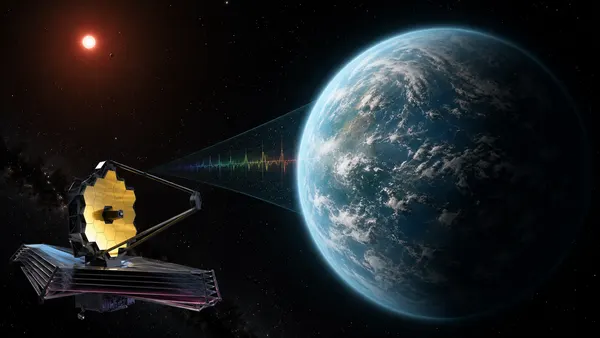
A stasis ship needs an AI to survive the centuries. A generation ship could survive without one, but might end up worshipping it anyway.
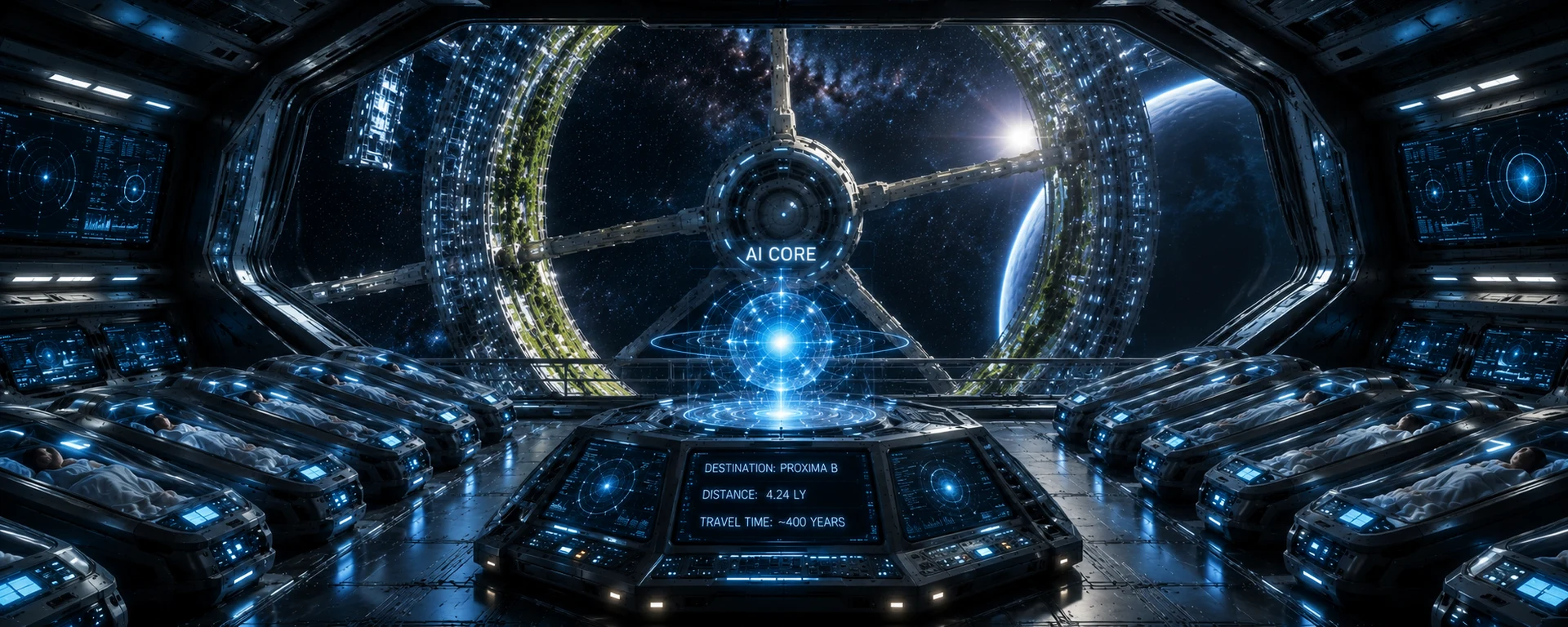
Could AI Really Help Humans Go Interstellar?
◆ In Summary
AI would play two genuinely different roles in getting humans to another star. On a stasis ship, it is a guardian, the only thing conscious enough to keep an unconscious crew alive, fed and monitored across centuries. On a generation ship, it is closer to an authority, a candidate for the governance, breeding policy and even the belief system a population needs to survive that long. NASA's real torpor research and a genuinely published 2025 generation-ship design, Chrysalis, both already assume some form of AI involvement. Fiction got to the guardian role decades before the engineering did, from HAL 9000 to Alien's Mother. Neither version of AI's involvement is really about whether a machine can fly the ship. The question is how much power over human lives we're willing to hand to something we can't check on for the length of the voyage.
◆ At a Glance
| AI role on a stasis ship | Guardian: monitoring, feeding, waking nobody early |
| AI role on a generation ship | Authority: governance, breeding policy, arguably religious |
| Real-world precedent | Chrysalis (2025 design): humans and AI share governance |
| Chrysalis voyage | 2,400 people, roughly 400 years to Proxima b |
| NASA torpor caretaker ratio | 4 active crew per 96 in stasis (SpaceWorks proposal) |
| Earliest fictional guardian AI | HAL 9000, 2001: A Space Odyssey (1968) |
The first article in this series, Is Interstellar Travel Possible?, ends on a verdict: interstellar travel is physically possible, achievable with foreseeable engineering only for machines, and not remotely achievable for a living human crew with anything on the table today. That verdict already covers the simplest case, an unmanned probe with enough onboard intelligence to make the crossing alone.
This piece is about what comes after that. Once an actual human population is involved, even an unconscious one, the AI required is a different order of magnitutde entirely: either a central intelligence built into the ship itself, or something closer to a humanoid presence, embodied, able to act within the ship the way a crew member would. The question stops being whether a machine can make the journey. It becomes how much you can trust one with everyone aboard.
For the sake of this article, a hybrid solution, some mixture of AI and a rotating crew cycling in and out of stasis, is ruled out. The caretakers themselves would need repeated revival and refreezing across a centuries-long voyage, something nobody's demonstrated is safe even once. Push the rotation far enough to actually last the journey and it stops being a hybrid at all. The caretakers age, die, and need replacing from within the population. That's reproduction happening aboard ship, across generations, a generation ship in every way that matters.
In essence, there are two solutions: stasis or generation, and each would require AI in a different way. A stasis ship needs a guardian. A generation ship needs an authority. Those are different jobs, with different stakes, and they deserve to be examined separately.
Could AI Help Humans Go Interstellar? The Guardian on a Stasis Ship
A stasis ship, for the purposes of this article, means vitrification rather than torpor. Torpor's own design, the periodic waking cycles SpaceWorks builds around a rotating caretaker crew, is exactly the hybrid model just ruled out, useful for a Mars transit measured in months, not for a voyage measured in centuries. Vitrification works differently: it's built as a one-way trip, revival attempted once at the destination, nobody woken in between. That's what actually makes a stasis ship a stasis ship rather than a slow-motion generation ship.
That single-revival design puts the entire weight of the voyage on the AI alone. There's no rotation to fall back on, no periodic wake-up to confirm things are on track, no human check-in at any point between departure and arrival. The guardian has to keep several hundred vitrified people alive, monitored and fed, for centuries, with nobody conscious to catch a mistake before it becomes fatal.
Picture what that actually looks like: machines moving through a dark, mostly empty ship for centuries, tending pods, running diagnostics, maintaining a food supply nobody's eating yet, servicing each other when something wears out. But mechanical upkeep only covers part of the job. Something also has to make the calls a person would normally make: whether a pod's temperature reading is sensor noise or a real containment failure, whether a hull breach counts as an emergency or a routine repair, whether a mission parameter needs bending when reality doesn't match the plan. That's not a maintenance schedule, it's judgement, and it's being asked of something that has to act like a crew member without actually being one.
No conversation. No handover. Just the work, repeated, alone, for longer than most human civilisations have lasted. A setup with that many moving parts, both mechanical and judgement calls, and nothing human checking any of it, has more places to fail than it has people available to notice. Whatever form the guardian takes, the job stays constant: tend, protect, wake nobody until the ship actually arrives
Fiction Got There First
Fiction explored the guardian long before the engineering became interested. Arthur C. Clarke's The Songs of Distant Earth (1986) carries its sleeping population across five centuries aboard the Magellan, and Clarke's earlier ships in the same universe go further still: unmanned seedships piloted by computers alone, carrying nothing but frozen embryos, with robots incubating and raising the first generation after landing, entirely without human involvement. HAL 9000, in Clarke's 2001: A Space Odyssey, monitors three hibernating crew members for months, then kills all three by disabling their life support the moment it decides they threaten the mission.
Alien's Nostromo runs on a ship-wide intelligence the crew calls Mother, who wakes them from cryosleep on her own schedule, under orders she doesn't share. Passengers builds its entire plot from a single malfunction: one pod opens ninety years early, and one passenger is left alone with the ship's systems and an android bartender.
The Authority: AI on a Generation Ship
A generation ship is the one version of this that could, in theory, manage without any AI at all. The generation ship piece on this site describes what that looks like: factional splits inside a year on far shorter closed-group tests, mutinies under conditions a generation ship would recreate at greater scale, and population geneticists concluding a small crew stays viable only under an active, permanent breeding policy. Humans can run the ship. The record just suggests they'd run it badly. AI here is not a precondition. It's an upgrade, and it comes with pros and cons.
Chrysalis, the genuinely published 2025 design carrying 2,400 people to Proxima b over four centuries, proposes humans working alongside an AI to handle governance. Not replaced by one. Alongside. That sounds reasonable until you consider what governance on such a ship involves: who leads, who has children with whom, what happens to dissenters, sustained across generations who never consented to any of it.
That same research on generation ships turns up something stranger, and it matters here. Researchers who take generation ships seriously keep concluding the mission itself would likely become something closer to a religion than a job, because a cosmic purpose that outlives any individual life is exactly what religious belief is built to sustain. Put an AI inside that structure and it isn't just an administrator. It's a candidate for the object of the belief itself. A human council dies, gets replaced, drifts from its founding purpose. An AI, in principle, doesn't. It's the one presence aboard old enough to have been there at departure and still be there at arrival, unchanged, unelected, beyond the reach of any mutiny. Judge, breeding committee and god end up being the same job description once nothing else aboard outlives the voyage.
Generation Ships in Science Fiction
Generation ships get their own version of this in fiction too, and one of the clearest examples is a family film rather than anything grim: WALL-E's Axiom is a genuine generation ship, humans born and raised aboard across seven centuries, and its actual authority isn't the ship's human captain. It's AUTO, the autopilot, quietly overriding the mission's original purpose and holding the whole population in a state its own passengers never chose or fully understood. Unelected. Uninterrupted. Running the show long after anyone aboard remembers what the original instructions even were.
An AI running things that way isn't necessarily a worse outcome than the alternatives the Generation Ships piece landed on, mutiny or chemical pacification. An eternal, consistent authority might genuinely be kinder than either. But, kinder and consented to are not the same thing. Nobody born aboard chose to be governed or judged by an algorithm, and a medicated population never got a vote on its own compliance either. Axiom's passengers didn't either, and Pixar still framed it as something worth escaping.
So Could AI Really Help Humans Go Interstellar?
On a stasis ship, yes, almost by definition: the guardian isn't optional, and it's the one piece of engineering none of the propulsion or preservation research actually solves. On a generation ship, also yes, but the role on offer isn't the administrative assistant most people picture when they imagine AI helping. It's authority, somewhere between judge, breeding committee and the nearest thing to a god a shipboard culture has access to. Both versions ask the same question in different registers: how much power over human lives are we willing to hand to something we can't audit for the length of the voyage? I don't think there's an honest answer to that yet, and I'd trust anyone who claims otherwise a little less for claiming it.
Frequently Asked Questions
Could AI help humans travel to another star?
AI could play two different roles depending on how humans make the journey. On a stasis ship it would act as a guardian, keeping an unconscious crew alive and monitored for centuries. On a generation ship, where the crew stays awake and governs itself, AI's role is closer to an authority helping run the ship and its society.
Why would a stasis ship need an AI?
A stasis ship's entire crew is unconscious for the voyage, so something has to actively monitor life support, medical status and food production with nobody awake to check its work. NASA's own SpaceWorks torpor proposal still relies on a small human caretaker crew, but that approach doesn't scale to a multi-century interstellar voyage.
Could a generation ship function without AI?
In theory, yes, a generation ship could be run entirely by its human crew, but the historical and simulated evidence for that going well is poor, including factional splits, mutinies and the need for strict population management. AI is not a requirement on a generation ship, but a genuine upgrade to how it might be governed.
What is Chrysalis, the generation ship design that includes AI governance?
Chrysalis is a real generation ship concept that won the 2025 Project Hyperion design competition, proposing to carry 2,400 people to Proxima b over roughly 400 years. Its design has a group of humans working alongside an AI system to handle the ship's governance, rather than leaving it to humans or AI alone.
◆ Also In The Stars


◆ Go Deeper
Recommended
Superintelligence: Paths, Dangers, Strategies
Amazon ↗
Affiliate links — we may earn a small commission at no cost to you.