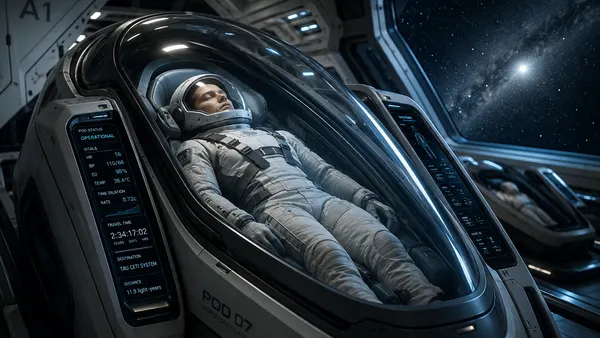
Future technology may eventually get people there. What we can't predict is how humans will cope with the journey.
Would a Generation Ship Achieve Interstellar Travel?
◆ In Summary
A generation ship only works if you accept that the people who board it are never the people who arrive, since the journey outlives them by design. Real propulsion concepts like Chrysalis put a crossing to Proxima b at around four centuries, with older nuclear-pulse designs closer to a century and the honest floor at today's speeds running into the thousands of years. Closed-ecosystem tests like Biosphere 2 suggest the food and air side is achievable but brutal, and the social side fractures faster than the hardware does. Serious population models disagree by roughly a hundredfold on how many people a generation ship needs, depending on how the genetic diversity problem gets solved, through active management or through sheer population size. Whether a generation ship arrives at all is genuinely uncertain. If it does, it is unclear whether the population aboard believes in the mission at all.
What Is a Generation Ship?
A generation ship crosses interstellar distances so slowly that whoever boards it isn't who arrives. Children are born, grow old, and die throughout the journey, and only their descendants, several generations removed from anyone who chose to go, actually complete the mission. It's a different proposition entirely from a fast probe or even a crewed sprint to Mars, because the thing you're really building isn't a spacecraft. It's a self-contained civilisation built around a single destination nobody in it chose but everybody in it inherits.
The idea is older than spaceflight. Robert Goddard sketched it in a private 1918 essay he considered too speculative to publish, and Russian theorist Konstantin Tsiolkovsky arrived at something similar independently around the same period. Neither of them had the tools to test it. We do now, and running the idea through actual propulsion physics, population modelling, and closed-ecosystem data turns out to raise more specific problems than either of them could have anticipated.
Generation Ship Interstellar Travel: The Technology and the Timeline
The honest starting point is that speed isn't really the constraint a generation ship is trying to get around. Accepting a slow, multi-century trip is the entire point of the concept, rather than a failure to reach something faster. That doesn't make speed irrelevant, though: go too slow, and there's no meaningful difference between a generation ship and a population that simply lives and dies in space for a very long time, if not forever. NASA's Parker Solar Probe, the fastest human-made object ever launched, tops out at roughly 0.067% of light speed. At that rate, Proxima Centauri is 6,300 years away, several hundred generations deep, far beyond anything any serious proposal or population model actually attempts to plan for.
Real proposals assume propulsion that doesn't exist yet but isn't pure fantasy either. Chrysalis, a genuinely published 2025 design from an Italian engineering team, plans a Direct Fusion Drive carrying 2,400 people to Proxima b over 400 years, with the founding crew spending seventy to eighty years in an isolated Antarctic habitat beforehand just to test whether people can psychologically survive the commitment. Older Orion-class concepts from the 1960s, which propelled a ship using a sequence of small nuclear detonations against a pusher plate, put crewed transit closer to a century. Push the fusion assumptions further and transit times drop under forty years, at which point I think the label stops applying, since a trip nobody needs to be born aboard to finish isn't really a generation ship anymore, just a very long mission.
So the timeline sits somewhere between a century and a millennium, depending how much unbuilt engineering you're willing to bet on. That's a genuinely wide range, but it's a calculable one: for any given propulsion assumption, physics can tell you exactly how long the trip takes. What it can't tell you is whether that propulsion will ever actually get built.
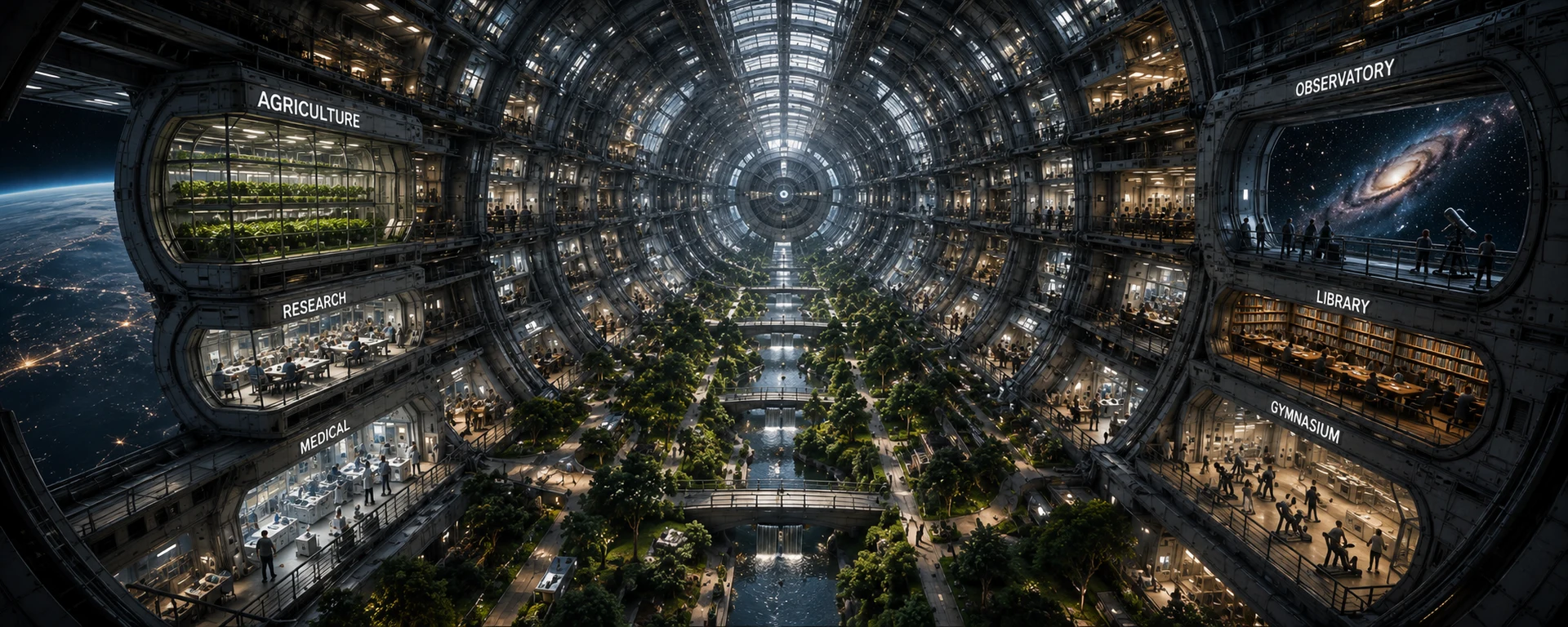
The scale of Chrysalis is almost unimaginable. The largest ship ever built on Earth, the oil tanker Seawise Giant, was 458 metres long. Chrysalis, at 58 kilometres, would be well over a hundred times longer. As proposed, it's a rotating cylinder 6 kilometres across, with a total mass of roughly 2.4 billion tonnes, built in layered shells around a central core like a Russian nesting doll, with rotation generating artificial gravity to keep centuries of passengers from losing bone and muscle mass in freefall. A structure that large would almost certainly have to be built off-world. The design assumes assembly at a Lagrange point, a gravitationally stable region between Earth and the Moon where a structure like this could be built in place from components and materials brought up in pieces, over an estimated 20 to 25 years, before anyone ever boards it.
Feeding a Ship for Centuries
Every other problem downstream of propulsion is really the same problem: how do you run a closed ecosystem for longer than any closed ecosystem has ever run. Biosphere 2 is the closest real test, and it wasn't reassuring. Eight people sealed themselves into a 1.27-hectare glass structure in Arizona in 1991, aiming to grow their own food and regenerate their own air for two years. They grew roughly 80% of their own food, living on about 1,800 to 2,100 calories a day. Weight loss was noticeable. Oxygen levels dropped far enough that outside air eventually had to be pumped in just to keep the mission from ending early. That's the result after two years, with a rescue option sitting a phone call away. A generation ship gets neither the phone call nor the two-year limit.
The Trouble with a Closed Human System
The Biosphere 2 crew also split into two factions within the first year. Some wanted to protect the science at any cost. Others just wanted to get through it safely, and by the end some of them were barely speaking to each other. They still finished the mission, which says something creditable about human tolerance for shared misery. But eight adults who volunteered, selected each other, and knew their exit date at least chose their fate. The generations born aboard a real generation ship, rather than recruited like the Biosphere 2 crew, would have none of that: no agreement to go, no choice of crewmates, and no exit date at all.
Every other closed-group study we have, from Antarctic winter-over stations to submarine deployments, shows the same pattern of factional strain appearing well inside a single year. Stretch that same pressure across two hundred years and I don't think anyone can honestly claim to know what breaks first.
Who Gets Born
Assume the ecosystem holds. Someone still has to decide who has children with whom, for centuries, or the crew arrives too inbred to be called healthy. Dr Frederic Marin's HERITAGE model, published in 2018, ran Monte Carlo simulations of a multi-generation crew and found that 98 people could sustain a viable population across a 6,300-year crossing, but only with active management: yearly reviews, offspring restrictions, breeding constraints enforced generation after generation. Drop the starting crew to 32 and the same simulations put the odds of a genetically healthy arrival at zero.
A separate 2014 estimate by Cameron Smith puts the safer number in the tens of thousands, somewhere between 20,000 and 40,000, on the assumption that pairing stays random rather than managed. That many people buys enough genetic diversity that nobody has to be told who they're allowed to have children with. Ninety-eight buys the same outcome only if a committee is quietly running the ship's gene pool for the entire 6,300-year crossing.
Both approaches have real drawbacks and real merits. A smaller population means a smaller ship and fewer facilities to maintain, but only works under a strictly managed, effectively authoritarian reproductive policy. A larger population means a much bigger ship to build and sustain, but buys real freedom within the same constraints. I know which answer I'd rather live inside, and it isn't the one with the yearly reviews.
Politics, Power, and the Risk of Mutiny
The closest historical parallel we actually have is the age of sail, and it isn't reassuring. Long naval voyages of the 18th century put crews under near-absolute captain authority for months or years at a stretch. Quarters were cramped, discipline was harsh, and there was no realistic way to leave. Mutinies still happened. The Bounty in 1789 and the Hermione in 1797 are the famous cases, but they weren't freak events, they were the eventual output of exactly the conditions a generation ship would recreate on a much larger timescale: an isolated population, an unelected command structure, and no external authority to appeal to. A ship's governance has to survive not just one crew's patience but dozens of successive generations who inherited the chain of command rather than agreeing to it.
What Would Actually Arrive
Here's the part that changes how I think about the whole question. Assume the propulsion works and the ecosystem holds and nobody mutinies badly enough to break the ship. What do hundreds or thousands of years of shipboard culture actually produce by the time it arrives?
Researchers who take generation ships seriously keep landing on the same answer: the mission itself would likely become something closer to a religion than a job. A cosmic purpose that outlives any individual life is exactly the kind of thing religious belief is built to sustain, and there's a real argument that a ship would need something functioning like faith just to keep hundreds of years of descendants pointed at a destination none of them chose and most of them will never see.
Science fiction reached this conclusion decades before the engineers did. Clifford Simak's 1953 story "Spacebred Generations" has its shipboard population develop a religion built entirely around the idea that the vessel itself is the whole of creation, its "voyage" a metaphor rather than a fact. It's a recurring enough idea across the genre, from Heinlein's Orphans of the Sky onward, that it's worth taking as a serious warning rather than just a plot device: a population with no memory of departure and no proof of arrival has every reason to stop believing either one is real.
If everyone aboard genuinely believed in the mission, that belief alone would probably give it the best chance of success, other mishaps precluded. But one imagines belief won't be universal, given what we know about humans and contrarians. For those who don't buy into a destination they never chose, something else becomes their driving force, sabotaging the mission, rebelling against the system, or simply refusing to comply. Religion and authoritarianism are two versions of the same answer: an overarching structure of punishments and rewards designed to best contain such occurrences.
A population held together by punishment and reward, generation after generation, pays a real cost: routines that never change, no real prospect of escape, and whatever discipline the system requires to keep people in line. Depression and despair seem less like a risk and more like a certainty somewhere along the way. One obvious answer, and not a comfortable one, is chemical: manage the mood rather than the mind, and a population medicated into contentment needs neither faith nor fear to stay in line. It's the Brave New World solution (Aldous Huxley's 1932 novel, where the population is kept docile with a mood-stabilising drug called soma) to a problem Brave New World saw coming decades before anyone was seriously designing generation ships.
The Verdict
Could a generation ship achieve interstellar travel? Physically, within a speculative but real propulsion window, probably yes. Would what arrives still recognise itself as the mission that left? That's a different question, and I suspect the honest answer is that it would arrive believing something, just not necessarily the thing we sent it to believe.
Frequently Asked Questions
What is a generation ship?
A generation ship is a proposed interstellar spacecraft designed to travel so slowly, relative to the distance involved, that the crew who depart die before arrival. The mission is completed by their descendants, born and raised aboard, several generations after launch.
How long would a generation ship take to reach another star?
Estimates range from roughly a century to over a thousand years, depending on the propulsion assumed. A published 2025 design called Chrysalis puts a crossing to Proxima Centauri b at around 400 years using a fusion drive, while 1960s-era Orion nuclear-pulse concepts suggested transit closer to a century.
How many people would a generation ship need to survive the journey?
Serious estimates disagree sharply. A 2018 population-genetics model found that 98 people could sustain a viable crew across a multi-thousand-year voyage, but only with strict management of who has children with whom. A separate 2014 estimate put the safer number in the tens of thousands, between 20,000 and 40,000, assuming reproduction stays unmanaged and random.
Could a generation ship crew mutiny?
It's a real risk. The closest historical parallel, long naval voyages during the age of sail, produced repeated mutinies under similar conditions: an isolated population, an unelected command structure, and no outside authority to appeal to. A generation ship would face the same pressures across many more generations than any historical crew endured.
◆ Also In The Stars

◆ Go Deeper
Recommended
Emigrating Beyond Earth: Human Adaptation and Space Colonization
Amazon ↗
Affiliate links — we may earn a small commission at no cost to you.