Space made Elon Musk the richest person who has ever lived. Asteroid mining is the idea most often floated as the next way to make trillions, and testing it means answering two very different questions: can it be built, and can it turn a profit.
Could We Actually Mine Asteroids for a Profit?
◆ In Summary
Elon Musk became the first trillionaire in human history in 2026, through SpaceX. This article asks whether asteroid mining could make someone else that kind of money, separating the engineering question from the economic one. The famous "$700 quintillion asteroid" headlines are misleading, since they assume metal could be sold at today's price despite flooding the market. A more realistic single asteroid might hold $25 to $50 billion in platinum. The company actually attempting this, AstroForge, has flown two missions and lost both, with a third due to launch before the end of 2026. Even if the engineering succeeds, extracting enough platinum to matter would likely crash the platinum price itself. Water, converted to rocket fuel, may be the only resource that avoids this problem entirely.
In June 2026 Elon Musk became the first trillionaire in human history, and he got there through space. SpaceX's stock market debut did what decades of PayPal, Tesla and everything else couldn't quite manage on their own. It's a natural question to follow: if space made one person a trillionaire, where else might that kind of money be sitting? Asteroid mining comes up as the most obvious source of space wealth, usually alongside a headline claiming some rock is worth more than the entire world economy. This article takes that claim seriously enough to actually test it, on two separate questions that get conflated more often than they should: can the engineering be made to work, and can real money be made from what comes back?
What Valuable Resources Could We Actually Mine from Asteroids
16 Psyche was discovered in 1852 by the Italian astronomer Annibale de Gasparis, the sixteenth asteroid found, and named for the Greek personification of the soul. For over a century that was it. An entry in a catalogue, nothing more. Then astronomers noticed something odd about the way it reflects radar, too strongly, and how dense it looked for a rocky asteroid. Metal, not stone, is the obvious read. The leading theory is that Psyche is the exposed iron core of a small, early planet, stripped bare by an ancient collision. Nobody has actually confirmed that. NASA’s Psyche orbiter, launched in 2023, is the mission meant to find out, and it is still about three years from arriving.
That unconfirmed metal core is where the eye-watering numbers come from. Psyche gets reported as containing $10,000 quadrillion or $700 quintillion in metal, take your pick, figures many times larger than the entire global economy, driven mostly by iron, since the asteroid is thought to consist largely of iron and nickel. These come from multiplying the estimated tonnage by today's market price per kilogram. But there's a flaw in this approach: it assumes you could sell all of it at today's price, and dumping that much iron on Earth would collapse the price of iron long before anyone banked the money. It orbits the Sun between about 235 million and 378 million miles away, in the main asteroid belt between Mars and Jupiter. Nobody is bringing home a gram of it any time soon, whatever it's worth on paper.
The more realistic targets are near-Earth asteroids, the ones close enough to actually reach. Even then, the shortlist is surprisingly small. Studies suggest that only a tiny fraction combine the right size, composition and accessibility to make mining economically plausible. And even for those, the estimates vary enormously, from under a billion dollars to many billions, depending on the assumptions behind the calculation. Whatever the true figure turns out to be for any specific rock, the same problem applies: real supply crashes real prices, and a near-Earth asteroid is no exception just because it is easier to reach.
The Engineering Problem
We've already reached asteroids. Japan's Hayabusa2 and NASA's OSIRIS-REx both returned samples, remarkable technical achievements that proved asteroid sample return is possible. Both, however, cost the kind of money only a national space agency finds comfortable. OSIRIS-REx alone had a life-cycle cost of just over $1.1 billion to bring back 122 grams of material. It shows the physics works, even if the price tag doesn't.
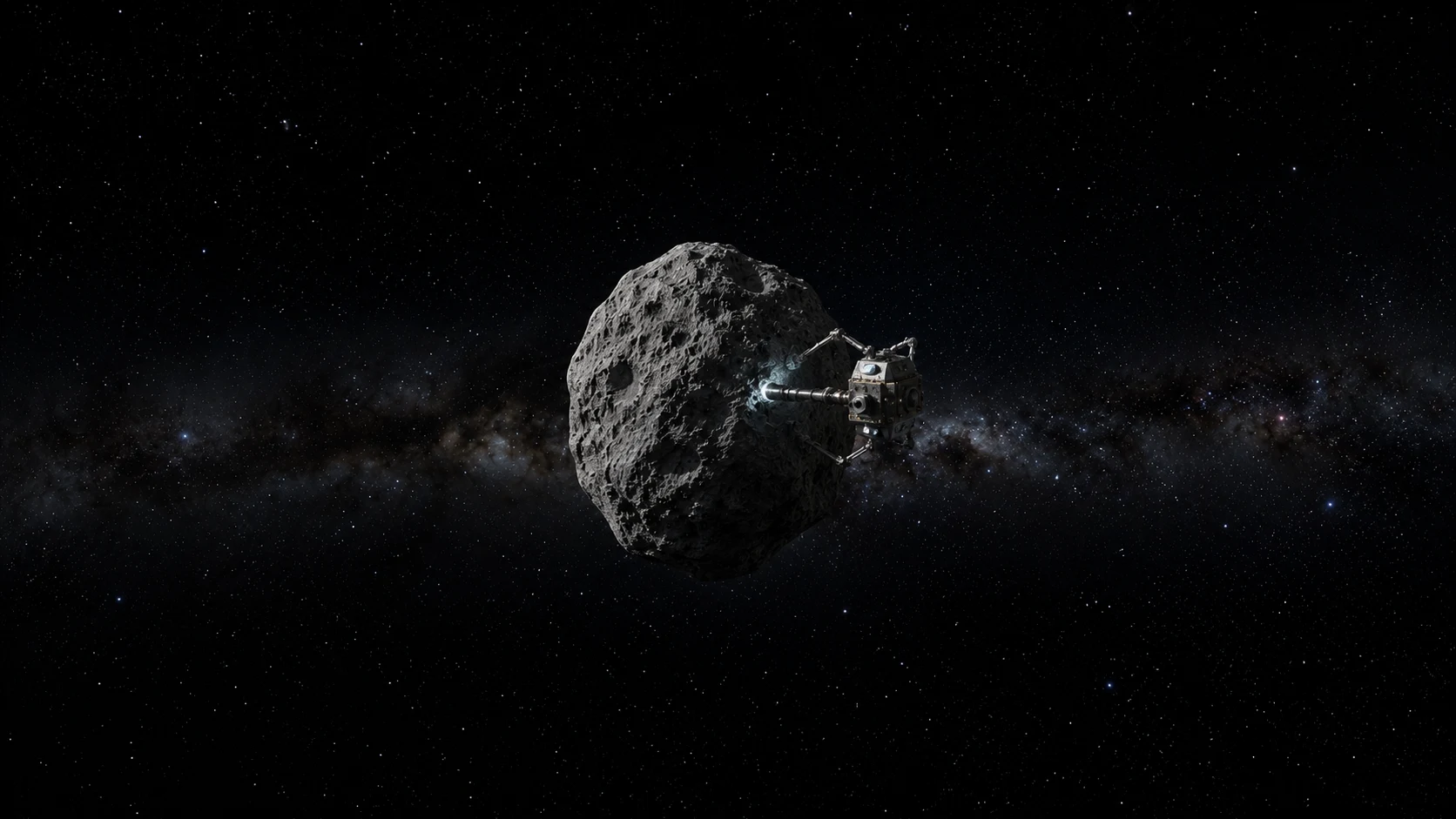
Proving the physics works is one thing. The company actually trying to prove the economics work is AstroForge, a California startup founded in 2022. Its first spacecraft, Brokkr-1, launched in 2023 with a small onboard refinery, meant to demonstrate that processing metal in space was even possible. It never got the chance. The team could never establish the command uplink needed to switch the refinery on, and by May 2024 contact was gone for good. The second attempt, Odin, fared little better. Launched in February 2025 as a rideshare on a Falcon 9, its job was a flyby of a near-Earth asteroid, just enough to confirm it was genuinely metallic. Ground-station problems hampered contact from early on, and AstroForge lost contact for good about 20 hours after deployment.
Two flights, two failures, for different underlying reasons. The company's next spacecraft is intended to try again, this time aiming to dock with a target asteroid using magnets. Extraction itself won't be attempted until a mission after that.
The Economics Problem
Say the engineering eventually works, reliably, repeatedly. A second problem sits underneath it, and it's not a problem better spacecraft or bigger budgets can solve, because it's not technical at all. I touched on it earlier, and it's a matter of supply and demand. Platinum-group metals are valuable because they're scarce. An operation that actually succeeded at pulling meaningful quantities out of an asteroid would be adding new supply to a market that was only ever priced for scarcity. The more successful the mining, the further the price falls before the metal reaches a buyer. Whatever comes back has to be sold slowly enough not to crash its own value, which poses a paradox: the business gets less profitable the better it works.
The Legal Question
There's also a legal question, which muddies the waters somewhat. The 1967 Outer Space Treaty bans any country from claiming an asteroid as territory, and says nothing about who owns material once it's extracted. The United States closed part of that gap unilaterally in 2015, passing a law that grants American citizens the right to own, transport and sell whatever they mine, while formally disclaiming any national claim to the asteroid itself. Luxembourg went further in 2017, stating outright that space resources are capable of being appropriated.
The Artemis Accords have tried to build something wider since 2020, and had 48 signatory countries by late 2024. Whether any of it actually satisfies the 1967 treaty, though, is another matter. Legal scholars still argue about it. The laws are sometimes described as a loophole: claim the metal, not the rock, and hope the distinction holds. And they only bind the countries that passed them. Nobody knows what happens if a company from a country with no such law reaches the same asteroid first. It's a real gap. It's just no longer an empty one.
What Musk Actually Thinks
Even Musk, the person this piece opened on, has stayed lukewarm about asteroids as a metals play. At a 2016 talk to the Royal Aeronautical Society he said the market he saw wasn't platinum. It was water, converted into propellant, for refuelling stations further out. That's a less ambitious proposal than the usual headline pitch, one that happens to single out water specifically. Musk built two fortunes by seeing profit in industries everyone else had written off, electric cars, reusable rockets, and now a stock market debut that made him the richest person alive. If asteroid platinum were the next obvious trillion-dollar business, he's exactly the kind of person who tends to notice first. He hasn't.
Water doesn't have a market-crash ceiling. Demand for orbital propellant grows every time another company launches something, and unlike platinum, nobody's holding water for its rarity. Companies such as TransAstra are building toward exactly this: not metals for Earth, but fuel for orbit. It's a smaller, less cinematic pitch than a trillion-dollar rock, and it may be the only version of this industry with a business model that survives its own success.
So Could We Actually Mine Asteroids for Profit?
Here's the verdict, in the two parts this article promised. Engineering: plausibly, eventually. We've already returned samples twice, at government expense, and a private company has now tried and failed twice at something harder, with a third attempt due within months. That's a trajectory, not a dead end. Economics, for metals specifically: genuinely uncertain, and structurally strange, since real success would undercut the very price that made the venture worth attempting. For water and fuel: the more plausible business, because demand doesn't collapse the way a metals market does.
Which brings this back to where it started. Could asteroid mining make somebody the next trillionaire, the way space just made Musk the first one? Almost certainly not from platinum, not without solving a problem no engineering breakthrough touches. Possibly, eventually, from something far less glamorous than a $700 quintillion headline: quietly selling water to spacecraft that need somewhere closer than Earth to fill up.
Frequently Asked Questions
What happened to AstroForge's asteroid mining missions?
AstroForge has launched two spacecraft and lost both. Brokkr-1 launched in 2023 with an onboard refinery meant to process metal in space, but the team never established the command uplink needed to activate it, and contact was lost by May 2024. Odin launched in February 2025 to fly past a near-Earth asteroid, but ground-station communication problems led to contact being lost about 20 hours after deployment. A third spacecraft is due to launch before the end of 2026, aiming to dock with a target asteroid using magnets. Extraction won't be attempted until a mission after that.
Is 16 Psyche really worth quadrillions of dollars?
Not in any usable sense. Headlines citing figures like $10,000 quadrillion multiply the asteroid's estimated metal content by today's market price. That calculation assumes all of it could be sold at current prices, but flooding Earth's markets with that much metal would collapse the price long before it happened. More realistic estimates put even a football-field-sized metallic asteroid in the tens of billions of dollars, still enormous, but a figure that can actually be compared with real industries.
Could asteroid mining crash the platinum market?
Yes, and this is the central problem with metals as a business case. Platinum-group metals are valuable because they are scarce. Any operation that successfully extracted meaningful quantities from an asteroid would be adding new supply to a market priced for scarcity, and the more successful the mining, the further the price would fall before the metal could be sold. It creates an unusual ceiling: the business becomes less profitable the better the engineering works.
Who owns the resources on a mined asteroid?
International law remains unsettled. Several countries, including the United States and Luxembourg, recognise private ownership of extracted resources under domestic law, but no large-scale operation has tested how those laws interact with the Outer Space Treaty.
◆ Also In The Stars

◆ Go Deeper
Recommended
Mining The Sky: Untold Riches From The Asteroids, Comets, And Planets
Amazon ↗
Affiliate links — we may earn a small commission at no cost to you.