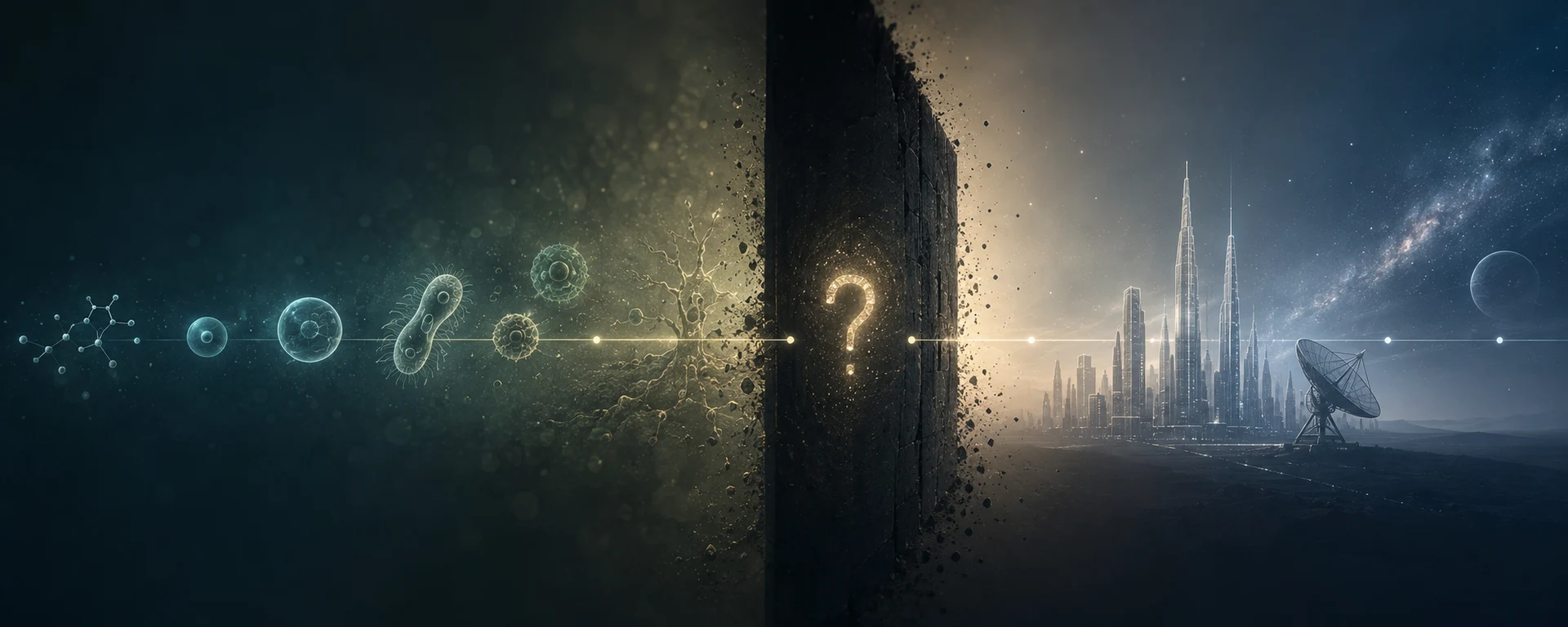
Robin Hanson's Great Filter hypothesis holds that somewhere on the road from chemistry to civilisation sits a step so hard almost nothing gets past it, and everything hinges on which one it is.
◆ In Summary
The Great Filter hypothesis, proposed by economist Robin Hanson in 1996, argues that somewhere between dead chemistry and a galaxy-spanning civilisation sits a step almost nothing survives. Using a timing method developed by physicist Brandon Carter, this piece walks through Hanson's nine candidate stages one by one, from abiogenesis to interstellar colonisation, weighing which look easy and which look hard. Two stages, the rise of complex cells and the rise of technological intelligence, stand out as intriguing candidates, both already behind us. But Hanson's own mathematics carries a sting: in a successful run like ours, a genuinely hard step can look deceptively easy, meaning the verdict may be less certain than it appears. A 2025 reassessment goes further, questioning whether long evolutionary delays reflect intrinsic difficulty at all, rather than a slowly changing planet. Stage nine, interstellar expansion, remains the one step nobody has ever observed happening, keeping Fermi's question exactly where it started.
What Is The Great Filter Hypothesis?
In one of my previous articles, I wrote about Enrico Fermi and his famous question "where is everybody?" He was articulating that we appear to be unaccompanied by other intelligent civilisations in the observable universe.
Over the subsequent years, many scientists and thinkers have attempted to answer that question. Some have tried searching for the answer in the sky, as exemplified by SETI. Others have approached the problem via pure reasoning. One such response is The Great Filter hypothesis.
To be more precise, The Great Filter hypothesis isn't really an answer per se, but rather a scaffolding which provides a pathway from dead chemistry through to interstellar-travelling civilisations. It allows us to place our civilisation on that pathway and identify the most challenging parts of the journey, perhaps explaining why we appear to be alone.
Robin Hanson wrote his essay "The Great Filter - Are We Almost Past It?" in 1996. It was subsequently revised in 1998.
In plotting this pathway, Hanson concluded that there must be a step so improbable to cross that almost no civilisation ever gets through it. This is The Great Filter.
This leads to a further, uncomfortable question, which Hanson himself called "ominous": are we past that filter point or are we yet to reach it?
Measuring Difficulty: Brandon Carter's Method
More questions, no answers you may say. Kicking the can down the road. This is partly true, but as an economist, Hanson was able to bring different thinking to Fermi's question than others had done. Instead of sifting through astronomical data as an astronomer would, he decided to employ statistics and probabilities, the tools of his field of expertise. He drew upon work done thirteen years earlier by Brandon Carter in the hope that it would provide some clarity.
Hanson identified nine stages in the pathway to becoming a galactic civilisation, each a potential point that prevents progression. Of course, we only have one evolutionary path to study and that is ours; by seeing what happened along our journey to where we are now, we can try and draw some conclusions. The basic methodology is to plot how long it took to reach each stage on the pathway and see which stages initially appear to have been the most difficult to cross.
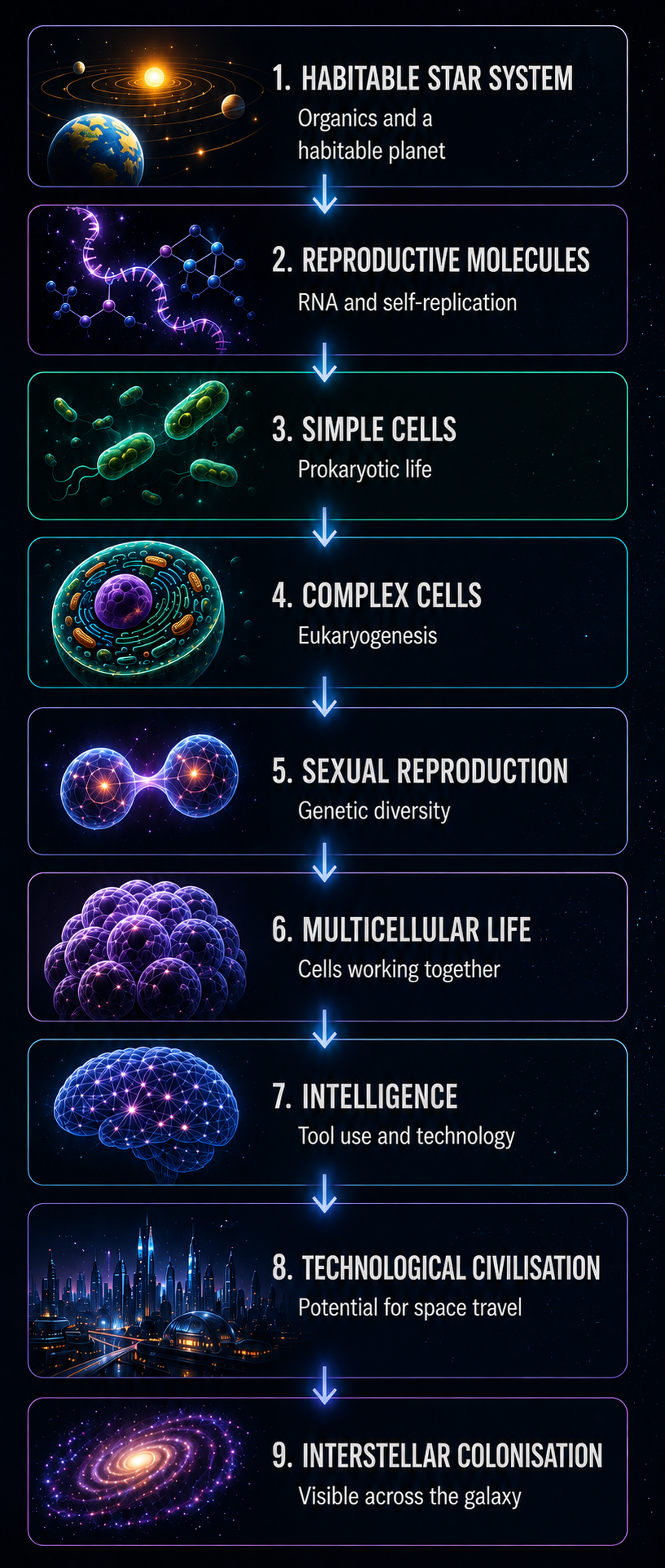
We know from our own example that we live on a planet in a star system that supports life. That takes care of stage 1, not so much a matter of timing, as a necessary precondition for life.
Stages 2 and 3 are difficult to separate in the timeline. We don't know precisely when stage 2, abiogenesis (the origin of life from non-living matter) took place. But, we can infer it happened between 4.4 and 3.5 billion years ago using the following logic: the earliest widely accepted evidence of microbial life dates to around 3.5 billion years ago, by which point stage 3, simple prokaryotic life, had already been reached. In turn, that means abiogenesis must have happened before that and after Earth became habitable. Whatever the precise timing, life appears to have emerged relatively early in Earth's habitable history. At first glance, this suggests that stages 2 and 3 may not have been particularly difficult stages to pass.
So, stages 2 and 3 happened relatively rapidly in Earth's history and perhaps indicate that if other planets have the right conditions, life could start quite quickly there too.
Stage 4 is somewhat different. The advent of complex cells took a longer time, over a billion years.
Endosymbiosis, the merging of two simple cells into a more complex organism, has happened multiple times, but the specific event that led to mitochondria and in turn every eukaryotic cell alive today, appears to have occurred only once. This means every plant, animal and fungus on Earth can trace its lineage back to that one point.
In comparison to stages 2 and 3, stage 4 stands apart as a potential filter.
Stage 5 is not as straightforward to judge. Estimates say sexual reproduction began around 1.2 billion years ago but there is no fossil evidence to support this, since it is not the type of thing a fossil can capture.
What we do know, however, is that it appears to have started independently multiple times, unlike eukaryogenesis. Organisms are also known to have switched from sexual reproduction, to asexual and then back again. This would all suggest that this stage isn't a strong filter candidate.
Multicellularity (stage 6) first appears around 1.6 billion years ago, and this has been seen to evolve independently many times across different eukaryotic lineages.
This stage, like 2, 3 and 5, gives the impression of being less of a filter since it shows repeatability.
Stage 7 deals with intelligence, specifically intelligence that has the potential to build a civilisation. While there are examples of general intelligence arising in several animals on our planet such as corvids, elephants, octopuses, primates and cetaceans, we are the only example of any species in over 4 billion years to have reached such a level.
This stage would appear to be another point of significant filtering alongside stage 4.
Stage 8 is where we sit on the pathway. We possess a technological civilisation and are continuing to increase our knowledge. We are beginning to think seriously about colonising the Moon and Mars and perhaps, at some future point, we will reach stage 9 and spread a visible and active presence across the galaxy in the way Hanson envisaged.
Ultimately, stage 9 is the great unknown. We have no data as to whether that has ever happened in the history of the universe. Of course it may have, but, if so, the successful civilisations haven't contacted us and our limited search hasn't found them either. Perhaps stage 9 is the greatest filter of them all.
A Word Of Caution
On the evidence we have examined, stages 4 and 7 remain intriguing candidates for possible filter points, while stage 9 remains the great unknown. However, Hanson was more circumspect about identifying any one evolutionary transition as the decisive filter. From his mathematical calculations, he realised there was a problem with drawing such conclusions from our evolutionary timeline: we may simply have got lucky. If that was the case, then the timings don't tell us which stages were the hardest to cross. They only tell us that we made it.
In 2025, a peer-reviewed paper by Mills, Macalady, Frank and Wright appeared in the journal Science Advances. It too took the viewpoint that a stage taking a long time to come about did not necessarily equal difficulty. The duration of any given stage may be explainable by other factors, such as the specifics of Earth's atmosphere. The stage may have been waiting for the conditions to change, and, once they did, could then happen quickly.
Where Does This Leave Us?
Despite Hanson's sobering conclusion, there is still much to draw from his Great Filter hypothesis. It is a useful exercise to plot our pathway and ponder what it all means for our existence.
So, Fermi's question remains largely unanswered. In truth, until we find another example of life somewhere else, our sample of one will always be just that. We are also left with a further question to go with Fermi's: have we already passed all the significant filters, or is the greatest one still to come?
Frequently Asked Questions
What is The Great Filter hypothesis?
The Great Filter hypothesis, proposed by economist Robin Hanson in 1996, holds that somewhere on the road from dead chemistry to a galaxy-spanning civilisation sits a step so improbable that almost nothing survives it.
Is The Great Filter behind us or ahead of us?
Nobody knows for certain. Two candidate stages, the rise of complex cells and the rise of technological intelligence, are intriguing possibilities and are already behind us, but the final stage, interstellar expansion, has never been observed happening anywhere, so it can't be ruled out either.
What is the hardest step in The Great Filter?
Based on Earth's evolutionary history, the rise of complex eukaryotic cells and the rise of technological intelligence are intriguing candidates. Both appear to have arisen only once on Earth. However, Robin Hanson's analysis shows that the time a transition took cannot by itself tell us how difficult it was, and he did not identify one specific step as the decisive filter.
Why haven't we found any evidence of alien civilisations?
The Great Filter hypothesis suggests it may be because almost no civilisation, anywhere, manages to pass every stage on the pathway from simple chemistry to a visible, spacefaring presence. Our limited search of the cosmos also means the absence of contact isn't conclusive proof either way.
◆ Also In The Stars
◆ Go Deeper
Recommended
Affiliate links — we may earn a small commission at no cost to you.