The physics of a space elevator has worked since the 1970s. The material to build one still doesn't exist.

Could We Build a Space Elevator? The Material Problem
◆ In Summary
A space elevator would use a cable running from an equatorial anchor to beyond geostationary orbit, replacing rockets with climbers powered by ground-based lasers. The four-part design is considered theoretically feasible, though substantial technological progress is still required. The obstacle is the tether material: the longest flawless carbon nanotube ever made is about a metre, against a cable that would need to extend tens of thousands of kilometres, with Obayashi's own design running to 96,000km. Obayashi Corporation still targets 2050.
In this article, I'm continuing my exploration of technologies that have been proposed in sci-fi and questioning whether they could ever see the light of day. This time, it's the turn of a lift, or elevator, depending on your vernacular, reaching up from the Earth's surface into orbit. If you've read Arthur C. Clarke's The Fountains of Paradise, you'll remember the space elevator around which the plot plays out. If not, I won't spoil the story in case you want to read it, but it's not all plain sailing for the elevator!
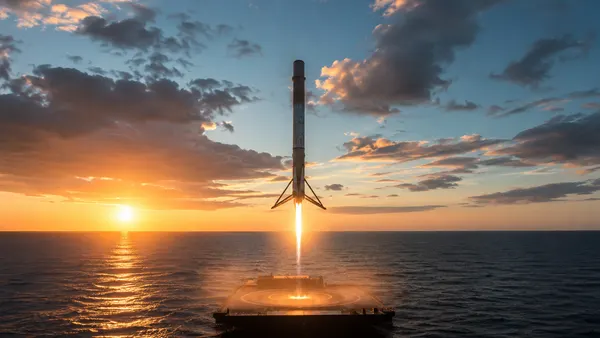
The benefit of a space elevator is easy to see. Rather than having to rely on a rocket, people and cargo could travel directly from Earth's surface to a station in space without using a conventional rocket. That's the idea anyway. But, on the face of it, it seems not many people are currently talking about making it a reality. NASA, Elon Musk et al. are understandably focussed on increasingly sophisticated rockets for trips to the moon and possibly beyond.
So, I thought I would take a deep-dive into the subject and find out where things stand today.
Why Not Just Use a Rocket?
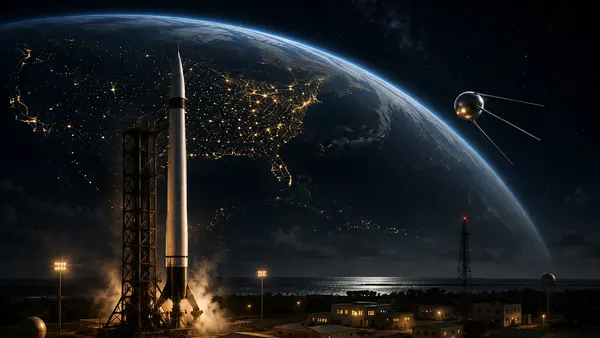
Getting into space has always been a huge challenge, ever since we first started to take the idea seriously. The problem that needs overcoming is Earth's gravity. In order to reach space, propulsion is needed that overcomes gravity's pull. That's straightforward enough.
Where it gets more difficult is the fact that the rocket has to carry its own fuel which also needs propelling. So you're not just having to think about the crew and cargo being transported, you also need to take into account the other aspects that add significant weight to the whole journey. This is known as the rocket equation and was formulated by Konstantin Tsiolkovsky in 1903. Incidentally, Robert Goddard also arrived at the same calculation independently a decade later. He even went further than Tsiolkovsky, taking into account gravity and atmospheric drag to enable more precise calculations. You can read about him in an article that explores his thoughts on interstellar travel.
All this makes rockets very expensive to launch. The notion of a lift that avoids all these challenges begins to sound quite appealing.
Could We Build a Space Elevator?
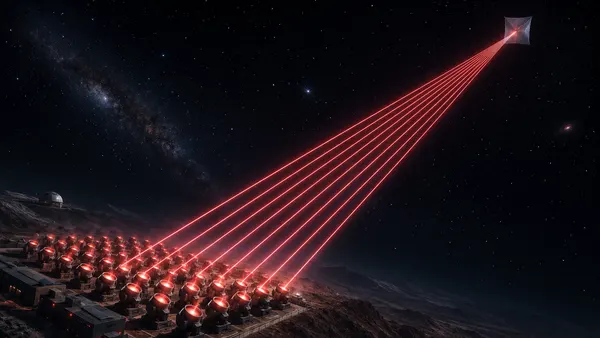
So, we've made a strong case for wanting one, but how would we build one? In essence, such a build has four components, the first of which is the ground station or anchor station. It would need to be located at the equator to allow the structure to be fixed relative to the Earth's rotation. Next is a tether, a cable which stretches from the ground and into and beyond geostationary orbit. Climbers are the units that crawl or travel up the tether, in which crew and cargo can journey. The climbers could possibly be powered via ground-based lasers, converting the light into electricity, rather than having to carry their own fuel. The final component is a counterweight. Its role is to keep the tether under tension via Earth's spin and would likely involve something like a captured asteroid, a space station or more cable mass beyond a geostationary orbit.
This four-component design is considered theoretically feasible, though the International Academy of Astronautics (IAA) and International Space Elevator Consortium (ISEC) are both clear that substantial technological progress is still required. But, if this part of the puzzle has been solved on paper, the next question is why isn't there one in use now?
Why Haven't We Built One Yet?
While there are clearly challenges to overcome with building all the individual components, the one that poses the most problems is the tether. More specifically, the cable needs to be made of a material that provides the necessary strength without being too unwieldy. At present, the strongest candidate is carbon nanotubes. These have huge tensile strength relative to their weight and, at least on paper, fit the bill. The trouble is, we've only managed to manufacture around a metre's worth of flawless nanotube. The tether itself would need to extend tens of thousands of kilometres into space; Obayashi's own proposed design uses a 96,000km cable, passing geostationary orbit at roughly 36,000km before reaching a counterweight further out still. That's quite some gap.
Aside from carbon nanotubes, other candidates include single-crystal graphene and hexagonal boron nitride. They too fall foul of the manufacture problem. It's one thing making small amounts, another thing entirely making it flawlessly at length.
When Could We Build One?
Given the issues currently holding a space elevator back, what might be a realistic timeline for its possible manufacture? One example comes from the Obayashi Corporation, a Japanese construction company. They published a plan in 2012 stating that they would begin constructing a space elevator by 2025, with the aim of having it in operation by 2050. Unfortunately, due to unspecified setbacks, the 2025 start date had to be pushed back. It seems 2050 is still the target deadline. If successfully built, they estimate a journey to geostationary orbit via space elevator would take around eight days.
Another estimate comes from the IAA, which published feasibility assessments in 2013 and 2019. The 2013 assessment suggested the necessary material capability could arrive within twenty years, putting that milestone around 2033, or seven years from now. That sounds unlikely, given where we are currently.
Is Anyone Optimistic?
Since Elon Musk is front and centre in all things space at the moment, you might be wondering what his take is on all this. I was too, so I checked. "This is extremely complicated. I don't think it's really realistic to have a space elevator". Those were his words when asked about it during a BBC interview. Of course, Musk has a highly successful rocket business in SpaceX, so that's perhaps a factor in his dismissal of a space elevator. At the same time, one might think that if there was money to be made from the idea, Musk, currently the richest man in the world, would already be involved.
Others are still confident that a space elevator will become a reality. Peter Swan, president of ISEC, thinks that once the material problem has been solved, it will be a "slam dunk". Admittedly, one might expect him to say that given he is the president of a consortium with space elevator in the name, but nevertheless it shows there are still people out there who are spending their own time trying to advance the idea.
That's basically where things stand as far as the space elevator goes. To be honest, I'm less convinced it'll see the light of day than I was before I wrote the article. Nobody with the resources necessary is pushing the idea forward and, even if they were, there is still a fundamental problem holding a space elevator back. The materials that would give it the strength it needs can't be made in the lengths required. A metre's length of carbon nanotube successfully made versus a 96,000km cable required. Only 95,999.999km short!
Frequently Asked Questions
What is a space elevator?
A space elevator is a proposed structure connecting Earth's surface to space using a cable, or tether, anchored at the equator and extending beyond geostationary orbit. Climbers would travel up and down the cable carrying crew and cargo, replacing rockets for routine journeys to orbit.
Why haven't we built a space elevator yet?
The four-component design (anchor, tether, climbers and counterweight) is considered theoretically feasible. The obstacle is the tether material. Carbon nanotubes have the theoretical strength on paper, but the longest flawless strand ever manufactured is about a metre, against a cable that would need to extend tens of thousands of kilometres, with Obayashi's own design running to 96,000km.
When could a space elevator be built?
Obayashi Corporation, a major Japanese construction firm, still targets 2050. The International Academy of Astronautics projected in 2013 that the necessary material capability could arrive within twenty years, putting that milestone around 2033, which is still several years away.
Does Elon Musk think a space elevator is possible?
No. In a BBC interview, Musk called the idea "extremely complicated" and said he doesn't think it's realistic, comparing it to building a bridge from LA to Tokyo. Peter Swan, president of the International Space Elevator Consortium, takes the opposite view, calling it a "slam dunk" once the material problem is solved.
◆ Also In The Stars
◆ Go Deeper
Recommended
The Fountains Of Paradise
Amazon ↗
Affiliate links — we may earn a small commission at no cost to you.