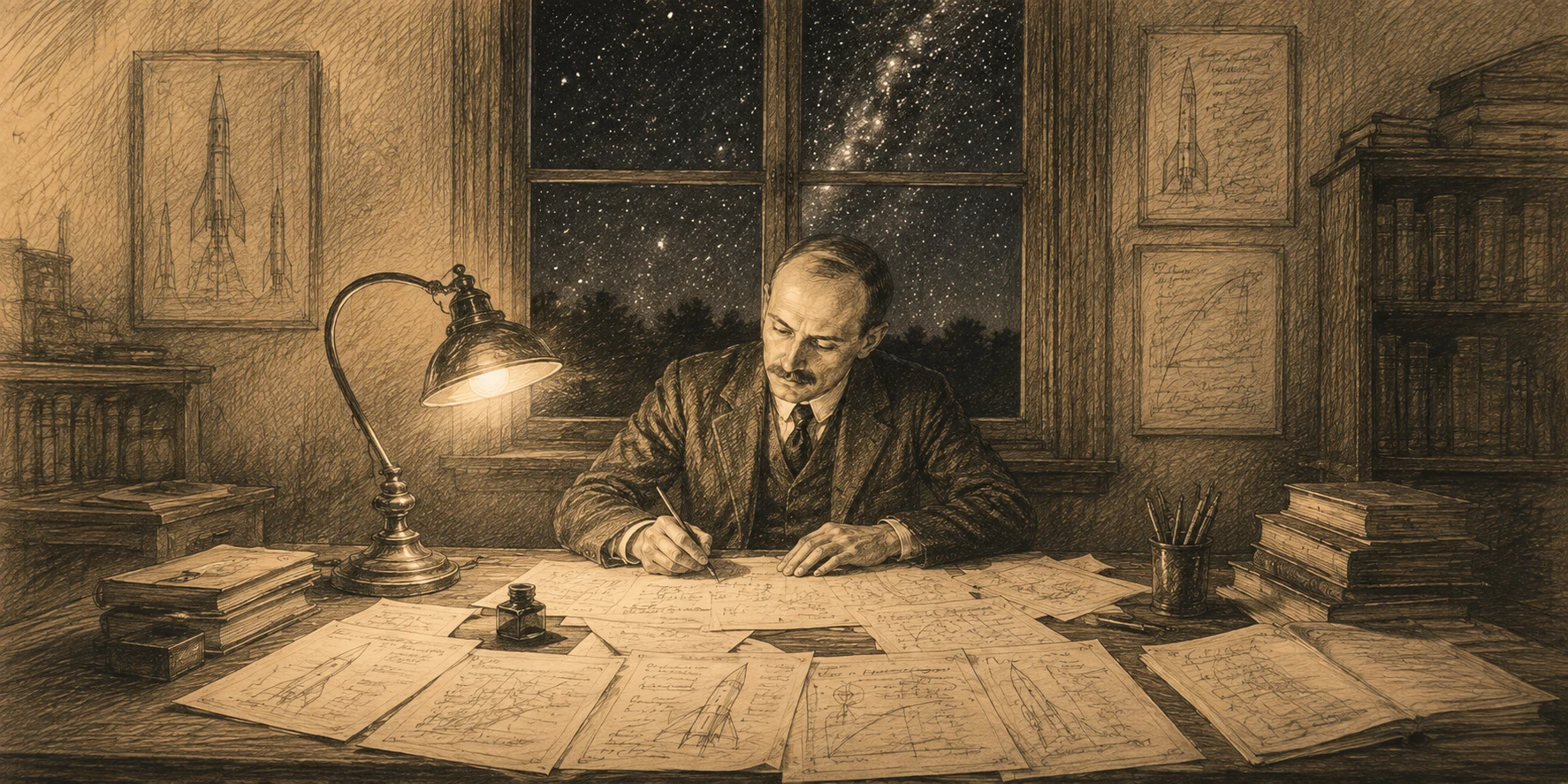
In 1918, rocket pioneer Robert Goddard sealed away a private essay imagining how humanity might one day flee a dying Sun.
◆ In Summary
In January 1918, physicist Robert Goddard privately wrote an essay proposing how humanity might one day travel to other star systems once the Sun cooled. He imagined a nuclear-powered generation ship, or a slower chemical-fuelled alternative in which a pilot was woken from suspended animation by a radioactive clock. Fearing ridicule, Goddard sealed the essay away in an envelope, and it remained unpublished for decades after his death. Only now can we appreciate how far ahead of his time he really was.
The Interstellar travel article introduced a number of discussion points revolving around humanity's potential pathway to reaching nearby stars. The choices boiled down to a stasis ship and a generation ship and these ideas have been covered extensively in science fiction works in film and books throughout the last 100 years or so. One of the earliest musings on this subject was written by Robert Goddard, a PhD rocket expert who drew upon his scientific expertise to explore the potential launch of a generation ship upon the death of our sun.
Robert Goddard: From Cherry Tree to Clark University
Robert Hutchings Goddard was an American engineer, physicist and inventor. He completed his PhD in physics at Clark University in 1911 and by 1918 he was a professor at the same institution. A shy and private man, he often retreated into his own thoughts and was a prolific diarist and documenter of his ideas. He was also affected by poor health throughout his life, nearly dying from TB in 1913.
At the age of 16 in 1899, Goddard read the recently published The War of the Worlds by H.G. Wells. It seems this kindled a fascination in matters of space and science fiction that would be with him for the rest of his life. That same year he expanded on this fascination, while perched up a cherry tree cutting dead branches off. He looked up at the sky and began thinking how wonderful it would be to build a device to travel to Mars. He would mark this day, 19th October, each subsequent year as his "Anniversary Day".
One of Goddard's earliest academic successes involved the core mechanics governing rocket flight. He formulated an equation that could calculate the potential speed of a rocket using two data points, the speed of exhaust gas and the ratio between the rocket's fuelled mass and post-burn mass. Unbeknownst to him, the same calculation had already been reached by Konstantin Tsiolkovsky some ten years earlier. Goddard, though, had gone further than the Russian, providing more realistic flight calculations that took into account the gravity and drag on the rocket to give a more precise speed.
Another example of his depth of thinking was his proposal for a recoil-free rocket launcher in 1918. Alongside colleague Clarence Hickman, Goddard demonstrated the idea to the Army Signal Corps and they were reportedly impressed. The idea didn't progress due to the signing of the Armistice and the end of the First World War.
The Sealed Envelope: Two Essays, One Afternoon
1918 was a prolific year for Goddard. Prior to his rocket launcher idea, he had already written the two essays which interest us in this article, The Last Migration and The Ultimate Migration.
Both essays explore how humanity might come to leave Earth before it becomes uninhabitable once the Sun starts cooling. Clearly, it was a subject he had thought deeply about and in the close to twenty years since his time up the cherry tree he had added scientific detail to his wonderings.
The Last Migration was the longer of the two, with The Ultimate Migration being a condensed version of the former. The longer version is not readily available to read online but the shorter essay is (see go deeper below).
At the time, Goddard made the curious decision to hand one of the essays, sealed in an envelope, to a friend to keep locked away. He had written on the envelope the words "The Last Migration" and "The notes should be read thoroughly only by an optimist". It seems he was genuinely concerned how his thoughts would be received at the time and they only came to light decades later, after his death.
Robert Goddard's Vision for Interstellar Travel
He opens his essay by asking the question whether it will be possible for humans to travel to the planets of other stars once life is no longer possible on Earth. This leads to two further questions: will it be possible to use intra-atomic energy and, if not, would it be possible to place a human body in a "granular state" and thereby survive the cold of space travel.
Goddard's first concern was whether we would have the means of propulsion for interstellar travel. He describes intra-atomic energy without going into any further details, so we can conclude he had some form of nuclear energy in mind to propel the spaceship. It's worth noting that he wrote this a year before Rutherford and his team published details of their successful altering of the atomic nucleus and a full twenty years before fission was demonstrated.
If a spaceship can be propelled by nuclear energy, he imagines that reaching nearby stars will be relatively quick. He also proposes using a large asteroid or small moon, or other large body, as a ship. While not entirely clear what his thinking is here, perhaps he envisages that having an abundant fuel source would allow use of such a large vehicle and in turn offer the crew a degree of protection from the dangers of space. If this vessel were also "a poor heat radiator", it should retain the heat of the nuclear fuel, in turn providing the passengers with warmth.
If nuclear energy is not possible, we would have to take the slow route and rely on a form of stasis to preserve humanity until our new home is found. For fuel, a chemical rocket could be used, burning hydrogen and oxygen. Solar energy could also be utilised, with speeds of 3 to 10 miles per second a possibility once the vessel has left the solar system.
Goddard wonders if the pilot, presumably key to the success of the mission, could be placed in suspended animation, and woken every 10,000 or 1,000,000 years (depending on the length of the journey) to make sure everything is on track. A clock driven by atomic decay could be used to monitor the timings, as an electrical or mechanical device may not survive such timescales.
Generational Change and the Granular State
He's not explicit about the rest of the crew, but one imagines that they would live out their lives, generations passing, until the new star is reached. Even if nuclear fuel is used, Goddard raises the possibility that so much time might elapse during the journey that the very nature of the humans might materially change. It's not clear to me why he feels the faster form of travel will still lead to slow journeys that last for possibly millions of years, and I wonder why he did not consider all the crew being in suspended animation alongside the pilot.
His use of the term granular state is also curious. Is he predicting a form of stasis being used, one that he might have known exists in nature? Perhaps, he was thinking of anhydrobiosis, whereby some creatures like rotifers (documented since the early 1700s) become severely dehydrated to survive turbulent times.
Goddard felt we should aim for an Earth-like planet with a large sun or a twin star system. If the star was young and burning hot, this planet should ideally be sufficiently far from that star, giving the crew plenty of time to settle and thrive before the same fate as Earth befalls their new home. He also recommended that a region of the Milky Way be chosen where there were lots of stars thickly clustered allowing further migration. Given the potential dangers from meteoritic matter in space, he also suggests that multiple expeditions be sent out to mitigate the risk of failure in any one of them.
If none of this is possible, a more stripped-back option is on the table. We could send granular protoplasm out of the Solar System, which, via evolution, would eventually produce human beings in the future. Again, his precise thinking is not clear, but perhaps he was imagining a living substance with a cell membrane (what might be described as a cytoplasm today). Or, he might have been referring to a desiccated organism similar to what he envisaged for the pilot.
Why Goddard Kept It Secret
I've already touched upon his decision to keep his musings sealed in an envelope, but thought it would be interesting to drill down into quite why he might have made that choice. Unfortunately, Goddard didn't go into detail in any of his other writings why he was so secretive. It is likely that it was a feature of his character. He was known to be a private individual and chose to work with technicians rather than other scientists on his level. Perhaps, he was genuinely concerned that these essays would cause consternation, or that his reputation would be tarnished, his peers thinking him to be a crackpot.
Around two years after he wrote these essays, Goddard published "A Method of Reaching Extreme Altitudes" via the Smithsonian Institution. It was a peer-reviewed study on rocketry, now considered one of the important early texts in the subject. Part of the paper explored how a rocket might reach the moon. This caused a stir and the press covered the subject mockingly. The New York Times ran an editorial in January 1920, questioning Goddard's basic understanding of physics, claiming that rockets would not work in space as there would be nothing in the vacuum which exhaust could push against.
This perhaps explains Goddard's desire to hide his thoughts on interstellar travel. Maybe he knew the mood of the general public and sensed they were not quite ready to hear such things. In 1969 around the Apollo 11 Moon landing, the Times printed a correction, acknowledging that Goddard was correct in his thinking.
I confess that I had not read Goddard's short essay before I wrote the previous articles on interstellar travel. I am impressed with his ideas and considering he wrote them over one hundred years ago it is quite something. He was clearly postulating ideas that were beyond the thinking of the general public and it is a pity that his fear of being ridiculed led to him sealing his thoughts in an envelope hidden somewhere in a colleague's house. I'm glad that they finally saw the light of day and that we are now able to learn from him.
Frequently Asked Questions
Did Robert Goddard really write about interstellar travel?
Yes. On 14 January 1918, Goddard privately wrote an essay called The Ultimate Migration, proposing how humanity might one day travel to other star systems once the Sun cooled. He sealed it away and it wasn't published for decades.
What propulsion method did Goddard propose for interstellar travel?
Goddard's preferred method was intra-atomic energy, recognisable today as nuclear energy, which he believed could provide a relatively quick journey. If that proved impossible, he proposed a chemical rocket burning hydrogen and oxygen, aided by solar energy.
Did Goddard describe a generation ship or suspended animation?
Both ideas appear in his essay. In his slower, chemical-fuel scenario, the pilot would be placed in suspended animation and woken at intervals of 10,000 to 1,000,000 years to check the ship's course. Goddard isn't explicit about the rest of the crew, though it's a reasonable inference that they lived out their lives across the generations of the journey.
Why did Robert Goddard keep his interstellar travel essay secret?
Goddard never explained his reasons directly, but he was a private man who may well have feared being dismissed as a crackpot. Two years later, his own peer-reviewed Smithsonian paper drew national press ridicule for briefly mentioning a rocket reaching the Moon, suggesting any such fear would have been well founded.
◆ Also In The Stars

◆ Go Deeper
Recommended
Affiliate links — we may earn a small commission at no cost to you.