An Englishman drew the moon through a telescope months before Galileo, then filed it away with almost everything else he discovered and never published.
◆ In Summary
Thomas Harriot pointed a telescope at the moon on 26 July 1609 and drew what he saw. The drawing predates Galileo's published lunar observations by several months. Harriot never published it. He never published most of what he did; not the law of refraction he derived before Snellius, not his observations of sunspots, Jupiter's moons or Halley's Comet. The reasons were partly circumstantial: his association with Walter Raleigh, his links to the School of Night, a heresy investigation that made caution rational. The result is that the story of the telescope was written around Galileo, and Harriot became a footnote. His manuscripts, thousands of pages of them, sat in country houses for centuries. They are well studied now. The history is not entirely recovered, but it is considerably less wrong than it was.
◆ At a Glance
| Born | Around 1560, probably Oxford |
| Died | 1621, cancer of the nose |
| Employer | Walter Raleigh |
| Virginia expedition | 1585, surveyor and observer |
| First lunar drawing | 26 July 1609 |
| Telescope | Six-power instrument |
| Manuscripts held at | British Library and Petworth House |
| Legacy | Lunar crater named Harriot |
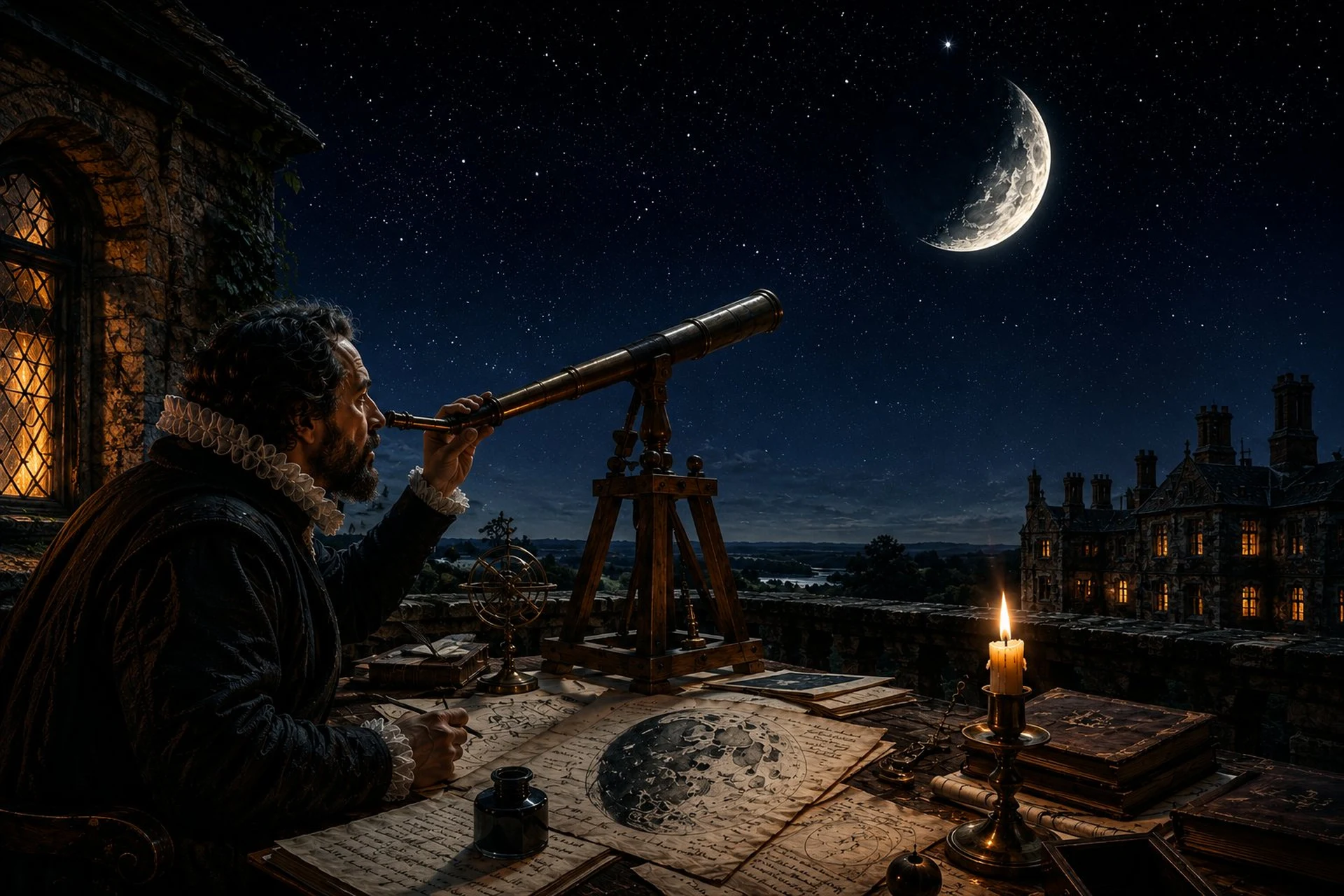
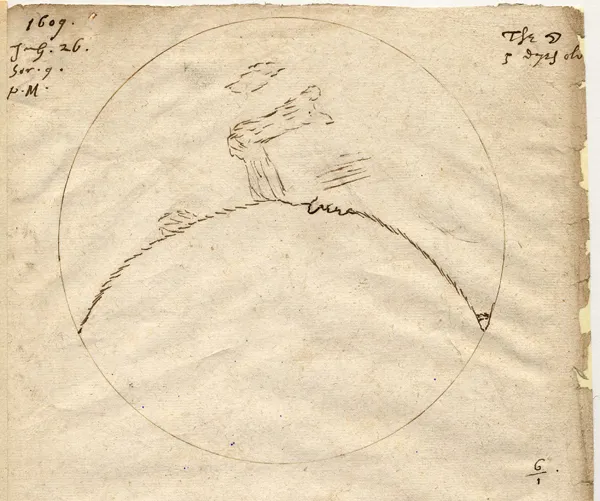
On 26 July 1609, Thomas Harriot pointed a telescope at the moon and drew what he saw. The drawing still exists. It shows a rough circle with a sketched terminator line and a handful of surface features. Crude by any measure, but the intent is clear. He was recording what he saw, not the perfect celestial sphere everyone assumed was up there. It predates Galileo's first telescopic moon drawings by several months. You probably haven't heard of Thomas Harriot because he rarely published his discoveries.
The Elizabethan Polymath
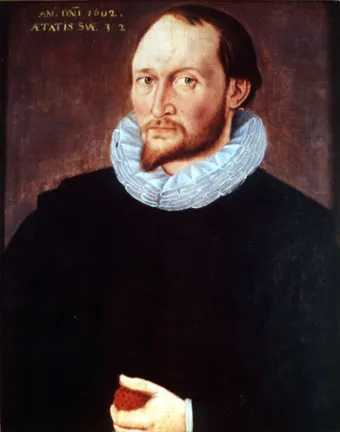
Harriot was born around 1560, probably in Oxford, though the records are thin. A young man of considerable intellect, by his mid-twenties he was working for Walter Raleigh, which in the 1580s was about as close to the centre of Elizabethan ambition as a mathematician was likely to get. Raleigh sent him to Virginia in 1585 as a surveyor and observer. Harriot spent a year there. He learned the Algonquian language well enough to hold a real conversation, which puts him in a very small category of Elizabethan Englishmen, and came back with a detailed account of what he had found. His report was published in 1588 under the title 'A Briefe and True Report of the New Found Land of Virginia'. One of the most detailed English accounts of North America produced in the sixteenth century. It was translated into Latin, French and German. People read it. Harriot was, briefly, well known.
Then he went quiet.
The Work Nobody Saw
Not inactive. Quiet. He continued working. He was corresponding with Kepler on the mathematics of refraction, developing algebraic notation that would influence later generations, watching sunspots through the telescope and writing down what he saw. His manuscripts show that he derived the law of refraction independently, years before it was published by Willebrord Snellius. He observed Halley's Comet in 1607 and tracked Jupiter's moons. Nothing went to press. His immediate circle knew about his work. Nobody else did.
Why Harriot Never Published
The reasons for his relative secrecy are not entirely clear. He had been associated with Raleigh, who ended up in the Tower. There was also the School of Night. The name attached to a loose group of thinkers with a reputation for atheism and free thought, and that reputation was the kind of thing that got people investigated. Harriot had been investigated. A man in that position did not necessarily rush to put his ideas into print. Caution was rational.
The Manuscripts
The result is that almost everything Harriot did survives only in manuscripts, thousands of pages of them, held now in the British Library and Petworth House. They were not seriously examined until the twentieth century. By that point Galileo had long been published and celebrated. He had also been persecuted, which tends to concentrate the historical attention. The story of the telescope's role in transforming our understanding of the cosmos had been written firmly around the Italian. Harriot existed as a footnote, if at all.
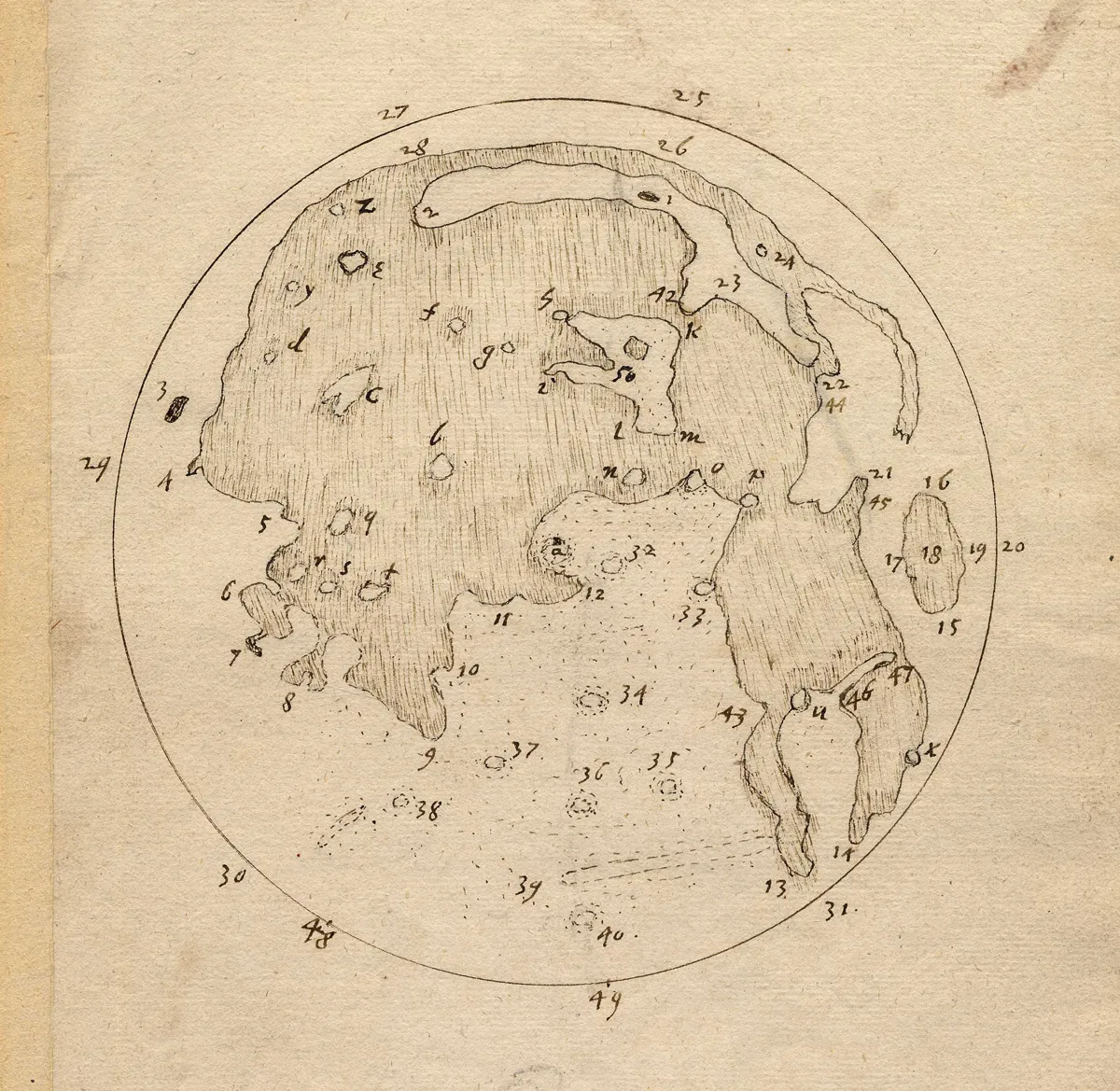
The Moon Through the Lens
What the manuscripts show is a mind of considerable range operating at the edge of what was then knowable. His moon drawings from 1609 are crude, as the surviving sketches show. But they were a start, and the maps he produced between 1610 and 1613 went considerably further. They show a surface with features that cast shadows and catch light differently depending on where the sun sits. That made the moon a place rather than a sphere, and back then that was a radical thing to put on paper.
Harriot and Galileo
The telescope he used was a six-power instrument, one he had obtained in the same summer that Galileo was building his own. The technology was spreading fast from its origins in the Netherlands, and several people were pointing versions of it at the sky simultaneously. Priority in the history of science is often messier than the textbooks suggest. The difference was not simply that Galileo looked first or hardest. He wrote it up and published it. He kept arguing for what it meant even when that became dangerous. Harriot looked at the moon, made his drawings, and said nothing.
Was Harriot a Tragic Figure?
There is a version of this story where Harriot's caution cost him his place in history. That reading is probably too neat. Patrons supported him. He corresponded with the best mathematical minds in Europe. He had everything a working scholar needed except an audience. He died in 1621 of a cancer of the nose, having spent his final years in relative comfort in Syon House under the patronage of the Earl of Northumberland. He left detailed and generous provisions in his will, money to friends, colleagues and servants. It reads less like the estate of a man who felt overlooked and more like someone who had got what he wanted from life.
The tragedy, if there is one, belongs to the history rather than to Harriot personally. A complete picture of who was actually looking at the sky in those years, and what they made of what they found, was delayed by several centuries because one of its key figures chose privacy over publication. The manuscripts sat in country houses while the story was written elsewhere.
Thomas Harriot's Legacy
They are well studied now, and Harriot's place in the history of astronomy is more secure than it was. Histories of mathematics mention him. So do accounts of early modern science and the record of English involvement in Virginia. A crater on the moon bears his name, which is probably the right scale of recognition for a man who spent years looking at it and kept the results to himself. But he remains the kind of figure whose significance you have to be told about rather than one you arrive at naturally, and the telescope arc of history still runs, in most people's minds, from Galileo forward.
The man who drew the moon first is worth knowing about. Not because priority matters more than publication, but because the story of how knowledge gets recorded is messier than the names we end up with suggest.
Frequently Asked Questions
Who was Thomas Harriot?
Thomas Harriot was an English mathematician, astronomer and explorer, born around 1560. He worked for Walter Raleigh, travelled to Virginia in 1585, and produced one of the most detailed English accounts of North America of the sixteenth century. He is best known today for making the first telescopic drawing of the moon, on 26 July 1609, several months before Galileo published his lunar observations.
Did Thomas Harriot observe the moon before Galileo?
Harriot's surviving lunar drawing is dated 26 July 1609, which predates Galileo's first published telescopic lunar observations. Galileo published his findings in Sidereus Nuncius in March 1610. Harriot observed the moon but never published his drawings.
Why did Thomas Harriot never publish his discoveries?
The reasons are not entirely clear. Harriot had been associated with Walter Raleigh, who was imprisoned in the Tower of London. He was also linked to the School of Night, a group of thinkers accused of atheism and free thought, and had himself been investigated for heresy. A man in that position had good reasons to keep his work private. Caution appears to have been a rational response to his circumstances.
What is the School of Night?
The School of Night was a loose group of Elizabethan thinkers with a reputation for atheism and free thought. Thomas Harriot was among those associated with it. The group attracted suspicion from authorities at a time when accusations of heresy carried serious consequences.
What happened to Thomas Harriot's manuscripts?
Harriot left thousands of pages of manuscripts, now held at the British Library and Petworth House. They were not seriously examined until the twentieth century. They show independent work on the law of refraction, observations of sunspots, Jupiter's moons and Halley's Comet, and the lunar drawings that predate Galileo's published work.
Is there a crater named after Thomas Harriot?
Yes. A crater on the moon is named Harriot in his honour.
◆ Also In The Stars

◆ Go Deeper
Recommended
Affiliate links — we may earn a small commission at no cost to you.