Kings and generals crossed the ancient world for an answer deliberately built to mean more than one thing, and that ambiguity kept the institution running for a thousand years.
The Oracle of Delphi: How a Sacred Site Shaped the Ancient World
◆ In Summary
For more than a thousand years, the Oracle of Delphi shaped the decisions of kings, generals and city-states across the ancient Greek world. Before a war, before a new colony, before almost any decision that carried real weight, Delphi was consulted. This was not superstition. It was politics, and the Oracle was one of the most sophisticated political institutions the ancient world produced. Its prophecies were almost always ambiguous. That was not a flaw. It was the mechanism that kept it functioning for a thousand years.
◆ At a Glance
| Location | Delphi, southern slopes of Mount Parnassus, Greece |
| Active | Approximately 8th century BC to 4th century AD |
| Sacred to | Apollo |
| Administered by | The Amphictyonic League |
| The Pythia | The priestess who delivered the prophecies |
| Consultation fee | Required, plus purification rituals and animal sacrifice |
| Most famous consultation | Croesus of Lydia, who misread the Oracle's answer about Persia |
| Last known consultation | Emperor Julian, 4th century AD |
For my sins, I studied Themistocles at school via Thucydides's History of the Peloponnesian War, and it certainly left its mark. What struck me then, and has stayed with me since, is that before he could persuade Athens to trust its fate to the fleet, the Delphic prophecy provided powerful support for his argument. The Oracle did not give permission exactly. What it gave was the kind of political cover that makes an already-decided plan survivable, which in the ancient world was often worth more than permission. The Pythia had told the Athenians to trust in their wooden walls, which Themistocles decided, conveniently, meant the fleet rather than the city's actual walls. Nobody in a position to argue had a better interpretation to hand. It helped win the battle that saved Greece from Persian conquest either way.
That an institution built around a prophetess speaking for Apollo could shape the decisions of kings and city-states for centuries is, when you step back from it, genuinely extraordinary.
How the Oracle of Delphi Got Its Power
The site had been sacred long before the Greeks built a temple on it. Two fault lines cross beneath the site, and gases rose through the rock. Something about it drew ancient peoples to the location, and a myth grew around it involving Apollo. It was believed he killed the serpent Python here and claimed the location as his own, displacing an older earth religion associated with Gaia. The temple followed, built to honour the god who had, in the telling, earned the ground. The geology came first. The god story followed, as it usually does.
Whatever you make of the myth, what followed from it was entirely real: a sanctuary that belonged to no single city-state but to the entire Greek world. That pan-Hellenic neutrality was what gave the whole thing its teeth, enforced by the Amphictyonic League, a council of Greek states that administered and protected the sanctuary directly. Customary deference was one thing. Having a formal body behind it was another. Attacking Delphi risked provoking a wider coalition of Greek states, which most cities preferred to avoid. No city wanted that on its record. The Oracle that operated within this framework inherited its authority not just from the god it claimed to speak for but from the political architecture that had been built around it over centuries.
The Art of the Ambiguous Answer
Delphi was not a place you visited out of curiosity. For more than a thousand years, from roughly the eighth century BC to the fourth century AD, it functioned as something close to a foreign policy institution for the ancient Greek world. Cities sent delegations before founding colonies, generals before campaigns. Kings who received ambiguous answers argued about what they meant rather than ignoring them. Croesus of Lydia is the instructive case. He asked whether he should attack Persia, received the answer that crossing the Halys river would destroy a great empire, and crossed. The empire was his own. He had not thought to ask which one.
That story gets told as a warning about hubris, which it is, but the more interesting reading is institutional. Croesus did not consult Delphi out of superstition. He consulted it because not doing so would have been politically unthinkable. Not consulting it before a major campaign was the kind of thing the Greek world noticed, and drew conclusions from. The Oracle sat at the centre of a web of relationships, obligations and prestige that connected the Greek world across its fractured city-states. To ignore Delphi was to signal that you considered yourself above the common framework. Nobody wanted to signal that. The mechanism of deliberate ambiguity in prophecy is one that recurs across history. It is, among other things, a large part of why Nostradamus has remained impossible to definitively disprove for five centuries.
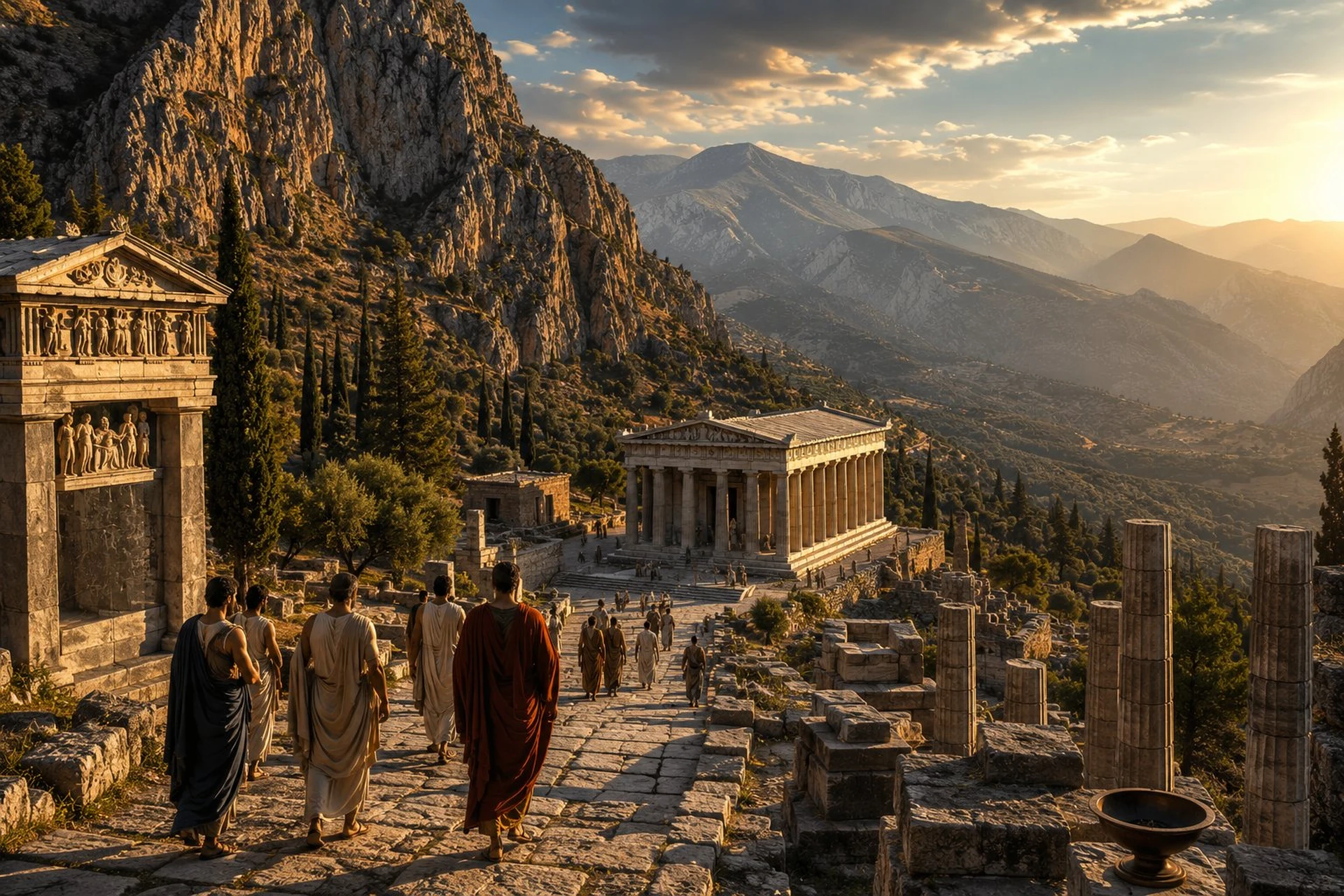
The site itself sits on the southern slopes of Mount Parnassus, in a landscape that still stops people dead. The Greeks called it the omphalos, the navel of the world, and standing there you understand why that claim stuck. The cliffs drop sharply, the light changes as you descend, and the sanctuary that accumulated around it drew treasuries from across the Greek world, with city-states competing to outdo each other in the impressiveness of their offerings, turning Delphi into something between a temple complex and a geopolitical scoreboard.
None of which explains what actually happened inside it.
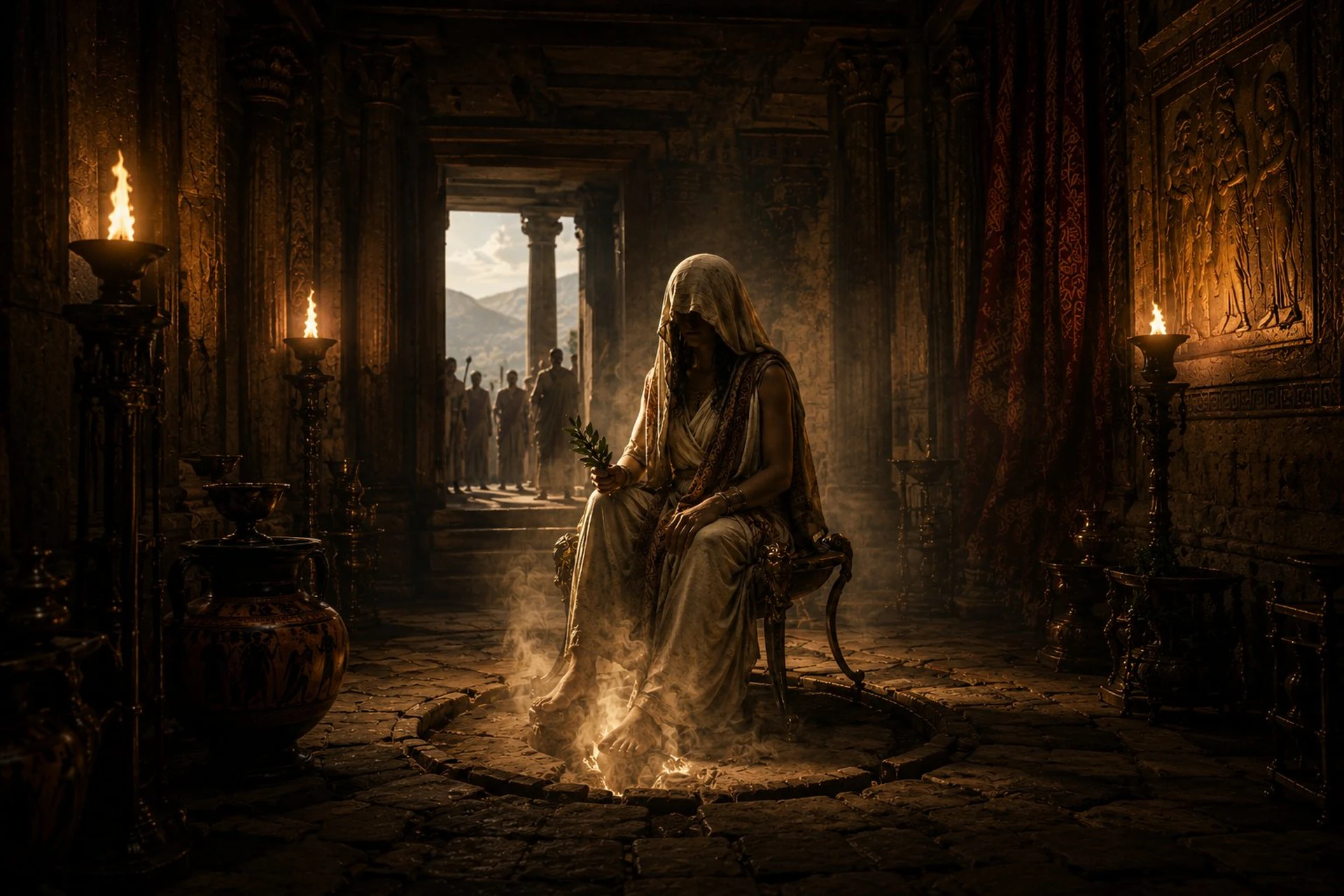
Getting an answer from Delphi was not straightforward, and that was deliberate. Deep inside the temple the Pythia sat, and ancient tradition held that she positioned herself above a fissure from which vapours rose, in a process nobody outside the inner sanctuary was permitted to witness directly. What exactly those vapours were, and what they did to her, is something covered in a separate piece on the Pythia herself. What matters here is the output: responses that were almost always ambiguous enough to be interpreted multiple ways, delivered in a state that made them impossible to argue with on their own terms.
What the Consultation Was Actually For
That ambiguity was not a flaw. It was the mechanism. An Oracle that gave clear, falsifiable predictions would eventually be wrong in ways that couldn't be explained away. One that spoke in riddles could always be retrospectively vindicated, and Delphi had been speaking in riddles for centuries. Thucydides, who I also studied and who was deeply sceptical about most things, noted this unease himself. Later generations pointed to an oracle said to have predicted a twenty-seven-year war, a coincidence Thucydides recorded with some discomfort. He did not know quite what to do with that. Neither, reading him, do I.
What Thucydides understood better than most was that the Oracle's power was partly independent of whether its prophecies were accurate. The consultation itself mattered. It created a pause, a moment of collective attention before a major decision, a ritual acknowledgement that the decision carried weight. In a world without the institutions we now use to legitimate power, parliaments, constitutions, international law, Delphi served some of those functions. It was a place where competing claims could be referred. Where disputes about colonies and boundaries could be submitted to something that stood outside any single city's interest. Its authority rested on universal belief, and that belief was self-reinforcing in the way that only truly embedded institutions manage.
The Long Decline
The Oracle's influence began to decline in the fourth century BC, as the Greek city-states lost their independence to Macedon and then Rome. Philip II of Macedon manipulated the Amphictyonic League that administered Delphi to serve his own political ends, which did the site's reputation no favours. Rome simply plundered, repeatedly and without ceremony. By the time the emperor Julian tried to consult it in the fourth century AD, what came back was not a prophecy but a lament: the sacred spring had run dry, the laurel was silent. Whatever had animated the place for a thousand years had apparently decided it was finished, and left no forwarding address.
What stays with me from studying this period is not any particular prophecy but the sheer accumulation of them. Delphi was consulted before wars, before new colonies, before almost any decision that carried real weight in the Greek world. It was not optional. The ancient world ran on the assumption that the future was knowable, that certain places and certain people carried access to it, and that consulting them was wisdom rather than weakness. How times have changed.
Frequently Asked Questions
What was the Oracle of Delphi?
The Oracle of Delphi was a sanctuary at Delphi in Greece where a priestess known as the Pythia delivered prophecies on behalf of the god Apollo. It operated for roughly a thousand years and was consulted by individuals, city-states and kings on matters of war, colonisation and political decisions.
Who was the Pythia?
The Pythia was the title given to the priestess who delivered the Oracle's prophecies. Dozens of women held the role over the centuries. She sat in an inner chamber of the temple, and ancient tradition held that she positioned herself above a fissure from which vapours rose.
Why was the Oracle of Delphi so powerful?
The Oracle's authority came from two sources: its religious prestige as the sanctuary of Apollo, and its pan-Hellenic status as an institution that belonged to no single city-state. The Amphictyonic League administered and protected it, making it structurally neutral in a way that gave its pronouncements unusual weight.
What did Croesus ask the Oracle?
Croesus of Lydia asked whether he should attack Persia. The Oracle told him that if he crossed the Halys river, a great empire would be destroyed. He crossed. The empire that fell was his own.
What happened to the Oracle of Delphi?
The Oracle's influence declined from the fourth century BC as Greek city-states lost independence to Macedon and then Rome. By the time the emperor Julian consulted it in the fourth century AD, the response was a lament rather than a prophecy. The sanctuary had effectively ceased to function.
Did the Oracle's prophecies come true?
The Oracle's prophecies were almost always ambiguous enough to be interpreted multiple ways, which meant they could rarely be definitively proved wrong. That deliberate ambiguity was central to how the institution maintained its authority over centuries.
◆ Also In The Stars

◆ Go Deeper
Recommended
Delphi: A History of the Center of the Ancient World
Amazon ↗
Affiliate links — we may earn a small commission at no cost to you.