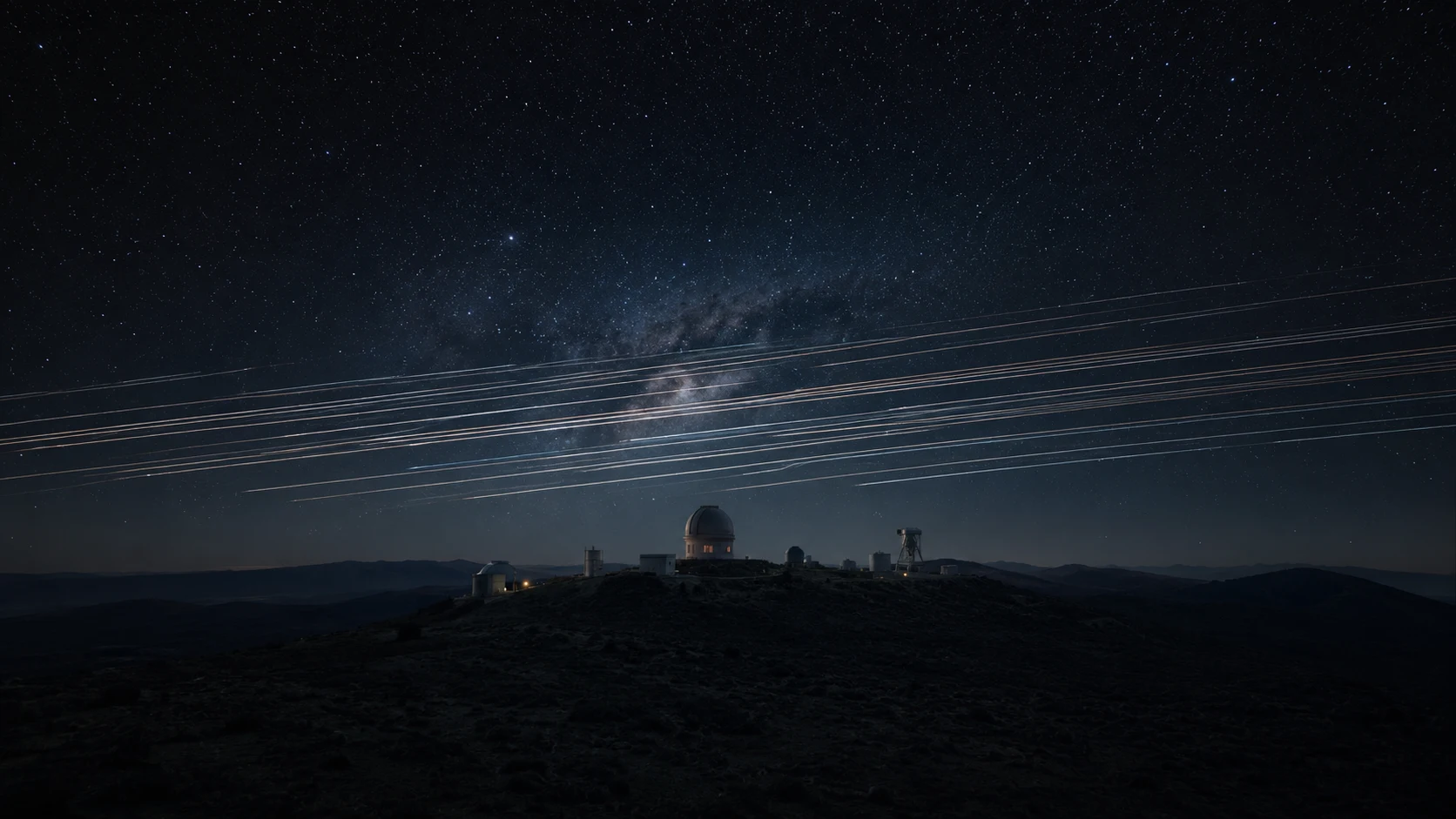
SpaceX agreed to fix the problem back in 2020, and by astronomers' own published measurements, the satellites are still too bright.
◆ In Summary
Astronomers began raising concerns almost as soon as Starlink launched in May 2019, though the photograph that made the problem famous, satellite trails crossing a Blanco telescope exposure, came six months later. SpaceX responded within the year, testing darkening coatings and other design changes. Those fixes exist, and by astronomers' own published measurements, they still fall short of what the IAU actually recommends. The scale keeps growing regardless, and Starlink isn't even the only constellation now causing the problem. Nobody involved here ignored a warning. The promise made in 2020 is just proving harder to keep than anyone expected, SpaceX included.
◆ At a Glance
| First spotted | Concerns from May 2019; famous Blanco telescope image followed in November 2019 |
| IAU's response | Centre for the Protection of the Dark and Quiet Sky, formally launched 2022 |
| SpaceX's public commitment | 2020, Gwynne Shotwell |
| IAU's recommended brightness | Fainter than magnitude 7, invisible to the naked eye |
| Starlink's actual brightness | Direct-to-Cell satellites measured near magnitude 5.5; varies by model |
| Active Starlink satellites today | More than 10,700 (mid-2026) |
| Legal outcome | FCC's approval of Starlink upheld on appeal, July 2024 |
What Astronomers Actually See When Starlink Passes Overhead
The first 60 Starlink satellites launched in May 2019. The astronomical consequences do not appear to have been fully anticipated at the time. It took six months for the problem to become impossible to ignore: on 18 November 2019, around 19 recently launched satellites streaked across a 333-second exposure taken by the Blanco telescope's DECam in Chile, leaving bright parallel lines straight through the frame. Nobody had asked for that photograph to become famous. It did anyway, because it provided the clearest demonstration yet of what satellite constellations could do to professional telescope images.
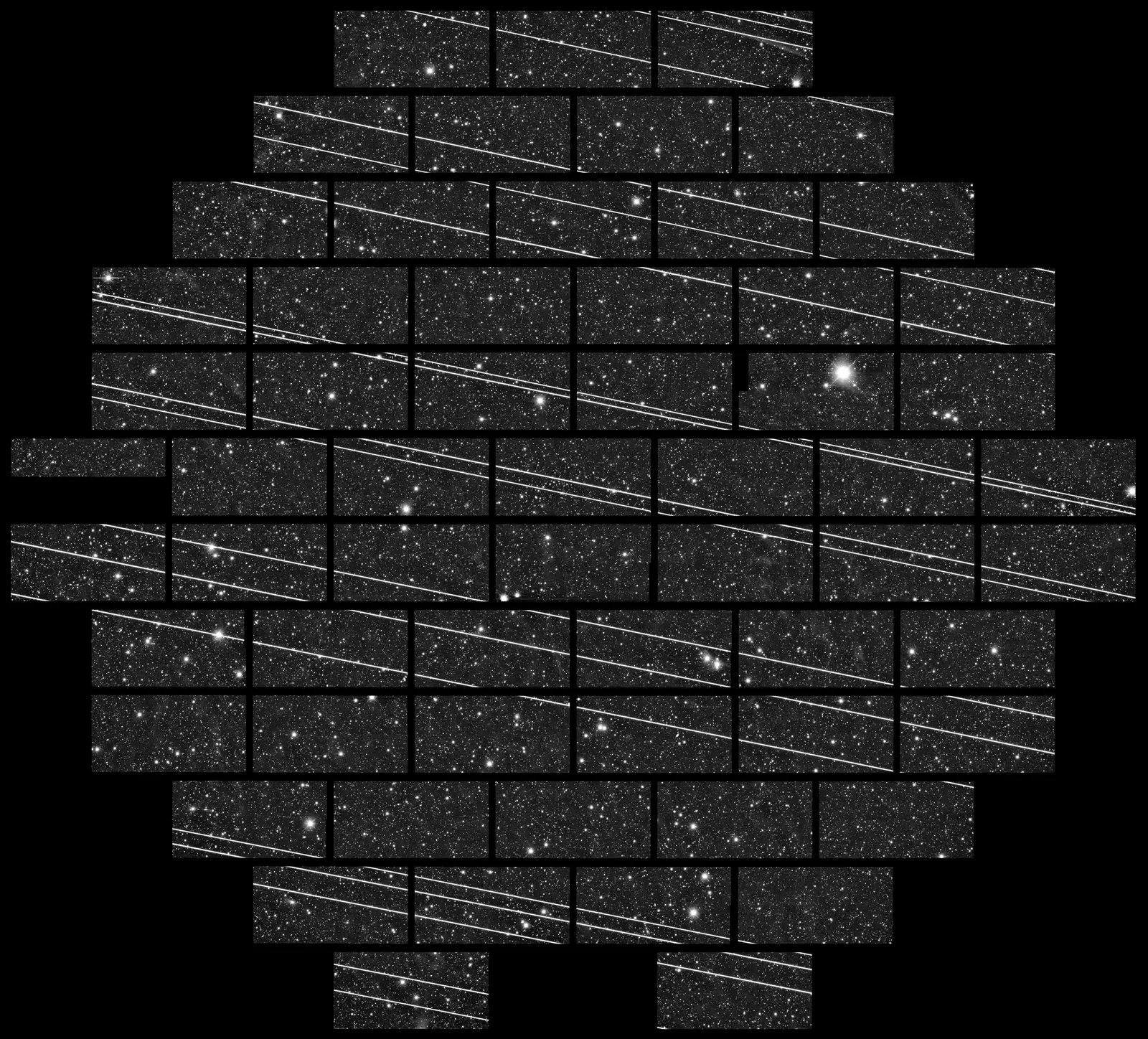
The mechanism is simple enough. A satellite doesn't produce its own light. It reflects sunlight, and it's most visible doing that in the hour or two after sunset and before sunrise, when the ground below is dark but the satellite, still up in daylight, catches the sun and throws it back down. A telescope taking a long exposure during that window doesn't record a fast-moving dot. It records a streak, a bright line dragged clean across whatever the astronomer was actually trying to photograph. A trail can contaminate part of an exposure, and in severe cases make scientifically useful data impossible to recover. Multiply that across a whole survey, and thousands of satellites cost far more than a handful of ruined frames.
What SpaceX Actually Did About It
To SpaceX's credit, and it's worth being upfront about this before getting to where the argument turns, the company didn't ignore the complaint. The controversy eventually helped lead the International Astronomical Union to create a dedicated body, the Centre for the Protection of the Dark and Quiet Sky, formally launched in 2022 to coordinate the astronomical response to satellite constellations. In 2020, well before that, SpaceX's president Gwynne Shotwell said publicly that the company would get the problem fixed. That's not a hedge. That's a specific, checkable promise.
SpaceX then actually did something about it. It tested dark coatings and deployable sunshades, then introduced further changes to satellite surfaces, orientation and operating procedures intended to reduce reflected light. Separately, on the radio side, SpaceX worked with America's National Radio Astronomy Observatory to develop techniques that redirect or briefly switch off satellite transmissions as they pass over sensitive instruments, including the Green Bank Telescope in West Virginia. None of that is a company stalling. It's a company that engaged, spent real engineering effort and can point to specific hardware and software changes as proof of it.
Why Do Astronomers Hate Starlink? The Gap That's Still There
Here's where the honest answer gets less comfortable for SpaceX. The IAU's own recommendation, developed with exactly this problem in mind, is that satellites stay fainter than magnitude 7.0, roughly one magnitude fainter than the conventional naked-eye threshold under a dark sky. Actual brightness varies by Starlink model, altitude and viewing geometry, and some mitigated satellites are considerably fainter than the earliest ones. But the newer Direct-to-Cell satellites have been measured at around magnitude 5.5 when normalised to a standard distance, brighter than the IAU's recommended limit, not by a rounding error but by a margin any working astronomer can measure and has measured. A 2025 paper by Mallama and Cole, published specifically to check this, concluded that satellite constellations across multiple operators exceed the brightness limits the IAU itself set. That's not an opinion. It's a published measurement showing that the problem SpaceX promised to solve has not yet been fully solved.
Scale makes the gap worse rather than better. More than 10,700 Starlink satellites are active as of mid-2026, and SpaceX's own long-term plans run considerably higher than that. For an instrument like the Vera C. Rubin Observatory, built specifically to survey much of the southern sky repeatedly over years, projections suggest a meaningful share of its images, particularly the ones taken near dusk and dawn when satellites are most visible, will carry some trace of a satellite trail. Fixing the brightness of any one satellite doesn't fix a sky with ten thousand of them moving through it.
The Court Case Astronomers Lost
The International Dark-Sky Association didn't stop at publishing papers. It formally challenged the Federal Communications Commission's approval of Starlink's second-generation licence, arguing the FCC hadn't properly weighed the astronomical harm before signing off. Filing a lawsuit against a federal regulator is not a symbolic gesture.
They lost. A federal appeals court upheld the FCC's authorisation in July 2024, and SpaceX's licence stayed exactly where it was. But look at what the court actually reviewed. Courts checking an agency decision like this one don't ask whether the underlying science is right. They ask whether the agency considered the evidence and explained itself reasonably, a much narrower test than "is this harm real." The panel even said there may still be effects from the satellites, which is not the sentence you write if you think the whole complaint was baseless. What got upheld was the FCC's process. Whether the streaking is actually a serious problem was never really on trial.
It Isn't Just Starlink
Starlink gets named in the question because it got there first and because it's the biggest, not necessarily because it's now the worst offender. Amazon's competing constellation, marketed as Leo, has also been measured above the IAU's recommended brightness limit, despite launching years after the Starlink controversy was already well known. Some satellites in China's Qianfan and Guowang constellations, both now actively deploying, have also been measured well above the IAU's recommended limits.
Aside from Starlink and Amazon's Leo, who are at least trying to mitigate and solve the problem, other operators show considerably less effort in that direction. Reflect Orbital is a different case entirely. Its proposed fleet of fifty thousand mirror satellites isn't trying to be dim, it's designed to do the opposite, beaming sunlight back down to Earth after dark on purpose. So far the FCC has only approved a single demonstration satellite, Eärendil-1, cleared on 9 July, days before this piece went up, and the approval was explicitly limited to that one test satellite, not the full constellation. The FCC was also explicit that astronomical harm and light pollution sit outside its jurisdiction, so none of that got weighed at all. If the full 50,000-satellite fleet eventually flies, ESO's own modelling says the background sky would brighten three to four times over. A disaster for astronomers and a sign of the direction of travel.
Astronomers Are Worried About More Than Starlink
A 2026 study from the European Southern Observatory modelled what happens if every currently proposed constellation actually gets built, not just Starlink's, and arrived at a genuinely startling number: over 1.7 million satellites in total, across every operator combined. The study concluded that no more than around 100,000 faint satellites, all below naked-eye visibility, should orbit Earth if modern ground-based astronomy is to remain workable. Starlink was where the problem started. Past a certain number of satellites, though, no amount of dimming or coating fixes it, the problem stops being brightness and becomes sheer traffic.
So the honest answer to the question in the headline isn't that astronomers hate Starlink out of spite, or that SpaceX has been careless. SpaceX made a specific promise in 2020 and has genuinely worked toward it. Astronomers have genuinely measured that the work isn't finished, and lost a real legal fight trying to force the FCC to weigh that harm more heavily. At this point I'm mindful of King Canute and the tide. Starlink's brightness might get solved. Amazon's might too. But the tide here isn't any one company's satellites, it's the sheer number of them, and that will make ground-based astronomy, unfortunately, very difficult, if not impossible.
Frequently Asked Questions
Why do astronomers say Starlink is a problem?
Starlink satellites reflect sunlight and leave bright streaks across long-exposure telescope images, particularly around dusk and dawn when they're most visible against a dark sky. With more than 10,000 active satellites now in orbit, astronomers say the cumulative effect is measurably interfering with observations and threatens the efficiency of major sky surveys.
Has SpaceX done anything to fix Starlink's brightness?
Yes. SpaceX publicly committed to fixing the problem in 2020, tested dark coatings and sunshades before moving to further design and operational changes, and worked with the National Radio Astronomy Observatory to reduce radio interference near sensitive telescopes. Astronomers say the fix has improved the situation but still falls short of the brightness levels the IAU recommends.
Is Starlink the only satellite constellation causing problems for astronomy?
No. Amazon's Leo constellation and China's Qianfan and Guowang constellations have also been measured above the IAU's recommended brightness limit. A 2026 European Southern Observatory study modelled the combined impact of every proposed constellation, not just Starlink's.
Did astronomers win any legal action against Starlink?
No. The International Dark-Sky Association challenged the FCC's approval of Starlink's second-generation satellites in court. A federal appeals court upheld the FCC's decision in July 2024, and Starlink's licence remained intact.
◆ Also In The Stars

◆ Go Deeper
Recommended
Affiliate links — we may earn a small commission at no cost to you.