Elon Musk just delayed the Mars mission he's been promising for two decades, and the real explanation is neither honesty nor spin, just good business.
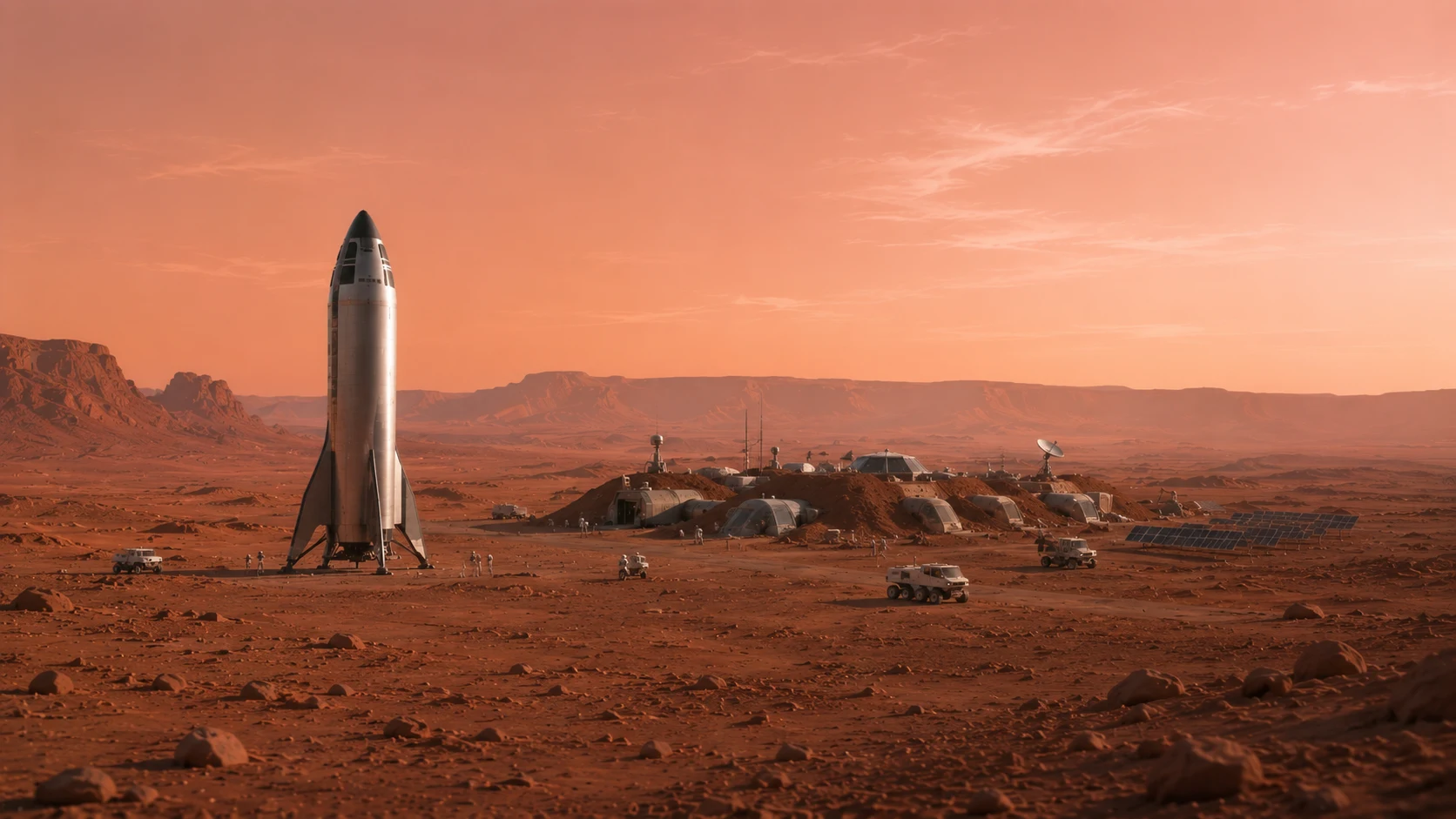
Can SpaceX's Starship Reach Mars, or Just the Moon?
◆ In Summary
Starship is closer to Mars than any vehicle in history has come, and further away than SpaceX said it would be twelve months ago. On 9 February 2026, Musk shelved the planned uncrewed Mars landing to focus on the Moon instead, pushing the realistic timeline into the early 2030s. Reaching Mars still requires solving orbital refuelling, a difficult atmospheric entry, and radiation shielding for a crew who would live inside the Starship hull itself once it lands. This piece examines the engineering case for Starship reaching Mars, and weighs it against the human cost.
◆ At a Glance
| Mars delay announced | 9 February 2026 |
| Delay length | 5 to 7 years |
| Propellant needed for Mars departure | ~1,200 tonnes in orbit |
| Largest propellant transfer demonstrated so far | 5 tonnes (Nov 2024) |
| Recommended crew shielding mass | ~30 tonnes of polyethylene |
| Mars surface radiation vs Earth | ~700x higher |
| Recommended crew size per ship | 10 to 20 people |
| Planned landing site | Arcadia Planitia |
The Starship Mars Mission That Isn't Happening This Year
Five uncrewed Starships were supposed to leave for Mars in the window that opens this November. That was the plan SpaceX had been building toward since September 2024, and as recently as May 2025 Musk was still putting the odds at fifty-fifty. Then, on 9th February 2026, he announced the whole thing was moving. Not cancelled. Delayed by five to seven years, in his own words, so SpaceX could focus on the Moon.
The reasoning he gave was that lunar transfer windows open roughly every ten days, against Mars's one narrow month every twenty-six. You can iterate on the Moon (test, fail, fix, try again within days). You cannot iterate on Mars, where the same mistake costs you a two-year wait to correct it. NASA's Artemis programme, which needs a crewed lunar lander variant of Starship, no doubt helped concentrate the mind too, and the multi-billion dollar contract attached to it certainly didn't hurt.
Why the Starship Mars Delay Is Smart Business, Not Spin
Given the goal was always Mars colonisation, not a Mars date, delaying to bank a lunar landing first is an understandable piece of sequencing, not a retreat. It buys iteration speed the 26-month Mars window can't give them, and NASA's money to do it with.
I think the IPO timing played a part too. SpaceX posted a $4.28 billion loss in the first quarter of 2026, with Starlink carrying most of the revenue, and a binary, high-cost Mars attempt failing live during a $75 billion roadshow is the kind of risk investors don't reward (they like surer bets, not stunts that lose them money).
For those of us who are keen to get the Mars missions started, it is a frustrating but defensible strategy.
How NASA's Moon Missions Prepare Starship for Mars
None of what follows is technically a Mars test. On paper it's all aimed at the Moon. But it's the same hardware chasing the same unsolved problems. What's good for the Moon is good for Mars.
The vehicle now being tested at Starbase is not the one that was going to attempt Mars this year. It's Starship Version 3, Block 3 hardware, which completed its first static fire (engines firing while the rocket stays clamped to the pad) in March, and flew its debut mission, Flight 12, in May. SpaceX had already ruled out a booster catch attempt for this flight, since it was the first outing for a substantially redesigned vehicle, and that caution proved justified: several engines failed during the boostback burn, the point after separation when the booster reignites engines to reverse course back toward the launch site or a controlled splashdown, and the booster broke apart over the Gulf of Mexico. The upper stage fared better, losing one engine early but still completing its ascent, deploying its payload, and reaching the Indian Ocean splashdown as planned.
Certainly progress, but Starship, even with those improvements, is still a long way from being a Mars-capable vehicle, and the distance between 'flew successfully' and 'flew to Mars' is where the real questions remain.
The single hardest problem, and every serious engineer who has looked at the architecture says the same thing, is orbital refuelling. It's not just a Mars requirement either, NASA's own Artemis Moon landing needs it too, and neither mission gets off the ground without it.
A crewed Mars Starship needs around 1,200 tonnes of propellant in orbit before it can leave Earth orbit. The Moon-bound version needs a similar amount, filled by roughly 10 to 16 tanker flights, each carrying up to 100 tonnes. But no tanker has ever actually transferred propellant to another Starship in orbit (fluid behaves strangely without gravity, the cryogenic propellant boils off if it isn't kept cold enough, and docking two 50-metre vehicles precisely enough to connect fuel lines has never been attempted at this scale). The closest attempt so far, in November 2024, moved five tonnes between two tanks on the same vehicle, not between two separate spacecraft. The real test, docking two Starships and transferring fuel between them, hasn't happened even once.
There's now a legal record of it, too. SpaceX's own IPO filing, submitted to the SEC on 20 May 2026 under obligation to disclose material risk, states outright: 'In-orbit refueling is complex, and we have not yet demonstrated or attempted it.' Not a critic's assessment. The company's own words, under securities law.
Artemis Is Already Behind Schedule, and Mars Is Waiting on It
The near-term roadmap now runs entirely through the Moon, in stages, and the revised version has already slipped once too: NASA redefined Artemis III in February 2026, then by April its own administrator was already describing the date as "mid to late 2027" instead of the mid-2027 target set two months earlier. This puts further pressure on the Mars timeline.
Artemis III itself won't put anyone on the surface. It's a docking test in low Earth orbit, Orion meeting a Starship lander, and separately, Blue Origin's competing Blue Moon lander, without anyone actually setting foot on either. The real landing has been pushed to Artemis IV, targeted for no earlier than 2028, and NASA hasn't committed to which company's lander gets to do it. That call comes after seeing how both perform.
None of that instability is really about money, for once. It's hardware and choreography: Starship V3 barely flying, cryogenic transfer (technical terms for fuel) never demonstrated, Raptor 3 reliability still being proven. But the wider Artemis programme has had its own money problems recently. An FY2026 budget proposal tried to end the Space Launch System and Orion outright after Artemis III, before Congress restored funding in July 2025, and NASA paused the Lunar Gateway station in February 2026 to redirect the money toward a lunar surface base instead. Mars, by contrast, runs on Musk's own capital and investor money. Whatever else threatens it, an appropriations fight in Washington isn't on the list.
What NASA's Moon Missions Don't Do for Starship's Mars Ambitions
Not everything Artemis is paying for is useful to Mars, though, and this is the part that gets missed when the two programmes get talked about as if they're the same effort wearing different destinations.
Artemis missions last days, at most a few weeks. Mars is roughly two and a half years door to door, six to nine months out, upwards of five hundred days on the surface, six to nine months back. That's not just more radiation, it's a different category of problem. Short missions never approach the career radiation dose limits that would constrain a Mars crew, so nobody has had to solve that problem yet.
Fuel is the same story. HLS Starship never has to fly itself home, the crew transfers back to Orion and the lander gets discarded. A Mars Starship has no Orion waiting. It has to manufacture its own return propellant on the surface, via the Sabatier reaction, water ice and atmospheric carbon dioxide turned into methane and oxygen, and that capability has never been demonstrated beyond the smallest lab scale by NASA's MOXIE experiment. Nothing about a successful Moon landing tests this at all.
For at least the first few years, there is no separate habitat either. The crew live inside the Starship that landed. One mission architecture paper, published through a NASA-affiliated review process, recommends ten to twenty people per crewed vessel and puts serious numbers on what keeping them alive requires: roughly 30 tonnes of polyethylene shielding layered over the crew section alone, plus multi-layer insulation wrapping most of the hull, plus solar-flare vests for the crew to wear when a particle event hits. That is a lot of mass, on a vehicle where every tonne of shielding is a tonne not spent on something else.
That shielding also has to make up for the fact that the stainless steel hull is a poor radiation shield on its own (steel was chosen for cost, cryogenic strength, and reentry heat tolerance, not radiation protection). Aluminium and steel both shatter under an energetic cosmic ray strike and throw off secondary radiation, which is part of why the actual protective layer has to be something hydrogen-rich instead, water, polyethylene, eventually the Martian regolith (the loose, rust-red dust and broken rock covering the surface) itself once there's equipment to move it. Lava tubes get mentioned in almost every serious paper on this as the eventual ideal, kilometres of rock overhead doing the shielding job for free. Nobody is landing anywhere near a lava tube on the first mission.
Radiation on the surface itself sits at something like 700 times what a person on Earth absorbs. A human body's tolerance for radiation is not a problem you iterate your way past. It's a hard biological limit, and the mission has to fit inside it, not the other way round.
Then there's the part with no engineering fix at all. Artemis crews can turn around and be home within days if something goes wrong. A Mars crew can't. For most of the trip there's no abort option, full stop. Communication runs up to twenty-four minutes each way, against roughly a second and a third for the Moon, and for about two weeks every twenty-six months Mars passes behind the Sun and goes completely silent, a blackout the lunar architecture never has to plan around at all.
What Is SpaceX Actually Doing About the Rest?
So what is SpaceX actually doing about the parts NASA isn't paying for? Not, as far as I can find, very much.
On shielding, the company has said Starship's larger interior gives it "more design flexibility," since the mass budget for shielding scales with the size of the vehicle. That's a real point, but it's a design argument, not a demonstrated solution. The actual shielding numbers, the thirty tonnes of polyethylene, the crew size recommendations, come from independent researchers modelling mission architectures, not from anything SpaceX has published itself.
On propellant production, the state of the art is still MOXIE, a NASA rover instrument that made a small amount of oxygen, not a demonstration of manufacturing enough fuel to launch a hundred-tonne vehicle off another planet. SpaceX hasn't run its own ISRU test at any scale.
On the psychological side, I couldn't find evidence of a dedicated SpaceX programme at all. What research exists, NASA's CHAPEA analogue missions among it, belongs to NASA, not the company that's actually going to fly the mission.
My Thoughts on Starship Reaching Mars
I'm a hopeful person and, for what it's worth, I still think Starship reaches Mars. It's clear the hardware has to go through many more iterations before it's capable of the journey, but there's no denying huge improvements have been made in the last decade. What seemed like a fantasy in 2015 is now reality, and the engineering has moved faster than almost anyone predicted, myself included.
The technical challenges will be overcome in due course. What I don't think has caught up is the honest accounting of what that landing costs the people doing it, and what's being done, right now, to close that gap. Two and a half years, give or take, inside a stainless steel tube on the surface of a planet with no rescue option, no fast return, and a radiation dose that career limits weren't built to accommodate. I can respect the ambition behind that and still think the human cost is being underweighted, not because anyone's hiding it, but because almost nobody outside NASA's own paperwork is currently being paid to solve it.
◆ At a Glance
| Orbital refuelling demo | 2026 target, not yet achieved |
| Artemis III (docking test only) | Mid to late 2027 |
| Artemis IV (first crewed Moon landing) | No earlier than 2028 |
| First uncrewed Mars attempt | 2028 to 2029 window |
| First crewed Mars mission | 2030s |
I intend to revisit these dates as and when they are reached and update the website on the progress. When/if any of those dates start slipping again, particularly the refuelling demo, it won't mean SpaceX has given up on Mars. It'll mean getting there is harder than the boffins are currently letting on.
Frequently Asked Questions
Is SpaceX still sending Starships to Mars in 2026?
Not as a firm commitment. Five uncrewed Starships were originally planned for the November to December 2026 transfer window, but Musk's 9 February 2026 announcement redirected SpaceX's near-term focus to lunar missions instead. The 2026 window hasn't been formally cancelled, but it's no longer the priority it was, and the realistic first Mars attempt now looks like the 2028 to 2029 window at the earliest.
Does Starship land on Mars in one piece, or does it use a separate lander?
The whole vehicle lands. Unlike the Apollo missions, which used a dedicated lunar module separate from the command ship, Starship's architecture has the entire spacecraft descend to the Martian surface and stay there. There's no separate ascent vehicle for the first missions, which is part of why the return propellant problem is so central to the whole plan.
Will Starship definitely be the lander that takes humans to the Moon?
No, it isn't guaranteed. NASA is developing SpaceX's Starship HLS and Blue Origin's Blue Moon in parallel, and Artemis III, now targeted for mid to late 2027, is only a docking test in low Earth orbit that doesn't select a winner. NASA won't commit to which lander flies the actual crewed landing, Artemis IV, until after seeing how both perform in that test.
What has SpaceX actually admitted about Starship's Mars readiness?
In its S-1 filing with the SEC on 20 May 2026, ahead of its IPO, SpaceX stated directly that orbital refuelling, the capability every version of the Moon and Mars plans depends on, "is complex, and we have not yet demonstrated or attempted it." That's a legally binding disclosure made under securities law, not outside speculation about the programme's readiness.
◆ Also In The Stars


◆ Go Deeper
Recommended
Liftoff: The inside story of Elon Musk, SpaceX and the dramatic origins of the world’s leading rocket company
Amazon ↗
Affiliate links — we may earn a small commission at no cost to you.