Three failures in a row, a company running out of money, and a rocket assembled in just six weeks that had to work or nothing else about SpaceX would have mattered.
Why Falcon 1 Failed Three Times Before SpaceX Succeeded
◆ In Summary
Falcon 1's road to orbit was far messier than SpaceX had planned. Not a record you want when you're running out of money. By 2008 SpaceX was nearly out of cash, and Elon Musk had ploughed most of his PayPal fortune into keeping it running. The fourth launch attempt was assembled in just six weeks using hardware already available to the team. Everything rode on it.
◆ At a Glance
| Rocket | Falcon 1 |
| Company | SpaceX |
| First launch | 24 March 2006 |
| Launches before success | 3 failures |
| First successful launch | 28 September 2008 |
| Launch site | Omelek Island, Kwajalein Atoll |
| Fourth rocket build time | 6 weeks |
| NASA contract after success | $1.6 billion (23 December 2008) |
SpaceX's first rocket almost ended the company before it built anything else. Falcon 1 went up three times and came down in pieces three times. That is not a record most businesses survive. Not with the money nearly gone. By 2008 SpaceX was down to its last reserves, and Musk had already put most of his PayPal fortune into keeping the lights on. The fourth launch attempt was built from spare parts in six weeks. Everything rode on it.
The First Falcon 1 Attempt
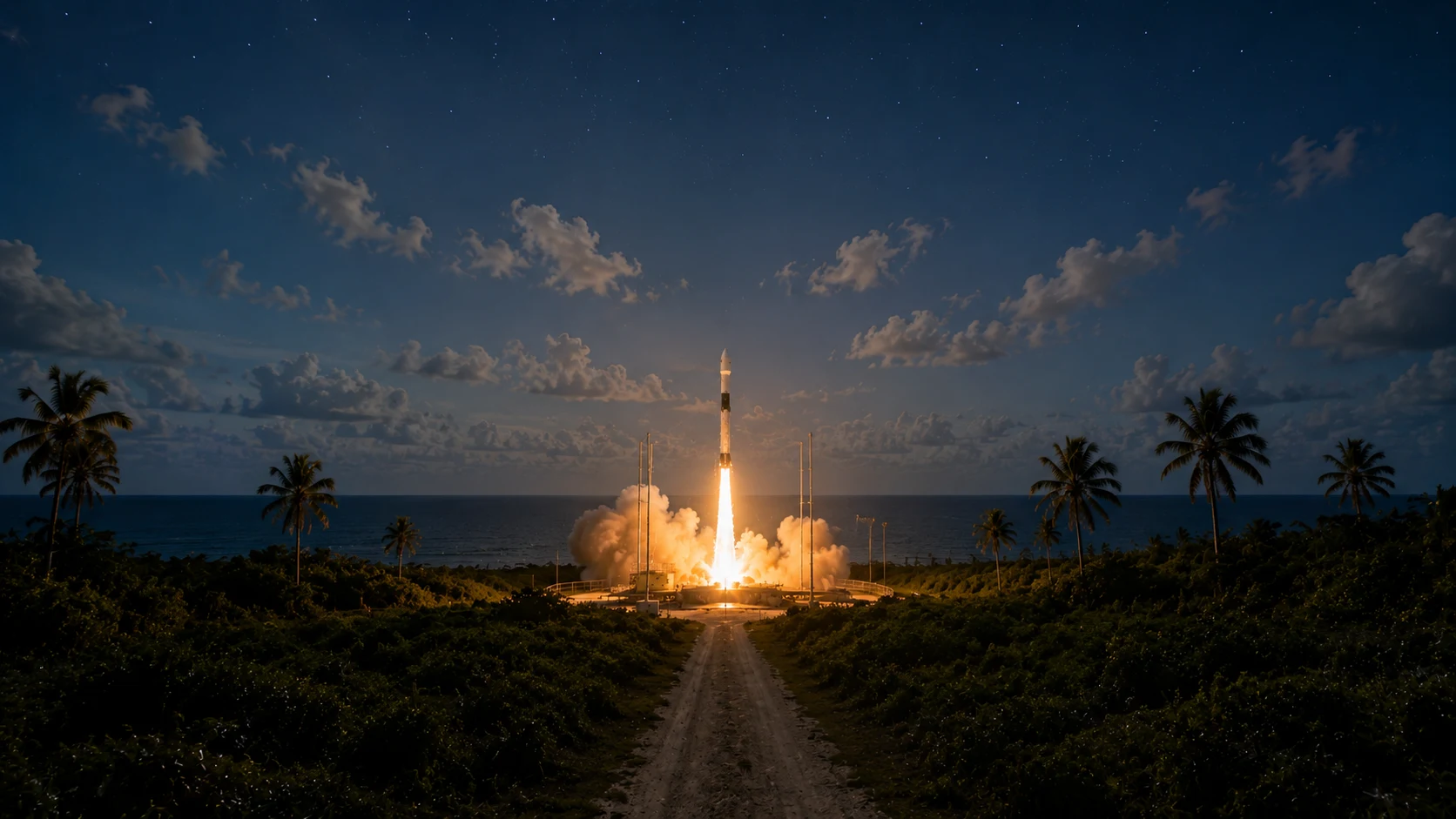
The first failure came on 24 March 2006. A rocket lifted off from a coral island in the middle of the Pacific. Twenty-five seconds later, it was over. That's all it managed before it was gone, back in the water roughly 250 feet from the pad it had just left. Not far, for that much fuel and ambition. If anyone on Omelek Island still believed this would be straightforward, that illusion ended there and then.
Why Falcon 1 Was Built Cheap, Not Cautious
SpaceX had been founded four years earlier, in 2002. The premise most of the aerospace industry treated as naive was simple enough to state. A private company, with no government cost-plus contract and no institutional inertia, could build a rocket for a fraction of what NASA or Boeing spent. That was the pitch, anyway, and nobody in the industry believed it would work. SpaceX could not prove it would either. Not yet. Falcon 1 was meant to settle the argument one way or the other.
The rocket was to be small and expendable. One engine on the first stage, a Merlin, doing all the work. It was meant to open up the smallsat launch market (small, cheap-to-build satellites needing frequent, low-cost launches) by undercutting everyone else on price. Falcon 1 had no flight history and no financial cushion. The rocket was assembled and tested on a tiny budget by a company with fewer than a hundred employees, most of whom had never actually put anything into orbit before.
Why Falcon 1 Failed Three Times in a Row
The first launch failed because of a corroded fuel-line nut, not the improperly tightened one SpaceX initially blamed, according to a later DARPA review. The second attempt, in March 2007, made it to space this time, further than most outsiders expected, before a fuel-slosh problem in the second stage sent it into an uncontrolled roll 300 kilometres up, short of the stable orbit it needed. Two failures. The third launch, in August 2008, came closer still. The first stage performed well. Then residual thrust from the new Merlin 1C engine kept firing fractionally longer than predicted, nudging the spent first stage back into the second stage during separation and tumbling the whole vehicle.
Three failures, three different causes, and by then SpaceX had close to no money left. Musk has since said plainly that a fourth failure would have been the end of the company, full stop. He was not exaggerating for effect. He had already spent most of his PayPal fortune keeping the company alive, and 2008 was, by his own account, close to the worst year of his life, professionally and personally both. Tesla was in comparable trouble at the same time. He was funding two near-bankrupt companies out of the same shrinking pool of cash. That is not Silicon Valley mythology. That is someone making an enormous bet they were not sure they could cover.
A Fourth Rocket That Saved SpaceX
There was no time or money to build a fresh vehicle from scratch. The team assembled the fourth Falcon 1 using hardware that was already available, on a six-week timeline. Most aerospace engineers would wince at that schedule. It nearly didn't survive the trip to the launch site. The rocket was flown out on a chartered Boeing C-17, and repressurisation during the flight exceeded what the team had calculated from the aircraft's own manual, partially imploding the vehicle mid-transit. It had to be repaired on the ground before it could fly at all. This was do or die for SpaceX. If it failed, all their work would count for nothing.
The NASA Contract That Followed Falcon 1's Success
On 28 September 2008, Falcon 1 finally reached orbit, carrying nothing more than a 165-kilogram aluminium boilerplate the team had nicknamed RatSat. Barely a payload at all. Enough, though.
Three months later, on 23 December, NASA handed SpaceX a $1.6 billion contract to fly cargo to the International Space Station. On a rocket that did not exist yet. Falcon 9 was still more than a year away from its first launch. So the contract was less a reward for what SpaceX had built and more a bet on what NASA believed it could build next.
Falcon 1 flew once more, successfully, in July 2009, and that was it for the little rocket that had nearly taken the whole company down with it. SpaceX moved on to the Falcon 9, and eventually to reusable boosters landing themselves on drone ships, and then Starship, and eventually a public listing that made the company worth more than most countries' GDP.
Frequently Asked Questions
How many times did Falcon 1 fail before it succeeded?
Falcon 1 failed three times in a row, in March 2006, March 2007 and August 2008, before succeeding on its fourth attempt in September 2008.
What caused the first Falcon 1 launch to fail?
A corroded fuel-line nut caused a leak and fire around 25 seconds after liftoff. SpaceX initially blamed an improperly tightened nut, but a later DARPA review found corrosion from salt water spray was the actual cause.
How close did SpaceX come to running out of money?
Very close. Elon Musk has said a fourth failure would have ended the company entirely. He had already spent most of his PayPal fortune keeping SpaceX and Tesla afloat at the same time.
What happened to SpaceX after Falcon 1's first success?
Three months after the successful fourth launch, NASA awarded SpaceX a $1.6 billion contract to resupply the International Space Station, stabilising the company financially and setting up the development of the Falcon 9.
◆ Also In The Stars


◆ Go Deeper
Recommended
Liftoff: The inside story of Elon Musk, SpaceX and the dramatic origins of the world's leading rocket company
Amazon ↗
Affiliate links — we may earn a small commission at no cost to you.