Something out past Neptune is bending the orbits of distant objects in ways nobody can explain. Whether it's a hidden planet or an illusion of incomplete data may finally be settled within years.
◆ In Summary
The hunt for Planet Nine is one of astronomy's most contested live debates. In 2016, two Caltech astronomers proposed that an undiscovered planet, five to ten times the mass of Earth, is orbiting at the far edge of our solar system. The evidence comes from a cluster of objects behaving in ways that defy explanation. The sceptics say the pattern may be an illusion created by incomplete surveys. Nobody has found it. The Vera C. Rubin Observatory, which began its ten-year sky survey in 2025, may settle the question within years.
It is one of those theories that keeps coming back. Every few years an astronomer publishes something suggesting there is an undiscovered planet at the far edge of the solar system, and every few years it comes to nothing. Planet Nine is the latest version of that theory, and the most credible one yet.
Planet X
Percival Lowell was the first to make it a serious obsession. He proposed what he called Planet X in 1906 and spent the rest of his life looking for it. He never found it. Pluto turned up in 1930, discovered by his observatory after his death, and everyone assumed that settled it. It didn't. Pluto was far too small, and the disturbances Lowell had measured turned out to be instrument errors. A fairly dispiriting outcome after decades of searching. Planet X was quietly retired. The idea didn't die with it. It just waited for better data.
Enter Planet Nine
That point came in 2016, when two Caltech astronomers, Konstantin Batygin and Michael "Mike" Brown, proposed that a genuine planet, far larger than Pluto and far further out, might be sitting undiscovered at the edge of the solar system. Planet Nine, they called it. The name has stuck.
The Kuiper Belt
The Kuiper Belt is where this gets interesting. It is vast, filled with frozen debris beyond Neptune, stretching from roughly 30 to 50 times the Earth-Sun distance (AU). Pluto lives there, at around 39 AU. So do hundreds of thousands of smaller objects, leftovers from the solar system's formation, circling in orbits that take centuries to complete. Most of it has been left alone. Some of it, eventually, gets dislodged. Nudged inward over millions of years, it becomes the short-period comets and, occasionally, the kind of object that NASA tracks.
The objects that shouldn't exist
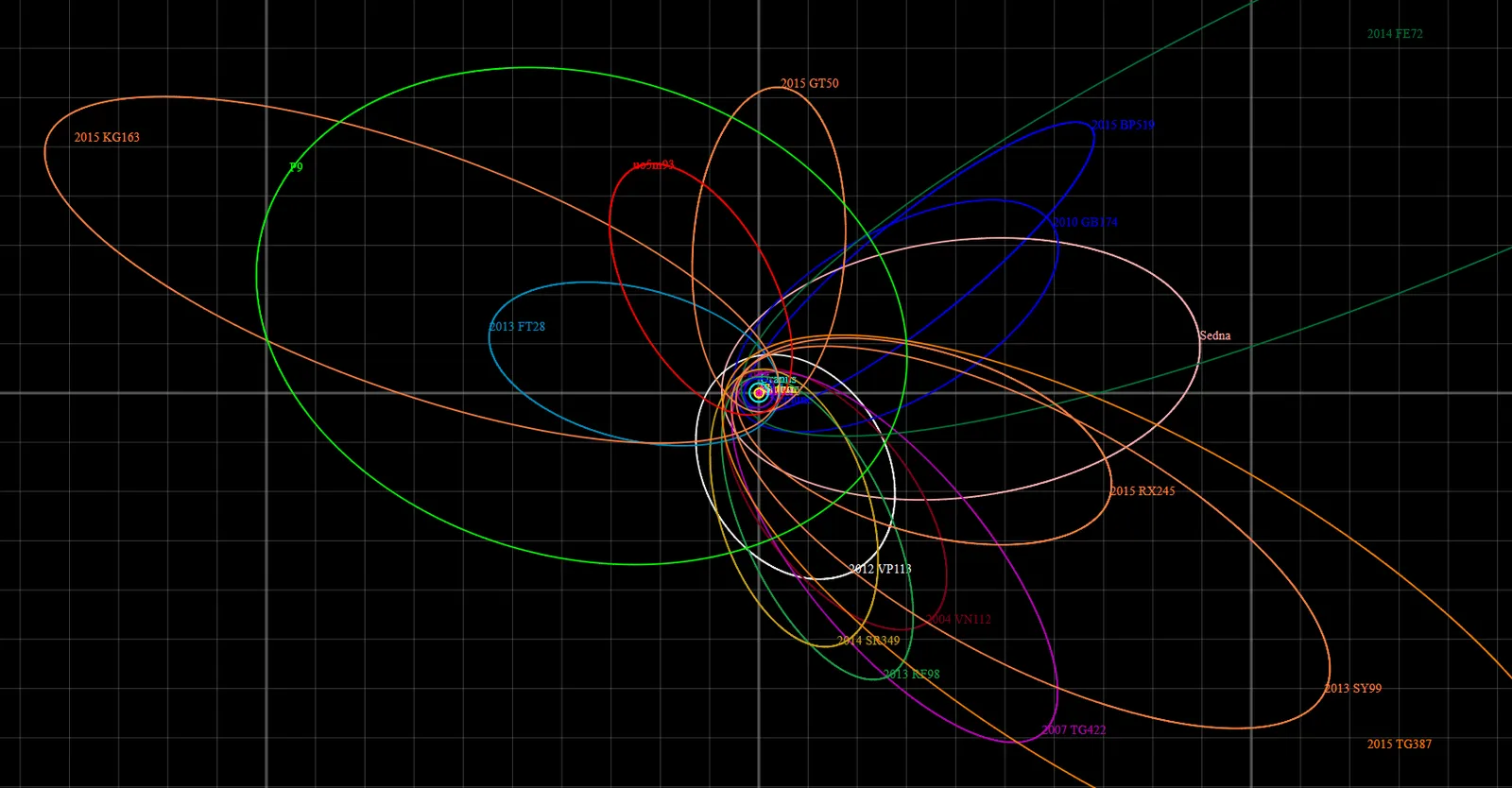
By the early 2000s, survey technology had improved enough that astronomers could systematically scan the outer solar system in ways that hadn't previously been possible. What they started finding was odd. Objects on peculiar elongated orbits, swinging far out into the dark and then back in again. Sedna was the first object that genuinely had no business being where it was, found in late 2003 on an orbit so strange it didn't fit any existing model. More followed. By 2014 something stranger was becoming clear. What they shared, these bodies known as extreme trans-Neptunian objects, were orbits that clustered. That word does not do justice to how strange this was. Tilted in similar directions, their closest solar approaches bunched together in the same region of sky. The probability of that being coincidence worked out at around 0.007 percent. Something was doing this to them.
The hypothesis
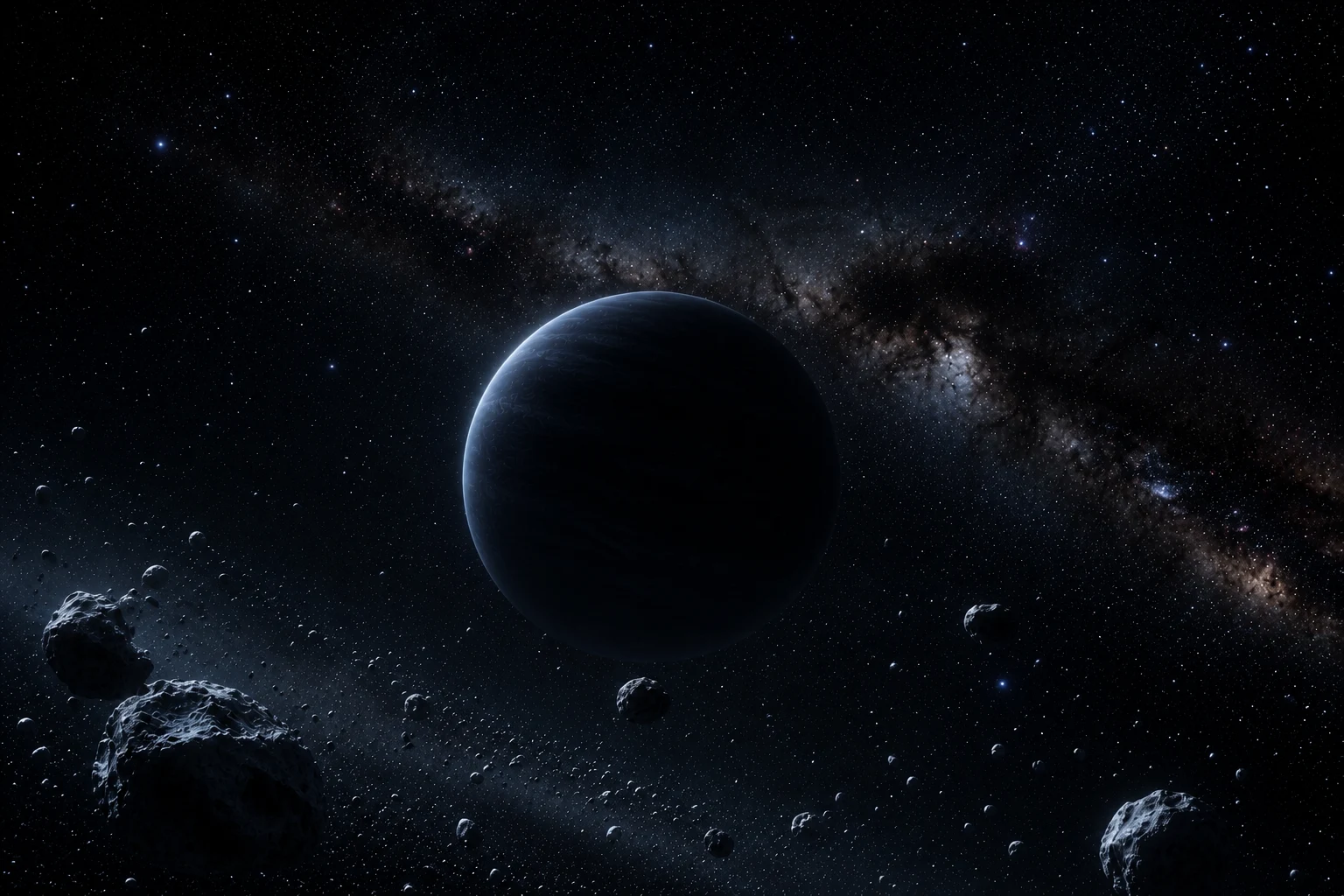
Batygin and Brown proposed an explanation: a planet, far beyond Neptune, massive enough to be gravitationally herding these objects into line. The scale of what they were describing is worth pausing on. Their model predicted a world five to ten times the mass of Earth, on a highly elongated orbit taking ten to twenty thousand years to complete. At its farthest point it would be perhaps 1,000 times the Earth-Sun distance away (ten times further than the boundary where the Sun's own solar wind gives out), and at that distance it would reflect so little sunlight that detecting it would be close to impossible with existing technology. Nobody has seen it. Nobody has come close.
The man who killed Pluto
In 2005 Mike Brown found Eris sitting out in the Kuiper Belt, a world roughly the size of Pluto. Brown is a professor of planetary astronomy at Caltech and has spent much of his career hunting objects at the far edge of the solar system. Most of the time, nothing turns up. That find created an immediate problem. The problem was Pluto. It triggered the vote that stripped it of its planetary status, a decision that still annoys a significant portion of the public and, one suspects, a few astronomers. Brown did not appear troubled by this. His response was to write a book called How I Killed Pluto and Why It Had It Coming. Not the title of someone who feels bad about it. He is not prone to understating things, which is precisely why his confidence in Planet Nine is worth paying attention to.
The strongest case yet
In April 2024 Brown and Batygin published what they called their strongest case yet, which is a confident thing to say about a planet nobody has seen. This time they were looking at seventeen bodies whose orbits are so extreme they actually cross Neptune's path at their closest approach to the Sun. Orbits like that should not exist. Neptune's gravity should have thrown them out long ago. The fact that they are still there, on those specific trajectories, needs explaining, and Planet Nine is the explanation that fits. Take it out of the simulations and the orbits stop making sense. Put it back in and the models work.
The sceptics
The main objection has always been observational bias, and it is a serious one. Surveys of the outer solar system have not covered all of it. If searches have been concentrated in certain regions, the objects found will naturally appear to cluster there, because that is where astronomers were looking. The apparent pattern might be saying something about the limits of the search rather than about a distant planet.
In 2021 Kevin Napier at the University of Michigan led a team that looked at three major survey projects and concluded the clustering was consistent with random distribution once bias was properly accounted for. Planet Nine was not required by the data. Brown and Batygin disputed the methodology. The disagreement has not been resolved, and argument alone will not settle it.
The alternatives
Stranger alternatives have been proposed. Two physicists suggested in 2020 that the culprit might be a primordial black hole, not a planet at all. A tiny ancient remnant from the first moments after the Big Bang, sitting undetected somewhere out there. There is actually a dedicated search programme looking for it, which tells you how seriously some people are taking the idea. A separate group has proposed a diffuse ring of smaller icy objects with enough combined gravitational pull to explain the clustering without requiring anything planet-sized. Both alternatives exist. Neither has been found either.
Where things stand
The question is genuinely open in a way that most headlines have not conveyed. Brown has said he considers it very unlikely that Planet Nine does not exist. Pedro Bernardinelli is an astronomer at the University of Washington who has spent considerable time conducting the kind of painstaking survey work that a Planet Nine detection would actually require. He has looked, seriously and at length. He is fairly convinced it is probably not there. He also says it would be foolish not to keep looking. That disagreement between two serious researchers is a more accurate picture of the field than most coverage suggests. Nobody has this settled. Yet things could change soon with the arrival of a new telescope.
The telescope
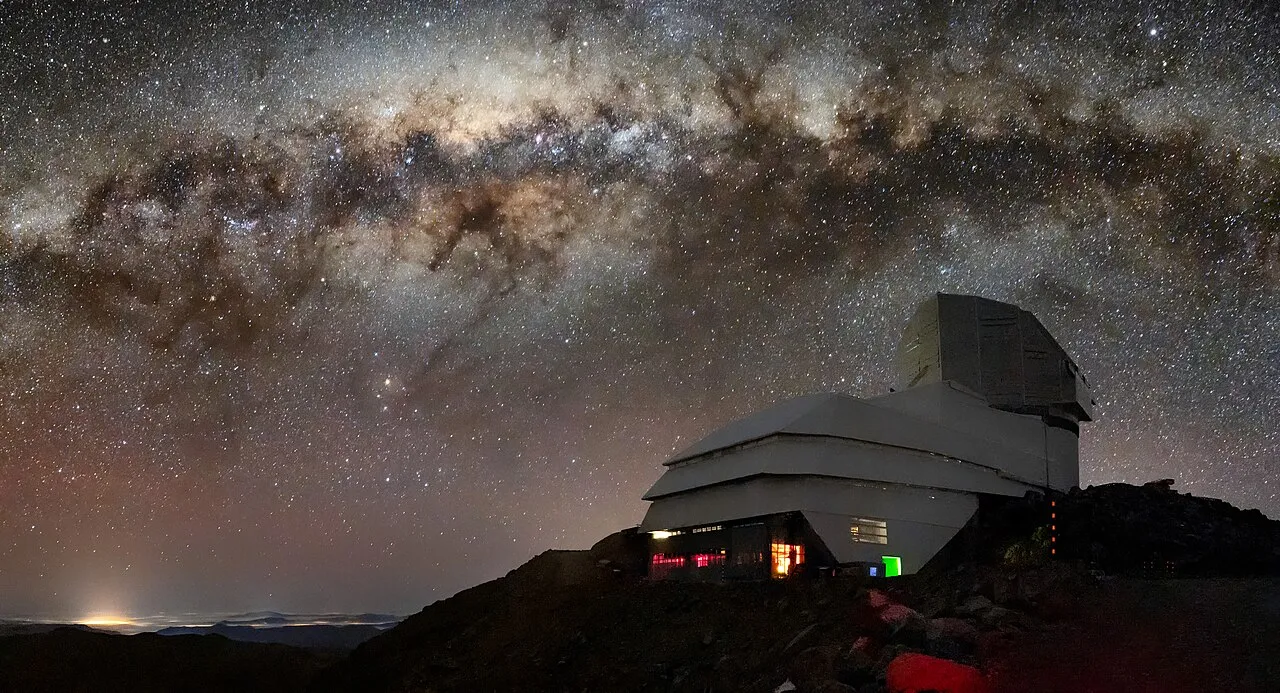
The Vera C. Rubin Observatory in Chile achieved first light in June 2025, and results are only just beginning to arrive. Its ten-year southern sky survey is now underway, imaging the entire available sky every few nights with the largest digital camera ever built for astronomy. What matters is sensitivity: it can pick up objects at the distances and brightnesses Planet Nine is predicted to occupy, which previous surveys could not. Scott Sheppard of Carnegie Science has put the odds of finding it with Rubin at seventy to eighty percent. Megan Schwamb at Queen's University Belfast has said the survey should settle the question within its first year or two.
Why it matters
A very large cold object at an enormous distance does not obviously affect anything. But if Planet Nine exists and is found, the solar system's origin story gets considerably more complicated. Batygin and Brown have suggested it may be the stripped core of a giant planet, something like a proto-Neptune, thrown outward by Jupiter's gravity in the chaos of the early solar system. If that is right, the eight planets we can see are not the solar system as it was always going to be. They are what survived.
If it does not exist, the clustering of these distant objects is either coincidence, observational bias, or something our gravitational models cannot yet account for. None of those is a comfortable answer. The telescope is running. The survey has started. After decades of a theory that kept returning without resolution, we may be close to finding out.
Frequently Asked Questions
What is Planet Nine?
Planet Nine is a hypothetical planet proposed by Caltech astronomers Konstantin Batygin and Mike Brown in 2016. Their model predicts a world five to ten times the mass of Earth orbiting at the far edge of the solar system, roughly 1,000 times further from the Sun than Earth. No one has detected it yet.
What is the evidence for Planet Nine?
A cluster of distant objects known as extreme trans-Neptunian objects have orbits that tilt in similar directions and bunch together in the same region of sky. The probability of that pattern occurring by chance is around 0.007 percent. Planet Nine's gravity is the leading explanation for why they behave this way.
Why hasn't Planet Nine been found?
At its predicted distance, Planet Nine would reflect so little sunlight it would be effectively invisible to most telescopes. Previous sky surveys lacked the sensitivity to detect objects at that range. The Vera C. Rubin Observatory, which began its ten-year southern sky survey in 2025, is the first instrument capable of finding it.
Will we find Planet Nine soon?
Possibly. The Vera C. Rubin Observatory is now scanning the entire available sky every few nights. Scott Sheppard of Carnegie Science puts the odds of finding Planet Nine with Rubin at seventy to eighty percent. Astronomer Megan Schwamb has said the survey should settle the question within its first year or two.
◆ Also In The Stars

◆ Go Deeper
Recommended
Affiliate links — we may earn a small commission at no cost to you.