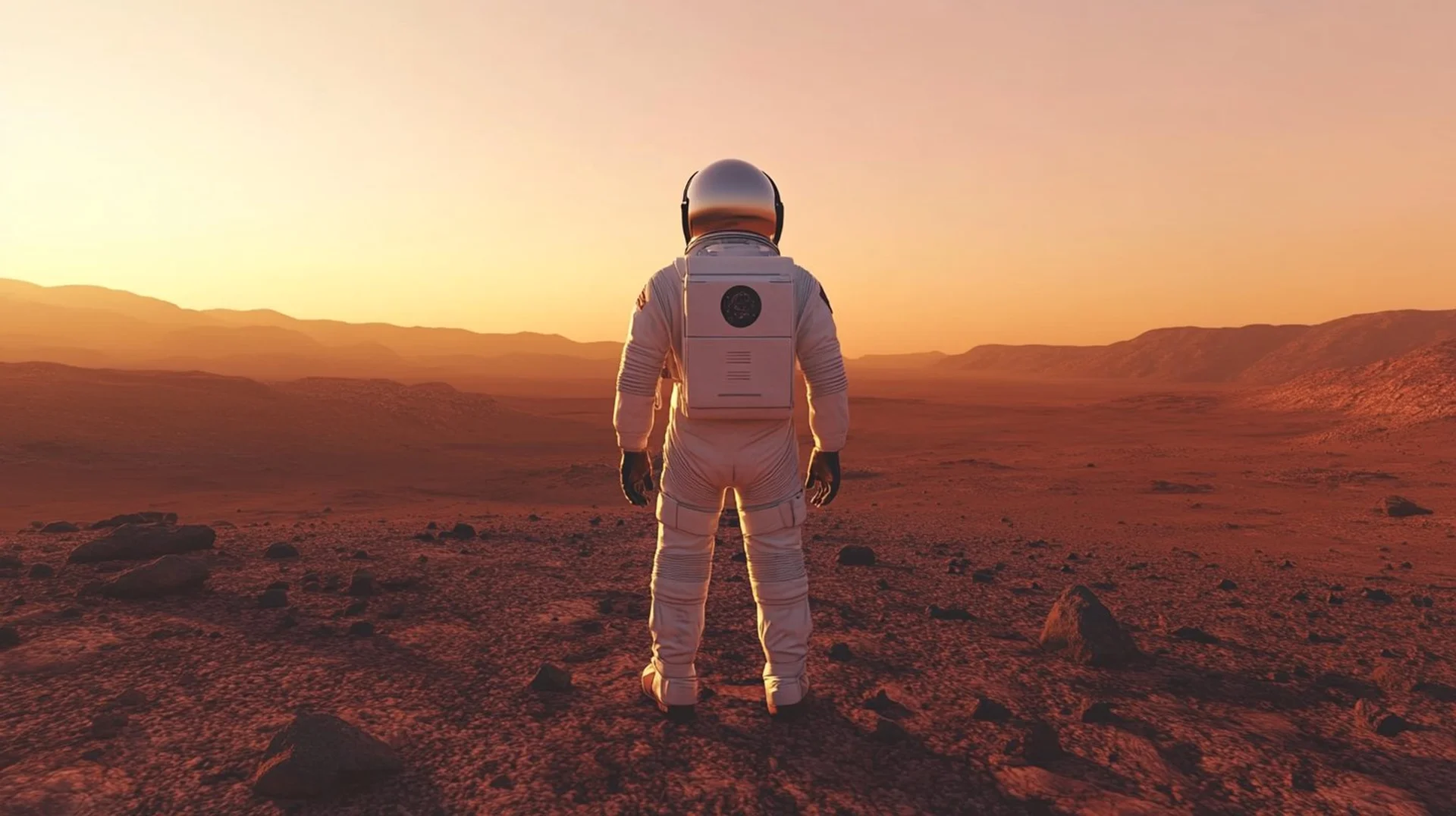
The first humans on Mars will arrive knowing they cannot come home. Not because anything has gone wrong, but because that is how the mission is supposed to work.
◆ In Summary
A mission to Mars is not just about getting there. Current mission plans would require astronauts to spend around 500 days on the Martian surface before the planets align for the journey home. The challenge is not landing. It is staying healthy, productive and psychologically resilient while living in isolation on another world.
A Year on Mars: Life on the Martian Clock
A year on Mars is not a year on Earth. It is closer to seventeen months, which is a different proposition entirely. The first crewed mission to reach the Martian surface, whenever it happens (the current realistic estimate is the late 2030s, and realistic is doing a lot of work in that sentence), will not be in a position to simply turn around and come home when the crew feels like it. The planets have to line up. Until they do, the surface is where the crew stays. Planetary mechanics do not negotiate.
The journey out takes roughly seven months. Then comes the wait. Around 500 days on the surface before the orbital window reopens and the return journey becomes possible. That is where the maths gets interesting. Four to six people, a pressurised habitat the size of a generous shipping container, everything they need either shipped ahead in cargo landers or waiting on their backs. They land. They work. They do not leave.
So imagine the anniversary. Day 365. Someone on the crew marks it somehow (there will be a designated morale officer, this is not a detail mission planners are leaving to chance). A meal that approximates something celebratory. A message from Earth arrives, delayed by the current transmission lag: at maximum separation, signals take around 22 minutes one way, which means a conversation with Houston is already an archaeological exercise before it begins. The crew drinks something notionally festive, checks the mission clock, and registers what the mission clock says. Roughly 135 days to go before the launch window. Five and a half months. About as far away as it was when they landed.
The Physical Cost of Staying
The physical reality of that much time in that environment is not something mission planners have fully solved. Bone density loss runs at roughly one to two percent per month without aggressive countermeasures, and the crews on the International Space Station have been working the exercise-and-resistance-loading problem for decades. They get resupplied regularly and rotated home. A Mars crew does not. Muscle atrophy, cardiovascular deconditioning, the particular misery of what prolonged radiation exposure does to the immune system: these are not theoretical concerns. They are the actual reason the 2030s estimate keeps slipping. The science of keeping four people functional for two years in a habitat with no meaningful atmospheric shielding is not finished yet.
The Psychology of Isolation
There is also the psychological question, which tends to get less column space than the engineering but may matter more. Isolation research run through NASA's HERA facility in Houston and the various Mars-analogue missions conducted in Utah and Hawaii has produced consistent findings: around month eight or nine, crew cohesion tends to develop what researchers diplomatically call "third-quarter effects." The energy of arrival is gone and the end is not yet visible. People get irritable. Small frictions become larger ones. On Earth, you can go for a walk. On Mars, going for a walk involves a suit-up procedure that takes the better part of an hour, a buddy system that means you never actually go alone, and the persistent awareness that the atmosphere outside is 95 percent carbon dioxide at a pressure that would kill you in under two minutes. Privacy is not available. The sky is salmon-pink and the sunsets are blue and eventually even that stops being remarkable.
Day 365 passes like any other Tuesday. The window home is still five months away. The sky outside is still salmon-pink. Someone makes coffee, checks the mission clock, and gets back to work. There is not much else to do.
Frequently Asked Questions
What is a year on Mars?
A Martian year lasts 687 Earth days, almost twice as long as a year on Earth. This is because Mars takes longer to complete one orbit around the Sun.
How long would astronauts stay on Mars?
Current mission concepts typically require astronauts to remain on Mars for around 500 days before the planets align for the return journey.
Why can't astronauts leave Mars whenever they want?
Earth and Mars must be in the correct positions for an efficient return flight. Missing the launch window could add many months to the journey home.
What are the biggest dangers of living on Mars?
Radiation exposure, muscle and bone loss, equipment failures, isolation, and limited medical support are among the most significant risks.
When could humans realistically live on Mars?
Most current projections place the first crewed Mars missions in the late 2030s or later, although schedules continue to shift as technical challenges are solved.
◆ Also In The Stars
◆ Go Deeper
Recommended
Affiliate links — we may earn a small commission at no cost to you.