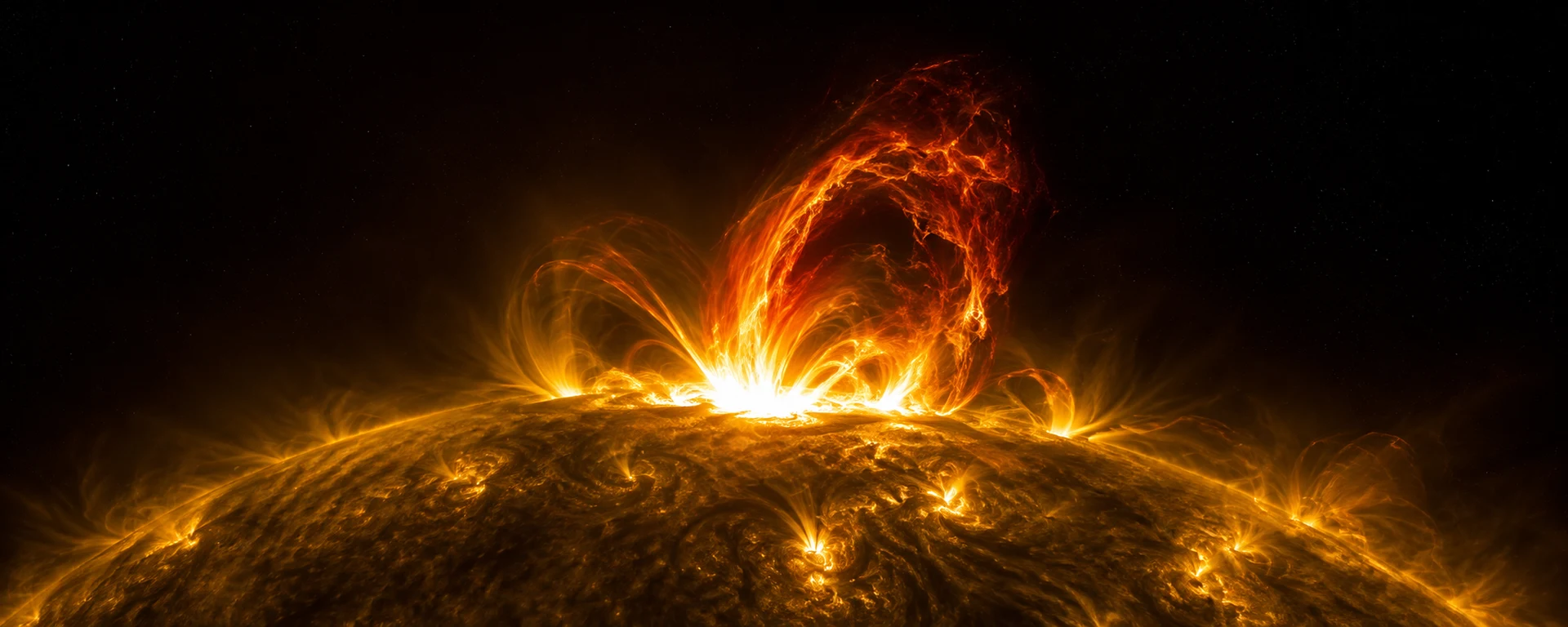
A single solar flare can release the energy of a billion hydrogen bombs in minutes, and during an active solar maximum the sun can produce one roughly every month.
◆ In Summary
A solar flare is an intense burst of radiation released when the sun's tangled magnetic field snaps and reconnects, and the strongest kind, X-class, can occur roughly once a month during an active solar maximum, though far less often across a full 11-year cycle. NASA and NOAA classify flares on an A to X scale, each letter ten times stronger than the last, tracked in real time by satellites in orbit because the flare's own X-rays never reach the ground. Every flare emits radiation; some are also accompanied by energetic particles or a coronal mass ejection, which can add further risks to astronauts, satellites, power grids and communications. The strongest flare ever recorded, in 2003, overwhelmed the sensor measuring it before anyone found its true peak. What starts as a burst of light on the sun's surface can end, days later, as a very different kind of problem on Earth.
◆ At a Glance
| Definition | Intense burst of radiation from the Sun's surface |
| Classification scale | A, B, C, M, X (each class 10x the last) |
| Strongest ever recorded | X28, 2003 (sensor saturated before true peak) |
| X-class frequency | Roughly 50–175 per 11-year solar cycle, depending on how active it is |
| Primary monitoring | NOAA GOES satellites (X-ray sensors, geostationary orbit) |
| Imaging | NASA Solar Dynamics Observatory (extreme ultraviolet) |
| Direct danger to people on the ground | None; risk is to ionosphere-dependent systems |
The sun spent the first four days of February 2026 in a state forecasters called solar chaos. One patch of its surface, an active region catalogued as AR4366, fired six X-class flares in that span, the strongest category there is, then kept going until it had produced 65 flares in total before rotating out of view.
Flares of some kind are common: the sun produces roughly one a day at solar minimum, rising to around twenty a day near solar maximum, almost all of them minor. X-class flares, the kind AR4366 kept producing, are far rarer: somewhere between fifty and a couple of hundred across an entire 11-year solar cycle, depending on how active it turns out to be, almost all of them clustered around the handful of years near solar maximum. The sun is currently six years into Solar Cycle 25, the twenty-fifth complete cycle recorded since systematic sunspot tracking began in 1755. It is now past the solar-maximum period announced by NASA and NOAA in October 2024. But as AR4366 demonstrated, individual bursts of extreme activity, sometimes the biggest of a whole cycle, often arrive well after that statistical peak rather than exactly at it.
What Is a Solar Flare?
A solar flare, in NASA's own words, is an intense burst of radiation on the Sun, a flash spanning the electromagnetic spectrum from X-rays and gamma rays through radio waves to ordinary visible light.
A flare unfolds in stages. The magnetic instability behind it can build for minutes before anything happens. The release itself, once the field actually snaps, is explosive: peak brightness can be reached in as little as a few seconds. What follows is the decay phase, the X-ray and ultraviolet emission fading gradually as the heated plasma cools, and that fade can take hours even after the flare's dramatic peak has already passed. Fast to detonate, slow to die down.
How Solar Flares Are Monitored
Most of what a flare emits is invisible; X-rays and gamma rays sit outside what a human eye can register. There is a visible-light component too, and on the rare flare bright enough, it shows up directly to a properly filtered telescope. Most flares aren't that bright. Eyes were never going to be the main instrument here. Satellites do that work instead, catching the invisible wavelengths and measuring the visible ones with far more precision than any observer could manage. Much of what we know about a flare in real time, including its class, timing and structure, comes from satellite observations.
NOAA's GOES satellites do the actual workhorse job, parked in geostationary orbit with X-ray sensors that watch the sun round the clock; every letter and number attached to a flare traces back to one of their readings. NASA's Solar Dynamics Observatory supplies the pictures rather than the numbers, high-resolution extreme ultraviolet footage from the same orbital neighbourhood, which is where the dramatic close-up flare footage tends to come from. Ground-based observatories still watch too, mostly sunspots rather than flares themselves. Genuinely useful work, just not quite as explosive!
The A to X Scale Explained
Flares are graded on a five-letter scale: A, B, C, M, X, each one representing a tenfold increase in peak X-ray flux over the last, so X-class sits a hundred times above C and ten times above M. It's the same logic as the Richter scale, and the comparison holds, mostly. Where the comparison breaks down is the number after the letter. That part climbs in a straight line, not another tenfold step, which is why NOAA logs flares as decimals rather than whole numbers, X1.9, X2.4, figures the Richter scale would never produce.
Unlike the Richter scale, X has no ceiling. The strongest flare ever recorded, in 2003, overwhelmed the GOES sensor measuring it before the flare had even finished. The detector maxed out. What's on record as X28 is a reconstructed estimate, pieced together afterwards, not a number the sensor ever actually read. The true peak was almost certainly higher. Nobody has ever been able to say by how much.
Radiation, Particles and CMEs: What a Flare Can Send Our Way
Every flare, without exception, emits radiation. That is what makes it a flare rather than anything else happening on the sun's surface. That radiation alone is enough to cause a radio blackout. X-rays and extreme ultraviolet from the flare disturb the ionosphere, and high-frequency, or HF, radio depends entirely on a stable one. It's the band long-distance aviation and maritime communication still lean on, precisely because it bounces off the ionosphere and travels well beyond line of sight, so when the ionosphere gets disturbed, that's the first thing to go. GPS accuracy degrades too. NOAA tracks this on its own R-scale, R1 to R5, a companion to the G-scale used for geomagnetic storms. NASA is explicit that this radiation poses no direct threat to anyone standing on the ground, Earth's atmosphere absorbs it entirely; the risk is to systems that rely on a stable ionosphere, not to people.
Some flares are also accompanied by an outward ejection of actual matter, a separate consequence of the same magnetic reconnection, not guaranteed by every flare regardless of size. A solar energetic particle event throws protons and electrons outward at speed, arriving in tens of minutes to hours, and is the main hazard to astronauts, including the Artemis II crew, who travelled beyond Earth's protective magnetosphere during their ten-day lunar mission, and high-altitude polar flights. A coronal mass ejection (CME) throws billions of tons of plasma and magnetic field outward, arriving a day or two later, and is what threatens ground infrastructure, inducing current in power lines, pipelines and undersea cable repeaters.
Neither is guaranteed by a flare's letter class. An X-class flare can happen with no ejection at all. A comparatively modest M-class flare can carry a serious CME. The letter measures the radiation. It says nothing about what, if anything, is riding alongside it.
Why the Sun Does This
The sun spins faster at the equator than at the poles, a pattern called differential rotation (possible in the first place because the sun is gas, not a solid body, so it doesn't have to rotate as one rigid piece). That mismatch does something violent to the magnetic field underneath. Picture a rope twisted from both ends until it kinks: the field winds the same way, tighter with every rotation. Sunspots are where it first shows, the twisted field forcing its way through the surface. They're darker because they're cooler than the plasma around them, and they sit there holding magnetic energy with nowhere obvious to go.
Eventually the rope reaches the point where it can't hold any more twist. The field snaps, reconnects into a lower-energy shape, and the energy stored in all that winding goes out in one burst. That burst, travelling outward as light, is the flare itself.
That mechanism, on its own, is just physics. What makes it worth paying attention to is what a flare's more energetic cousins, the coronal mass ejections that don't always come along for the ride but sometimes do, are capable of doing once they reach a planet as wired together as this one. One less obvious piece of infrastructure potentially exposed to a severe event is the undersea cable network the internet itself runs through, largely invisible, rarely discussed, and never yet tested against anything close to a worst case. That is the question the follow-up article takes on.
Frequently Asked Questions
What is a solar flare?
A solar flare is an intense burst of radiation from the sun's surface, released when the sun's tangled magnetic field suddenly snaps and reconnects. It spans the electromagnetic spectrum, from X-rays and gamma rays through to radio waves and visible light, and can build in seconds before fading over hours.
What causes a solar flare?
Solar flares are caused by the sun's differential rotation, spinning faster at the equator than the poles, twisting the magnetic field around sunspots until it reaches a breaking point. When the field snaps and reconnects into a lower-energy configuration, the stored magnetic energy is released as a burst of radiation.
How are solar flares classified?
Solar flares are classified on an A, B, C, M, X letter scale, similar to the Richter scale, where each letter represents a tenfold increase in energy over the last. Classification is based on X-ray brightness measured by NOAA's GOES satellites, with a number after the letter indicating strength within that class.
Can a solar flare harm people on Earth?
The radiation from a solar flare itself poses no direct threat to people on the ground, since Earth's atmosphere absorbs it completely. The real risk comes from what sometimes accompanies a flare: energetic particles that threaten astronauts and polar flights, or a coronal mass ejection that can damage power grids, satellites and undersea internet cables.
◆ Also In The Stars

◆ Go Deeper
Recommended
Affiliate links — we may earn a small commission at no cost to you.