It tracked five planets, predicted eclipses and ran on gears precise enough to model the moon's uneven orbit. Nothing else came close until medieval Europe.
◆ In Summary
The Antikythera mechanism is a hand-cranked bronze computer built around 100 BC and recovered from a Greek shipwreck in 1900. It could predict solar and lunar eclipses, track the positions of all five visible planets and calculate the dates of the ancient Olympic games. The nearest comparable technology in European history does not appear until the astronomical clocks of medieval Europe, roughly 1,400 years later. Two thirds of the original device is still missing.
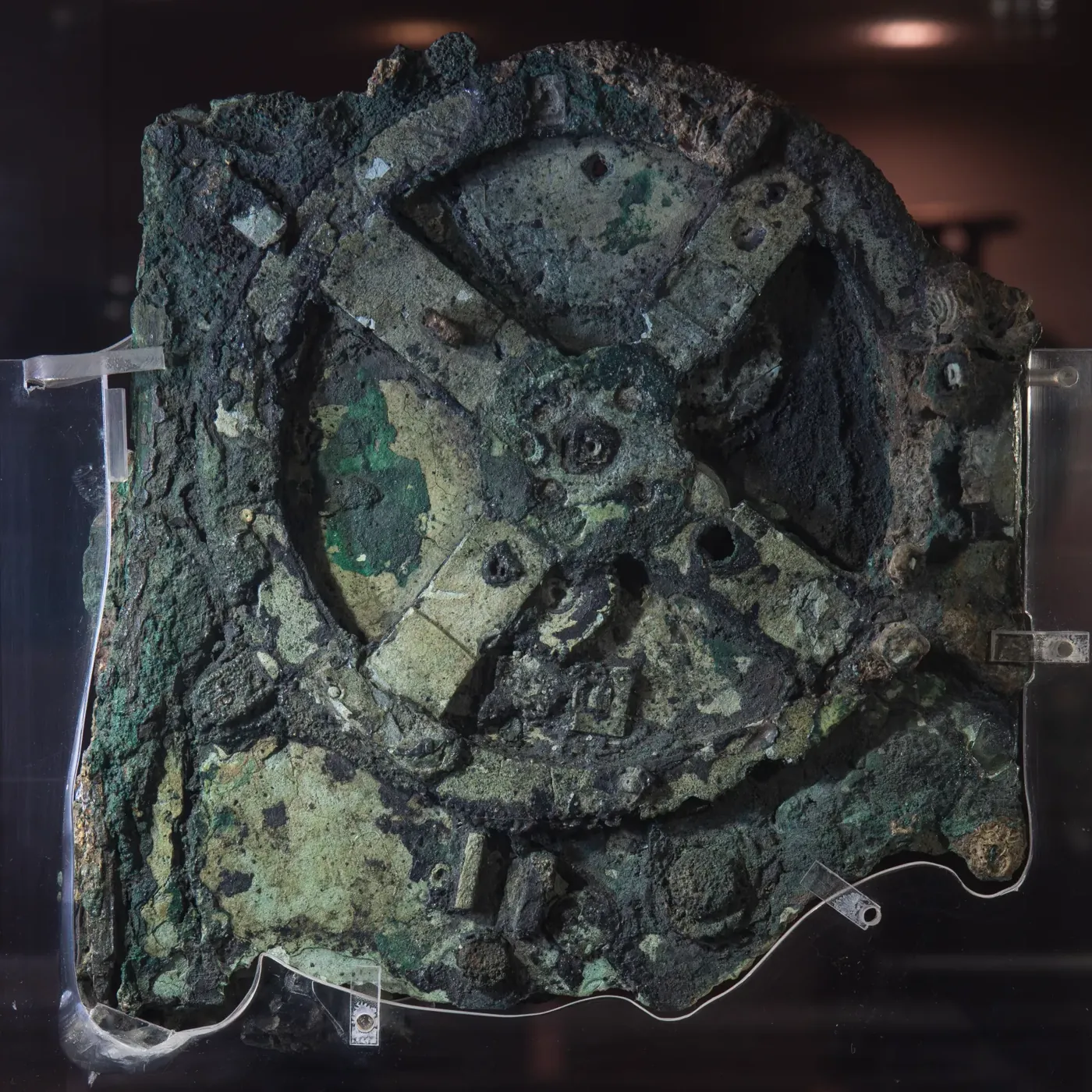
The Antikythera mechanism came up from the sea in 1901 as an unremarkable lump of corroded bronze, one more piece of metal salvage among the bronze statues, marble figures and glassware the wreck was yielding. Nobody looked twice.
It sat in the National Archaeological Museum in Athens for the best part of a year before a gear wheel, cracked loose from the surface, caught the eye of the archaeologist Valerios Stais in 1902. Precisely cut, interlocking bronze gears, miniaturised and stacked in a configuration that had no business existing in 100 BC. It took the better part of a century for anyone to work out what it was. The answer, when it came, suggested our picture of the ancient world was not as complete as we had hoped.
What Is the Antikythera Mechanism?
The Antikythera mechanism is the oldest known analogue computer, which is not what you would necessarily expect to find in a two-thousand-year-old Greek shipwreck. The mechanism was, in essence, a hand-cranked calculator for the sky. Turn the handle and it could predict eclipses, track the Olympic games calendar and model the variable speed of the moon's orbit. That last capability still surprises researchers, because reproducing the moon's variable speed mechanically requires a level of sophistication that nobody expected to find in a device from 100 BC.
The nearest comparison in European history does not arrive until the astronomical clocks of medieval Europe, roughly fourteen hundred years later. That gap is worth sitting with for a moment. Extraordinary is the more honest word, and the one that keeps appearing in the academic literature is "anomaly," which is the polite version of "we have no idea how this fits."
How it worked
The front face showed the positions of the sun and moon against the zodiac, driven by a hand crank. Move it forward and the pointers advanced. Move it backward and you were doing astronomy in reverse, finding where the moon had been rather than where it was going.
The back was more complicated. Two spiral dials tracked the Metonic cycle and the Saros cycle. The Metonic runs nineteen years, the period after which lunar phases fall on the same calendar dates again. Knowing that was useful for anyone trying to plan around religious festivals or agricultural seasons. The Saros was a different calculation entirely, 223 months, built specifically for eclipse prediction. The Saros dial had a subsidiary indicator showing what kind of eclipse was expected and whether it would be visible. Every feature here served a function: this was a working instrument for people who needed to know, in advance, when the sky was going to do something significant.
A smaller dial tracked the four-year cycle of the Panhellenic games. The Olympics, the Pythian, the Isthmian, the Nemean, the four great games festivals of the ancient Greek world, all accounted for, which suggests whoever commissioned this needed it for practical scheduling as much as celestial calculation.
The moon presented a specific engineering problem. It does not travel at a constant speed. It accelerates and slows as it moves through its elliptical orbit, which is something the Greeks had observed and described mathematically but which is genuinely difficult to reproduce mechanically. The mechanism solved it with a pin-and-slot device that caused one gear to drive another at a varying rate. It is an elegant solution. It works. Researchers who finally understood it in the twentieth century said so with what reads, in the dry language of academic papers, like barely concealed amazement.
Who built it
The ship sank somewhere around 60 to 70 BC, travelling from the eastern Aegean toward Rome. Where the mechanism was made, and by whom, the wreck cannot say.
Rhodes is the leading candidate. The island was a serious centre of astronomical learning in the Hellenistic period. Posidonius, the philosopher who lived and worked there in the first century BC, was known to have built mechanical models of celestial motion. Cicero says he saw one himself: a bronze sphere built by Posidonius in Rhodes that reproduced the motions of the sun, moon and five planets. He also describes a second device, attributed to Archimedes and brought to Rome as war booty after the fall of Syracuse. The mention comes from a philosophical treatise, not one of his speeches, which is the context where he was least likely to be embellishing for an audience. Take him at his word, and at least two machines like this existed before this one went down with a ship bound for Rome. Almost nothing else about either of them survived.
Archimedes gets mentioned regularly. He died in 212 BC, a century before the mechanism was probably made, but ancient sources describe him building a mechanical planetarium and the mathematics embedded in the device sits comfortably within the tradition he founded. The connection is unprovable. It keeps being made anyway.
What the scans found
The Antikythera Research Team, drawing on researchers from University College London, Cardiff University and elsewhere, has spent years doing things to the surviving fragments that would not have been possible a generation ago. X-ray tomography revealed internal structures that had been invisible since the device was new. Polynomial texture mapping recovered inscriptions that two thousand years of seawater had rendered illegible.
In 2021 they published a reconstruction of the front panel that revised everything previous analyses had assumed. Five pointers on the front face, not fewer, tracking the sun, the moon and all five planets visible to the naked eye, each running on its own epicyclic gearing. Mercury, Venus, Mars, Jupiter, Saturn, all accounted for in a box roughly the size of a modern laptop, which makes the fact that two thirds of it is still missing feel like a particular kind of loss.
The back cover, which apparently carried instructions for using the device, is only partially recovered. There is considerably more to learn.
The knowledge that was lost
Here is the question the mechanism raises that nobody has satisfactorily answered: why did nothing else like it survive?
The standard explanation runs through the fall of Rome, the burning of libraries, the fracturing of Mediterranean trade networks that had kept Greek intellectual life connected and funded. All true. Mechanical traditions require institutional continuity; break the chain and the knowledge goes with it. It's the same pattern that swallowed the Sibylline Books, another body of knowledge that depended on a small number of people and a chain that only had to break once. The people who built the next generation of astronomical clocks in medieval Europe had no idea this device had ever existed. They invented their versions from scratch, a millennium after someone else had already got there.
What the mechanism does, sitting in its case in Athens, is make that gap visible. It is evidence that the past was not a steady climb toward the present, that knowledge can peak and vanish and leave no trace except occasionally on the seabed.
The sponge diver was looking for sea creatures. He found the most sophisticated machine the ancient world ever made. It took another hundred years to understand it, and there are still parts of it nobody can explain. Let's hope another diver gets lucky.
Frequently Asked Questions
What is the Antikythera mechanism?
The Antikythera mechanism is an ancient Greek analogue computer built around 100 BC. It was recovered from a shipwreck off the island of Antikythera in 1900 and is now held at the National Archaeological Museum in Athens. It used a system of interlocking bronze gears to predict eclipses, track planetary positions and calculate the timing of the ancient Greek games festivals.
How old is the Antikythera mechanism?
The mechanism dates to approximately 100 BC, making it roughly 2,100 years old. The ship carrying it sank sometime between 60 and 70 BC. No comparable mechanical device appears in the historical record for another 1,400 years, until the astronomical clocks of medieval Europe.
What could the Antikythera mechanism do?
It could predict solar and lunar eclipses using the 223-month Saros cycle, track the positions of the sun, moon and all five planets visible to the naked eye, and calculate the four-year cycle of the Panhellenic games. It also modelled the variable speed of the moon's orbit using a pin-and-slot gear mechanism, a solution that still impresses modern engineers.
Who built the Antikythera mechanism?
The maker is unknown. Rhodes is the most likely place of origin, as it was a major centre of astronomical learning in the Hellenistic period. The philosopher Posidonius worked there and was known to have built mechanical models of celestial motion. Archimedes is sometimes mentioned, though he died a century before the mechanism was probably made.
◆ Also In The Stars



◆ Go Deeper
Recommended
Affiliate links — we may earn a small commission at no cost to you.