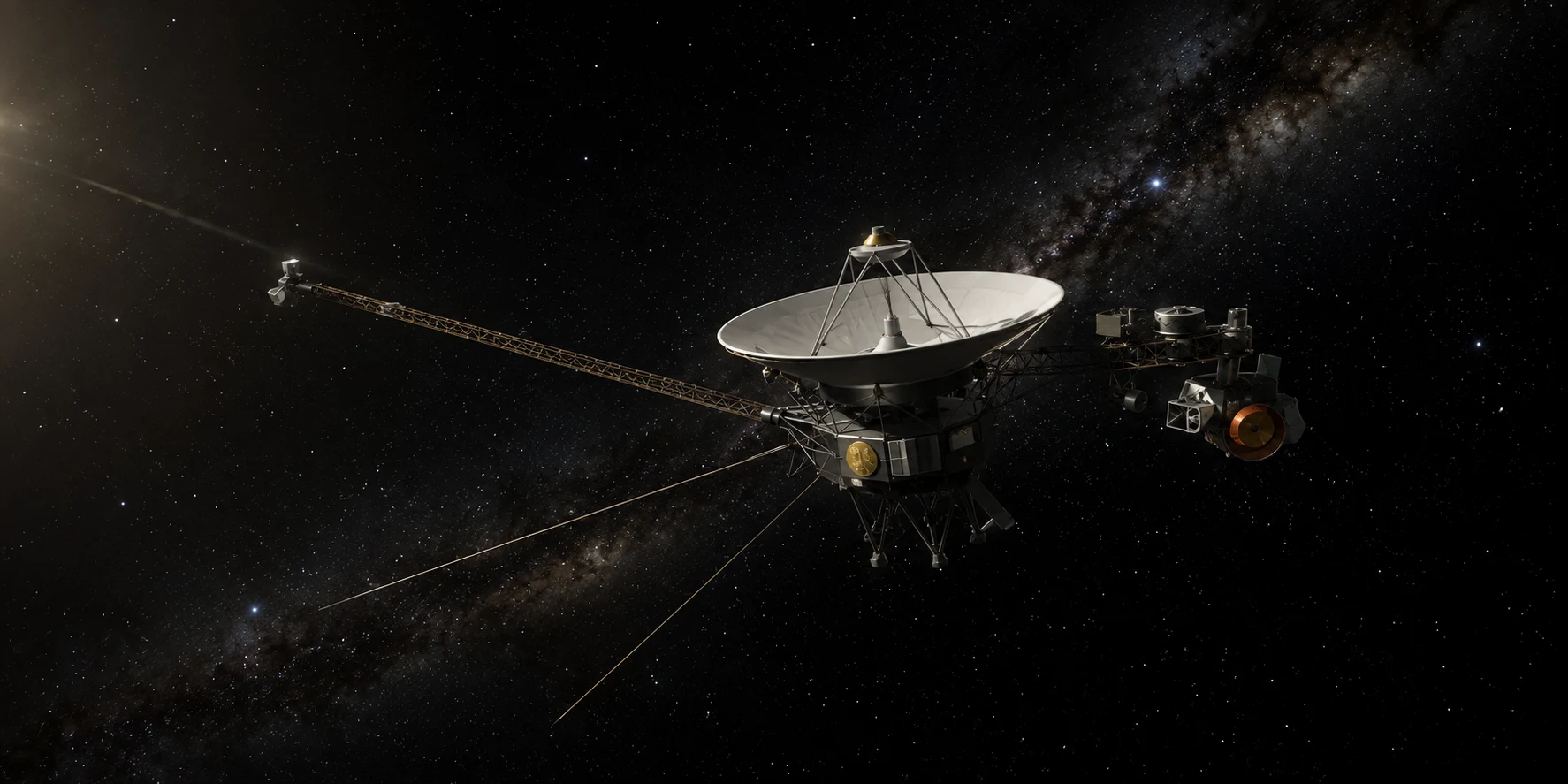
Launched with a message for any civilisation that might find them, Voyager 1 and 2 are now being kept alive four watts at a time.
◆ In Summary
Voyager 1 and 2 launched in 1977 to take advantage of a rare planetary alignment, riding on trajectories designed by Gary Flandro. Each carried a Golden Record, built in under a year and shaped in part by lessons learned from the earlier, more controversial Pioneer plaques. Between them, the probes visited all four gas giants, with Voyager 2 remaining the only spacecraft to reach Uranus and Neptune. Both later crossed the heliopause into interstellar space, Voyager 1 in 2012 and Voyager 2 in 2018, and both are still transmitting today, nearly 50 years after launch. With their power supply shrinking every year, the mission team is now managing a slow, irreversible decline, aiming to keep at least one instrument running on each probe into the 2030s.
Continuing the recent theme on the website, I wanted to explore the history of the only confirmed man-made objects to have crossed the heliopause. Voyager 1 and 2 are each currently around 16 billion and 13 billion miles respectively from Earth, each plotting a journey across interstellar space.
Voyager 1 and 2: A Symbol of Hope
The creation of these two probes represented a moment in time in the 1970s when there was a degree of negativity about space, the enthusiasm generated by the moon landing having long since evaporated. Voyager 1 and 2, as well as having specific scientific goals, were also a symbol of hope, a meaningful way of engaging the American and wider public with space, and an elegant way of providing a small signpost to our existence.
The Origins of the Grand Tour
The idea for a probe came about in 1965 when a graduate student working at JPL discovered there would be a rare alignment of Jupiter, Saturn, Uranus and Neptune in the coming years. Gary Flandro showed his discovery to his superiors and proposed a "Grand Tour" of the planets with four spacecraft being sent out to visit all four plus Pluto. Not keen on funding four probes, NASA ruled out visiting Pluto and eventually committed to sending the two that flew the mission.
Two Probes, Two Routes
The thinking behind having two probes addressed a couple of issues. The obvious one was having a second in case the first one failed. Having two probes would also allow them to assign different routes through the solar system. Voyager 2 would be sent out on a slower trajectory first, the JSX route, heading for Jupiter, then Saturn with the remainder of its journey dependent on Voyager 1's success or otherwise. Voyager 1 would follow the JST route, Jupiter first, then Saturn, followed by a close pass of Saturn's largest moon Titan. Even though it left second it would be the first to arrive at Jupiter, hence Voyager 1.
The probes themselves would be identical. Each would carry ten instruments which would enable the Voyagers to carry out a total of eleven investigations, including an ultraviolet spectrometer to gauge atmospheric composition, a plasma spectrometer to measure solar wind plasma and a magnetometer to measure magnetic fields.
The Golden Record
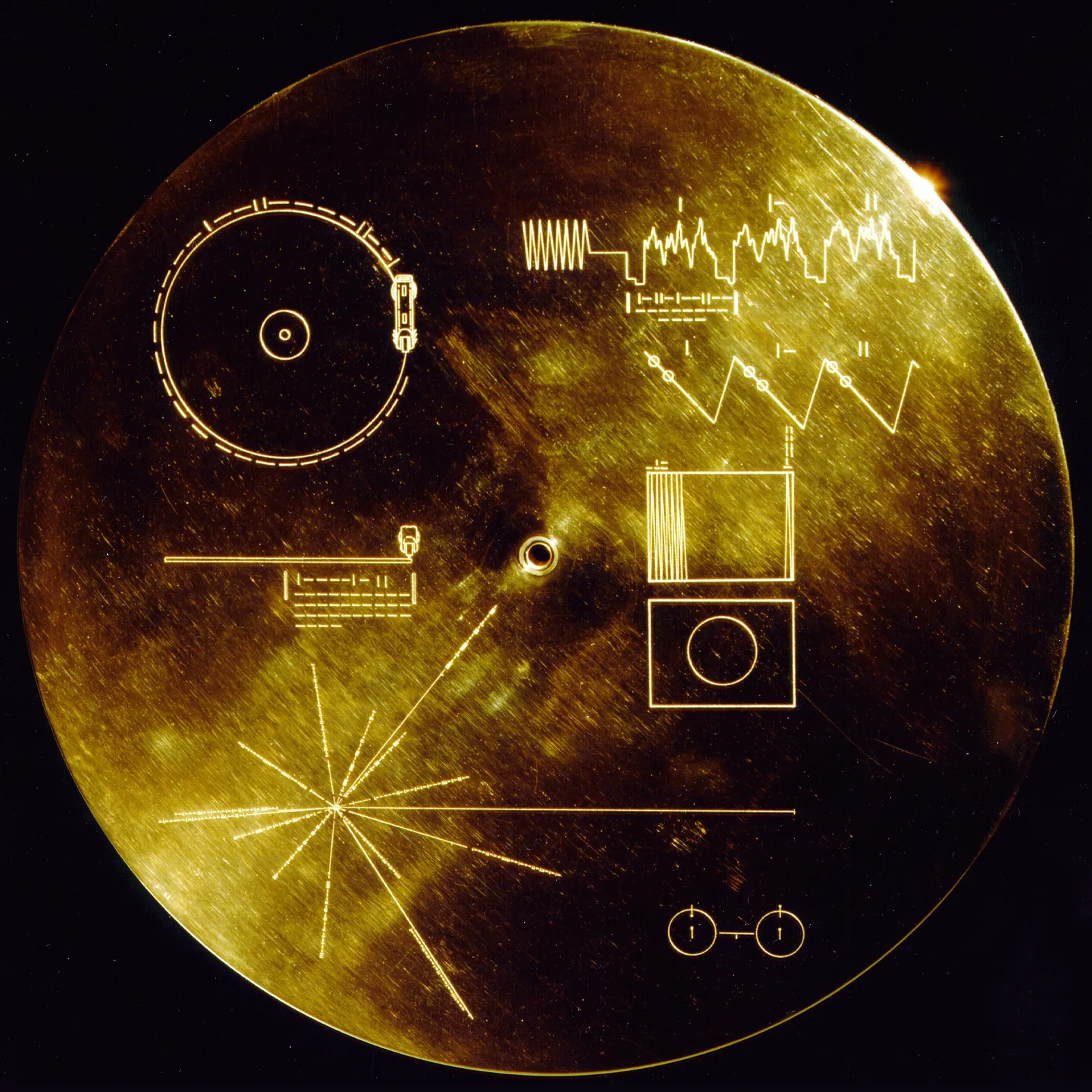
Now we get to probably the most famous aspect of this mission, the Golden Record.
The scientific aspects of the mission were one thing, but the part that really captured the imagination of the public was the idea of attaching a Golden Record to each probe; a literal record of our existence there for extraterrestrial life forms to discover in the future.
The notion of attaching a plaque to a probe wasn't a new one. Pioneer 10 and 11 had been the first to carry messages; Carl Sagan and Frank Drake among others had been heavily involved in deciding what the plaques would actually say, and when it came to what to put on the Voyager probes, John Casani, the project manager, knew they were the obvious people to ask.
In the limited amount of time they had before the launch of the Voyagers, those involved, particularly Sagan, had a notion that they wanted to go further than the Pioneer plaques. Sagan was keen to provide molecular biology information to show what humans were physically made of. This idea evolved into one of providing a "full-spectrum view of humanity."
One of the team, Ann Druyan, a writer serving as creative director on the project and future wife of Sagan, was the one to propose a phonograph record that would allow images and audio to be sent out with the probes.
This idea caught the imagination of the team and they set to work collating the material to make the most of the record.
The records on the Voyager probes borrowed some of the illustrations on the Pioneer plaques. A pulsar map and a hydrogen atom diagram survived and were prominent on the cover of the record. Some new additions were made including a binary hydrogen reference symbol and instructions showing how to play the record and how the images were encoded. They even included a sample of Uranium-238 to provide a way for any potential finder of the probe to work out how long it had been travelling.
One sticking point was what to do with the famous image of a naked man and woman on the Pioneer plaques. The Voyager team wanted to go further and include a real photograph of a naked man and pregnant woman. NASA, mindful of the backlash they had faced from the Pioneer illustration, refused.
A compromise was reached with the acceptance of a silhouetted picture of a man and pregnant woman and fetus to be included in the 116 images encoded into the record.
The audio content was a key part of the record. Music, voices and sounds from Earth gave a rich snapshot of humanity at that moment in time. Greetings in 55 languages, a whale call and sounds of nature were recorded. Songs were also added: "Johnny B. Goode" by Chuck Berry and a Georgian folk song "Tchakrulo".
Also encoded onto the record was a diagram showing vertebrate evolution featuring a naked man and woman. NASA, despite refusing to include a photograph of a naked man and woman, were satisfied that in this instance nudity was justified. There was even a recording of Druyan's brainwaves. She argues that it provided a different form of information. When her brainwaves were recorded, she said she was thinking about the man whose marriage proposal she had just accepted, Carl Sagan. They would marry several years later in 1981.
A final touch before launch was stitching a Dacron American flag into the thermal blankets.
Launch
Voyager 2 successfully launched on 20th August 1977 from Cape Canaveral, although there were some tense moments during its departure from Earth's atmosphere when it separated from the booster slightly too early. Just sixteen days later, Voyager 1 launched on 5th September 1977. Both were within the narrow planetary alignment window they had to reach the planets in optimal time for the "Grand Tour."
The Planetary Tour
As planned, Voyager 1 on the speedier route reached its closest approach of Jupiter on 5th March 1979, Voyager 2 on 9th July. They discovered active volcanism on the moon Io, the first ever observed beyond Earth, and an unknown faint ring around Jupiter.
Saturn was next. Voyager 1 arrived in November 1980, and its route provided the opportunity to closely pass the moon Titan, at the expense of being able to see the other planets. Voyager 2 arrived 25th August 1981 and between them they were able to learn more about Saturn's rings, documenting "braids" and "radial spokes".
It was left to Voyager 2 to visit Uranus and Neptune. It arrived at Uranus on 24th January 1986 where it discovered ten new moons and the strange nature of the planet's tilted magnetic field.
Three and a half years later, on 25th August 1989, Voyager 2 reached Neptune. New information found included a "Great Dark Spot", the existence of complete rings around the planet and six new moons. This marked the end of the "Grand Tour" that had been envisaged by Gary Flandro way back in the 1960s. No probe has visited Neptune since.
The Pale Blue Dot
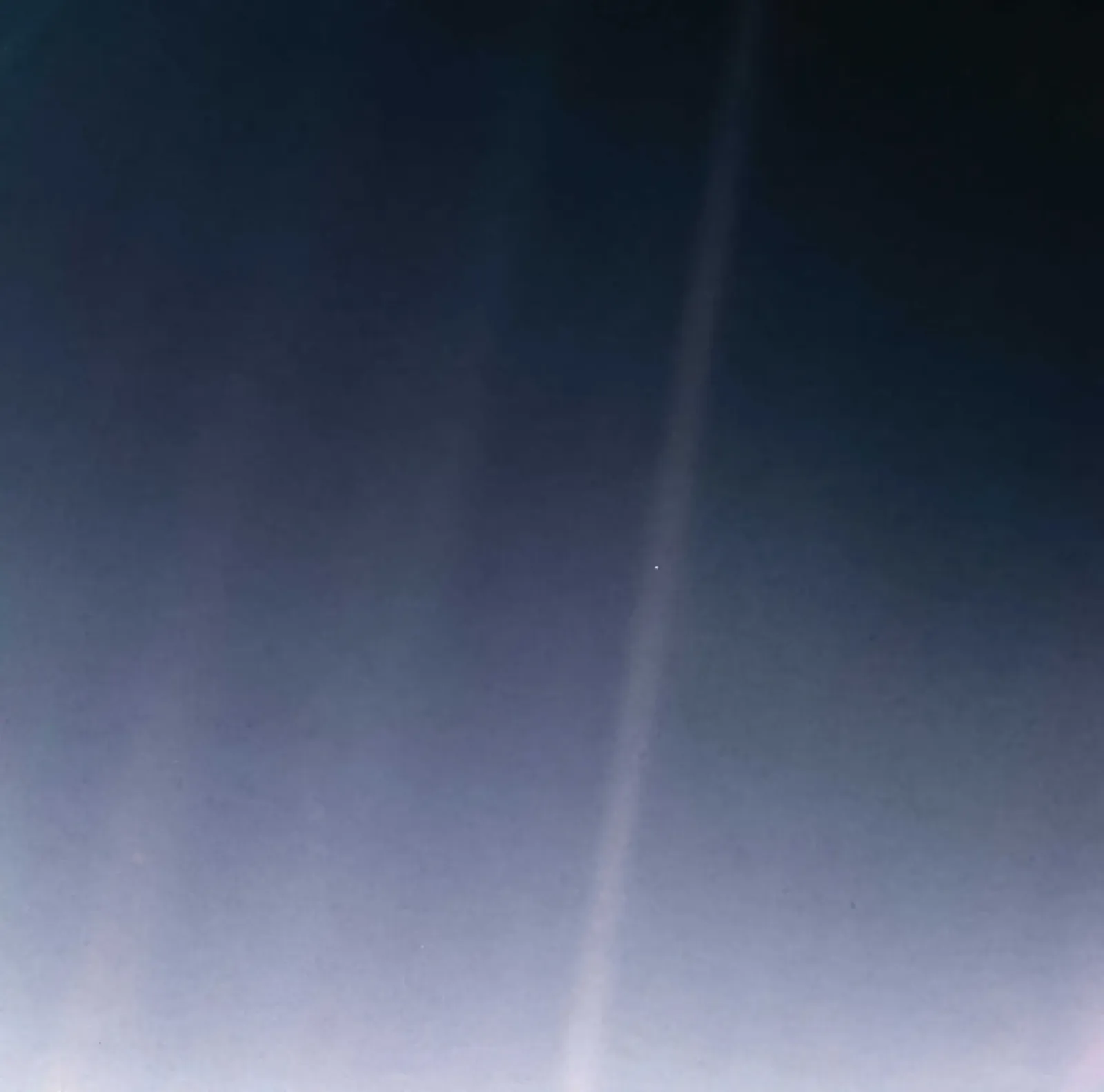
As a final flourish, after Voyager 2 had visited Neptune and the main part of the mission was completed, Sagan suggested they take a shot of Earth.
Voyager 1 turned back toward the inner solar system and took arguably the most famous image of Earth ever and certainly the most famous of the mission, "The Pale Blue Dot".
The Voyager mission was hugely successful, perhaps more than they had hoped. Between them, the two probes had visited the four gas giants and some of the moons, sending back a huge amount of data. But as we know, that wasn't the end.
Losing Power
Unlike the Pioneer probes, which lost contact some years ago, we are still just about in touch with the Voyager probes.
Those still running the project have been able to turn off various redundant processes and instruments to keep the useful ones still functional.
Voyager 1 has two instruments still functioning, the magnetometer and plasma wave subsystem. The former measures the interstellar magnetic field and the latter electromagnetic waves, which enabled the team to prove it has exited the heliosphere.
Voyager 2 still has three instruments on the go. The magnetometer and plasma wave subsystem like Voyager 1, and in addition the cosmic ray subsystem.
On the 4th August 2026, just a few days before I wrote this piece, the team carried out what they described as the "Big Bang". Fearing Voyager 2 would lose another instrument by the end of 2026, they initiated a power manoeuvre to simultaneously swap out two power-hungry components (heaters and a tape recorder) with lower-power alternatives that could do the same job. It was a success and has hopefully prolonged the usefulness of the probe. The team intend to give Voyager 1 the same treatment soon. It may even allow them to turn on the charged particle instrument that had been shut off in April 2026.
Power will increasingly be an issue for the probes. They gain their energy from thermocouples that convert heat emitted by radioactive isotope plutonium-238 into electricity. Each year, as the plutonium-238 decays, the generators produce about 4 watts less electrical power. This means the team will have to make decisions going forward to preserve as much functionality as possible.
These two probes are effectively priceless. They cannot be replaced and once they cease to work, NASA loses an incredibly rare opportunity to study interstellar space. Their long-term goal is to try and keep at least one science instrument working on each probe into the 2030s.
Voyager 1 will reach a milestone on 18th November 2026 when it crosses the one-light-day mark. That means a command sent from Earth will take 24 hours to arrive and a further 24 hours to receive a reply.
All that is left for the team at NASA is to nurse the probes for as long as possible. There will come a time when both go silent. They will continue their travels alone, Voyager 1 reaching the star Gliese 445 in roughly 40,000 years and Voyager 2 the Sirius neighbourhood in approx. 296,000. Quite some journey.
Frequently Asked Questions
What instruments did Voyager 1 and 2 carry?
Each probe launched with ten instruments covering eleven investigations: an imaging system, infrared and ultraviolet spectrometers, a photopolarimeter, a magnetometer, a plasma spectrometer, a plasma wave subsystem, a low-energy charged particles detector, a cosmic ray subsystem, a planetary radio astronomy instrument, and radio science using the spacecraft's own communications radio. Most have since been switched off to save power; only the magnetometer and plasma wave subsystem remain active on both probes, with Voyager 2 also still running its cosmic ray subsystem.
How far away are Voyager 1 and 2 now?
As of August 2026, Voyager 1 is roughly 16 billion miles (25.6 billion km) from Earth, and Voyager 2 is roughly 13.3 billion miles (21.5 billion km) away. Voyager 1 is expected to cross the one-light-day distance on 18 November 2026.
When did Voyager 1 and 2 enter interstellar space?
Voyager 1 crossed the heliopause, the boundary of the Sun's magnetic influence, on 25 August 2012. Voyager 2 followed on a separate trajectory, crossing on 5 November 2018. They remain the only spacecraft with a confirmed, instrument-measured crossing.
What is on the Voyager Golden Record?
Each record carries 116 images, natural sounds of Earth, greetings in 55 languages, a whale call, and a selection of music from around the world. The cover carries a pulsar map and hydrogen atom diagram borrowed from the earlier Pioneer plaques, playback instructions, and a sample of uranium-238 that allows its age to be calculated from radioactive decay.
◆ Also In The Stars
◆ Go Deeper
NASA's official overview of the Voyager Golden Record, including full cover diagrams and the reasoning behind each element.↗ NASA's account of the August 2026 'Big Bang' power-saving manoeuvre that extended Voyager 2's remaining instruments.↗ The Pale Blue Dot image itself, available to download from NASA, along with the story behind the 1990 photograph.↗