The evidence that dark matter exists is overwhelming. Fifty years and several generations of increasingly sensitive detectors still haven't found out what it actually is.
◆ In Summary
The hunt for dark matter is one of the biggest unsolved problems in physics. We know it exists: the gravitational evidence, from galaxy rotation curves to the Bullet Cluster, is overwhelming. What we do not know, despite fifty years of searching with increasingly sophisticated instruments, is what it actually is. The leading candidate, the WIMP, has failed to appear in any detector. The alternatives, axions, sterile neutrinos, primordial black holes, remain unconfirmed. The Vera C. Rubin Observatory, now surveying the sky from Chile, will not solve the mystery directly, but it will sharpen the picture. The answer, for now, remains: we do not know.
There is something wrong with the universe. Most people will never notice. But physicists have spent the better part of a century trying to answer one extraordinary question: what is dark matter made of? Everything we have ever seen or measured accounts for roughly five percent of what the universe actually contains. Every star. Every planet. Every gas cloud, galaxy, instrument and observation. Five percent. The remaining ninety-five percent is dark matter, dark energy, or something we have yet to identify. That ought to bother more people than it does.
Dark matter appears to provide unseen gravity, the kind that isn't there when you count up the stars. Without it, galaxies like ours should fly apart. Dark energy is stranger still. It appears to do the opposite, pushing everything apart, driving the accelerating expansion of the universe. Both are inferred from their effects. Neither has been directly detected.
Dark matter alone accounts for around twenty-seven percent of the universe. Dark energy accounts for the remaining sixty-eight percent. Neither has been identified. We know dark matter is there. That much, after decades of evidence from multiple independent directions, is not seriously disputed. What nobody has managed, despite fifty years of increasingly sophisticated searching, is to identify what it actually is. That is the gap. It is a significant one.
The rotation problem
When something spins, the outer parts move more slowly than the inner ones. Every planet follows that rule. It is not a theory. It is observation, replicated everywhere gravity has been tested. Mercury moves at 47 kilometres per second. Neptune manages 5. Galaxies should work the same way. They don't. In the 1970s Vera Rubin, an astronomer at the Carnegie Institution in Washington, measured the rotation curves of spiral galaxies and found the outer stars moving just as fast as the inner ones. Sometimes faster, which was not supposed to be possible. The curves were flat where physics said they should be declining. Something invisible and massive had to be out there, distributed in a halo far beyond what any telescope could see. Rubin hadn't been looking for this. The data found her.
Fritz Zwicky, a Swiss astronomer working at Caltech, had made the same argument decades earlier after observing clusters of galaxies. Nobody listened, which was the standard response to Zwicky (he was not, by most accounts, an easy man to deal with). What he argued, back in the 1930s, was that galaxy clusters contained far more mass than their visible components suggested. Dunkle Materie, he called it. Then he spent the rest of his career watching everyone ignore him.
The Bullet Cluster
In 2006, a collision between two galaxy clusters known as the Bullet Cluster produced what many physicists still consider the clearest case for dark matter ever obtained. The clusters had collided roughly 150 million years ago, and the evidence had been waiting in the sky ever since. When clusters merge, the gas and dust slow down. They interact with each other, heat up, get dragged back. Dark matter, if it exists, would do none of those things. It would pass straight through. And that is exactly what the mass maps showed: the gravity had kept going while the light got left behind. Explaining that without dark matter turned out to be extremely difficult.
What Is Dark Matter Made Of?
The leading candidate for most of the past four decades is the WIMP. Weakly Interacting Massive Particle. Supersymmetry theory predicts the existence of a particle with almost exactly the right properties to be dark matter. The right mass, the right interactions, or rather the right lack of them. Nobody designed it to explain dark matter. It fell out of the maths. A WIMP barely interacts with ordinary matter, which is either the property that makes it nearly impossible to detect or the property that makes it a perfect explanation for dark matter. Take your pick.
So far, nobody has found one. Underground detectors buried kilometres deep in mines, shielded from cosmic radiation, have been running for decades looking for a WIMP nudging an ordinary atom. Nothing. The Large Hadron Collider at CERN, near Geneva, at energies high enough to have produced WIMPs at the predicted masses, found nothing.
One alternative to the WIMP is the axion: an extremely light particle proposed to solve a completely unrelated problem in particle physics that happens to have the right properties for dark matter. Sterile neutrinos are another possibility, though heavier, cousins of the ghostly particles that pass through ordinary matter in their billions every second. Primordial black holes got a second look after LIGO, the gravitational wave detector, found mergers at unexpected masses. None confirmed. Several ruled out.
The embarrassment of ignorance
The honest version of this situation is uncomfortable. The WIMP had the best theoretical case behind it and received the most experimental attention. It hasn't appeared. The collider that should have found supersymmetric particles didn't find them. The framework that made WIMPs seem almost inevitable is now under serious pressure, and there is no obvious replacement waiting.
Some physicists are now entertaining the possibility that dark matter is not a single particle but an entire sector of invisible matter, with its own forces and interactions. A shadow universe, running parallel to the one we can see. If that is right, hunting for one WIMP-like particle is roughly as useful as trying to explain all of chemistry by finding one element.
Where things stand
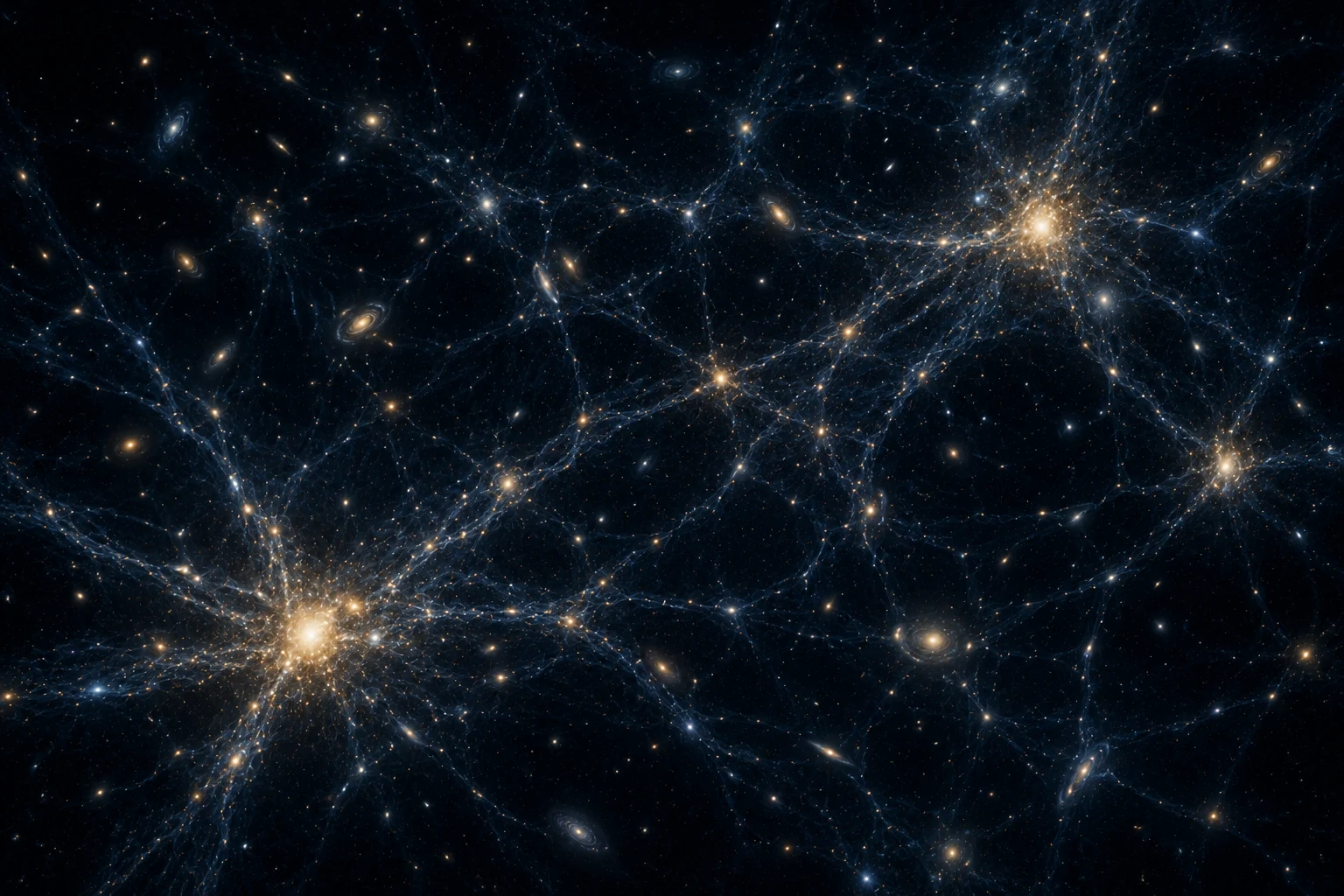
The Vera C. Rubin Observatory is currently mapping the sky in Chile. It won't detect dark matter directly. What it will do is trace its distribution across the large-scale structure of the universe through gravitational lensing. It sharpens the picture of what dark matter does, even while the question of what it is stays open. Next-generation underground detectors are coming. Axion searches are getting serious. The field is moving.
The answer to the question remains: we don't know. Not approximately. Not pending one more experiment. Just: we don't know. Five percent. That is the share of the universe that consists of everything humanity has ever seen, built, burned, named or imagined. The rest is mostly something we cannot identify. The universe is under no obligation to be made of things we can find.
Frequently Asked Questions
What is dark matter?
Dark matter is an invisible form of matter that does not emit, absorb or reflect light but exerts gravitational pull. It accounts for around twenty-seven percent of the universe. We know it is there from its effects on galaxies and galaxy clusters, but nobody has directly detected it or identified what it is made of.
What is the evidence for dark matter?
The strongest evidence comes from three sources. Galaxy rotation curves, first measured by Vera Rubin in the 1970s, show stars at the outer edges of galaxies moving faster than visible mass can explain. The Bullet Cluster, observed in 2006, shows the gravitational mass of two colliding galaxy clusters separating cleanly from the visible matter. Gravitational lensing maps consistently show more mass than visible matter can account for.
What could dark matter be made of?
The leading candidate has long been the WIMP, a weakly interacting massive particle predicted by supersymmetry theory. No WIMP has been found. Other candidates include axions, sterile neutrinos and primordial black holes. None has been confirmed. Some physicists now think dark matter may not be a single particle at all but an entire sector of invisible matter with its own forces and interactions.
Will we ever find out what dark matter is?
Possibly. Next-generation underground detectors are coming online with far greater sensitivity than their predecessors. Axion searches are entering a serious experimental phase. The Vera C. Rubin Observatory will map dark matter distribution across vast scales through gravitational lensing. None of these will necessarily identify what dark matter is, but they will significantly narrow the field. The answer may be closer than the past fifty years suggest.
◆ Also In The Stars
◆ Go Deeper
Recommended
Affiliate links — we may earn a small commission at no cost to you.