Frank Drake never meant his 1961 formula to answer whether we're alone. Sixty years on, it still hasn't, but it knows exactly which questions we're failing to answer.
◆ In Summary
The Drake Equation is a formula for estimating how many technologically communicating civilisations may exist in the Milky Way. Frank Drake wrote it in 1961 not as an answer, but as a framework for asking the right questions. More than sixty years later, the first terms are clearer than ever, but the most important ones remain unknown: how often life begins, how often intelligence appears, and how long a civilisation stays detectable.
◆ At a Glance
| N | The number of civilisations in the Milky Way with which communication might currently be possible. The answer the equation is trying to reach. |
| R* | The rate of star formation in the Milky Way. Currently estimated at roughly three new stars per year. |
| fp | The fraction of those stars that have planets. Once unknown; now, thanks to Kepler, understood to be most of them. |
| ne | The average number of planets per star that could support life. Rocky planets in habitable zones are common. Exactly how common is still being refined. |
| fl | The fraction of suitable planets where life actually develops. Unknown. We have one data point. |
| fi | The fraction of life-bearing planets where intelligence emerges. Also unknown, and possibly the most contested term in the equation. |
| fc | The fraction of intelligent civilisations that develop technology capable of communicating across space. Uncertain, and complicated by what intelligence tends to do with itself. |
| L | The length of time a civilisation remains detectable. The most consequential unknown. Our current value is roughly a hundred years. |
I remember the first time I encountered the Drake Equation. I was probably fourteen or so, reading something about SETI, and the idea that you could reduce the question of whether we are alone in the universe to a piece of arithmetic struck me as genius. To think that it is possible to give some idea to the possible number of civilisations out there in the cosmos is an inspiring and humbling thought.
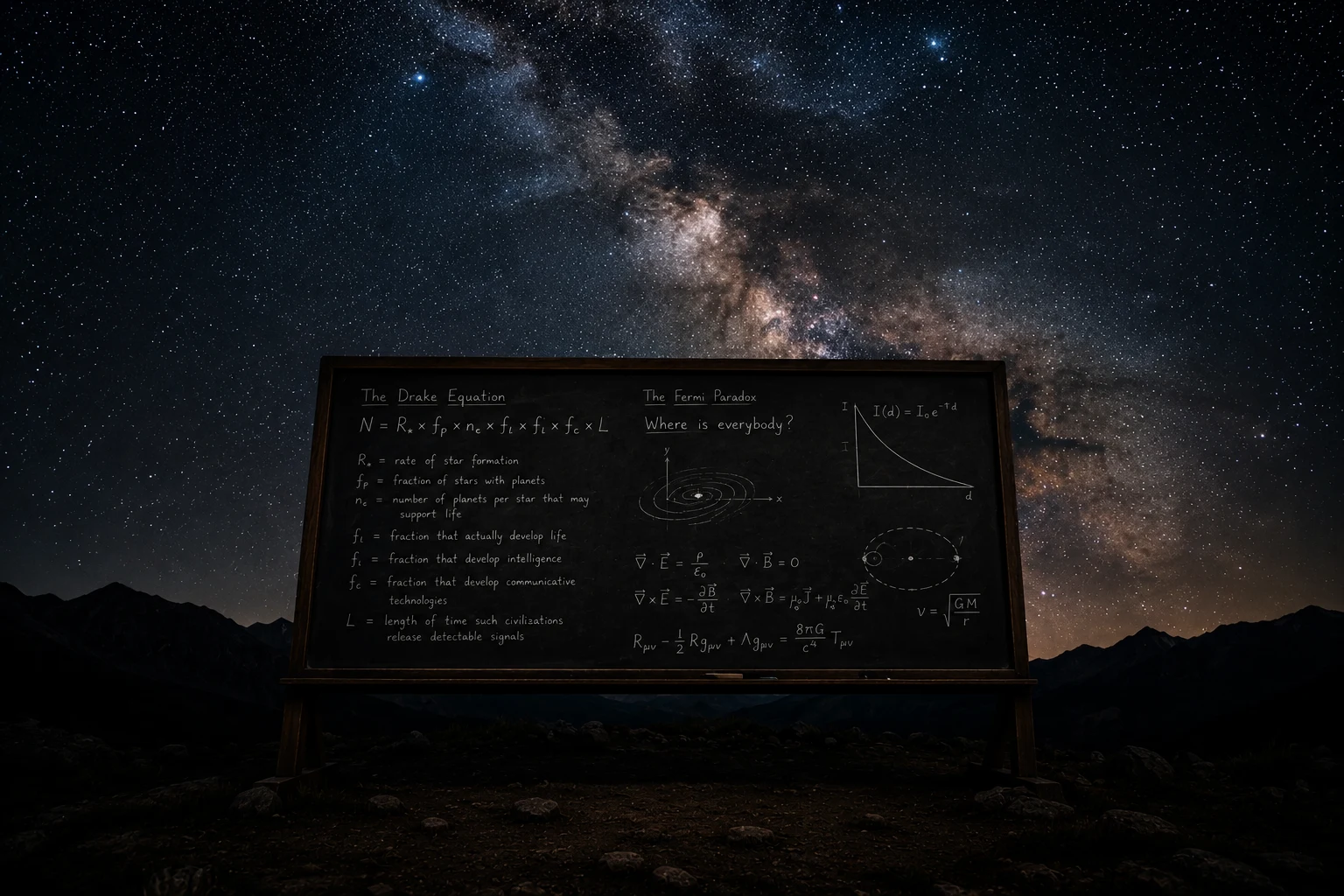
Frank Drake revealed his equation in 1961 at a meeting in Green Bank, West Virginia, that is now considered the founding moment of the scientific search for extraterrestrial intelligence. Drake wrote it on a blackboard at the start of the conference not as a finished piece of science but as an agenda. He wanted to organise what the assembled scientists knew, what they did not know, and what they would need to find out. A framework for a conversation, not an answer to one. It looks like this:
What the Drake Equation actually measures
N is the number of civilisations in our galaxy with which communication might currently be possible. Everything else is an attempt to calculate it. R* is the rate of star formation in the Milky Way. fp is the fraction of those stars with planets. ne is the average number of those planets that could support life. Then it gets harder. fl, fi and fc cover the fractions of suitable planets where life develops, where intelligence emerges from that life, where intelligence then learns to broadcast itself into space. And finally L: the length of time a civilisation remains detectable. Seven terms. One answer nobody has pinned down in sixty-five years.
Star formation in the Milky Way runs at roughly three new stars per year. The fraction of stars with planets was essentially a guess in 1961. Kepler changed that. Its successors kept changing it. Most stars have planets. Rocky ones in the right orbital range are common enough that the early pessimism looks misplaced, which is not something the 1961 attendees at Green Bank would have predicted. Those first two terms, fed into the equation, give you something almost optimistic.
Where the trouble starts
Whether life on Earth represents a near-inevitable outcome of the right chemistry given enough time, or an accident so improbable it may not have happened twice in the observable universe, is a question one data point cannot resolve. We have Earth. That is it. Serious scientists put the probability anywhere from near-certain to vanishingly unlikely, a range so wide it is effectively an admission that nobody knows. The fraction of life-bearing planets where intelligence emerges is no cleaner. Life existed here for roughly three and a half billion years before anything appeared that could build a radio telescope. Whether that delay is typical or extraordinary, and whether intelligence is a reliable product of evolution or a rare fluke, remains genuinely open.
The uncomfortable question
The fc term forces an uncomfortable question. What does intelligence actually do? We developed technology. We also developed nuclear weapons, industrial-scale habitat destruction, and a track record of organised self-destruction that does not suggest civilisational longevity is guaranteed. There is no principled reason to assume that intelligence produces long-lived technological civilisations rather than short-lived ones that go quiet.
The term that keeps people up at night
Which is what makes L the term that keeps people up at night. If civilisations typically last a few centuries before falling silent, the galaxy could be littered with the ruins of intelligence and none of it detectable at the same moment. If L runs to millions of years, the signals should be everywhere. We have been broadcasting detectable radio for roughly a hundred years, which is our current lower bound on L. A hundred years is nothing in cosmic time. Whether we manage to extend it is, arguably, the most important question our civilisation faces.
The shape of what we don't know
Drake himself, running the equation at Green Bank in 1961, arrived at somewhere between one thousand and one hundred million civilisations in the Milky Way. That range is not a failure of the equation. It is the equation working exactly as intended, mapping the shape of what we do not know. Not a calculator. A register of productive ignorance, which sounds like a consolation prize. It isn't. That kind of structured not-knowing is what eventually hardens into data, and Drake understood that better than most.
Where is everybody?
The Fermi Paradox is where the equation's optimism runs into a wall. If the higher values are right, the galaxy should be full of detectable civilisations. It isn't, or at least we haven't found them. Either the optimistic values are wrong, or something happens to civilisations before they become visible, or we are looking in the wrong way, or the universe is stranger than any of our models suggest. None of those answers is reassuring.
The most recent attempt to put a specific figure on it came from a 2020 University of Nottingham study, which used updated stellar data and assumptions about civilisational longevity to arrive at around 36 active communicating civilisations in the Milky Way. That number was widely reported and widely contested. It depends heavily on assumptions about L that many researchers consider generous, which tells you less about how many civilisations are out there and more about how much the answer still hinges on the one term nobody can measure.
Frank Drake died in September 2022, aged ninety-two, without an answer, and the equation's unsettled state was always the honest outcome. The James Webb Space Telescope is now returning atmospheric data on exoplanets that will eventually tighten several of the terms he sketched on a blackboard in West Virginia. The numbers improve. The silence continues.
Frequently Asked Questions
What is the Drake Equation?
A formula proposed by astronomer Frank Drake in 1961 to estimate the number of technologically communicating civilisations in the Milky Way. It was designed as a framework for organising scientific uncertainty, not as a definitive calculation.
How many civilisations does the Drake Equation predict?
Drake's own 1961 estimate ranged from one thousand to one hundred million civilisations. A 2020 University of Nottingham study used updated data to arrive at around 36 active communicating civilisations, though that figure remains contested. The range reflects genuine scientific uncertainty across several terms, particularly those relating to the emergence of life and intelligence.
What is the L term in the Drake Equation?
L represents the length of time a civilisation remains detectable — the period during which it broadcasts signals into space. It is considered the most consequential and least knowable term in the equation. Our own current lower bound on L is roughly a hundred years.
How does the Drake Equation relate to the Fermi Paradox?
The Fermi Paradox asks why, if the Drake Equation's optimistic values are correct and the galaxy should be full of civilisations, we have detected none. The two sit in direct tension: the equation suggests we should have company; the silence suggests otherwise.
◆ Also In The Stars



◆ Go Deeper
Recommended
Affiliate links — we may earn a small commission at no cost to you.