The sun has five billion years left, but the oceans start boiling away in about a billion, which makes the real deadline for life on Earth considerably closer than the dramatic one.
◆ In Summary
In roughly five billion years, the sun will exhaust its hydrogen fuel, swell into a red giant and consume Mercury and Venus. Whether Earth is swallowed or drifts outward as the sun loses mass is genuinely unresolved, and astronomers are not being diplomatic when they say so. The first consequences arrive much sooner: in about a billion years the oceans begin to evaporate, and the window for complex life closes long before the red giant phase begins. What follows is a white dwarf, a planetary nebula, and a solar system orbiting an ember. The interesting question is not whether Earth survives, but whether anything that evolved on it will have found somewhere else to be.
What Happens to Earth When the Sun Dies?
The sun is not going to last forever. What happens to Earth when the Sun dies is one of the oldest questions in astronomy, and one of the few with a reasonably clear answer. Astronomers have known the broad outline for decades, and the broad outline offers little comfort. In roughly five billion years, the Sun will exhaust its hydrogen fuel, swell into a red giant many times its current size, and in all likelihood swallow the inner planets. Earth included. What happens to Earth when the Sun dies is therefore not really a question about a distant ending, but about the long chain of events that leads there.
A Ceasefire, Not a Permanent Condition
Some of those stages are uncomfortably near, astronomically speaking. The sun is about 4.6 billion years old. Halfway through its fuel, roughly. The second half of its life is where the trouble starts. Nuclear fusion pushes outward. Gravity pulls in. For now they balance. That balance is not a permanent condition, it is a ceasefire, and like most ceasefires it has a time limit. This will last for another 4.5 to 5.5 billion years, after which the balance finally breaks.
The First Sign of Trouble
The first sign of trouble arrives long before the red giant. Astronomers estimate that the sun's habitable zone will expand past Earth's orbit in about a billion years, at which point the heating sun begins evaporating the oceans. Solar radiation then blasts away the hydrogen from the water. What is left behind is not a planet that supports life. It is a rock. A billion years sounds like a comfortable margin. Then again, complex life on Earth only appeared around 600 million years ago, which reframes the arithmetic considerably. The margin shrinks when you put it that way.
Not the Climax. The Trigger.
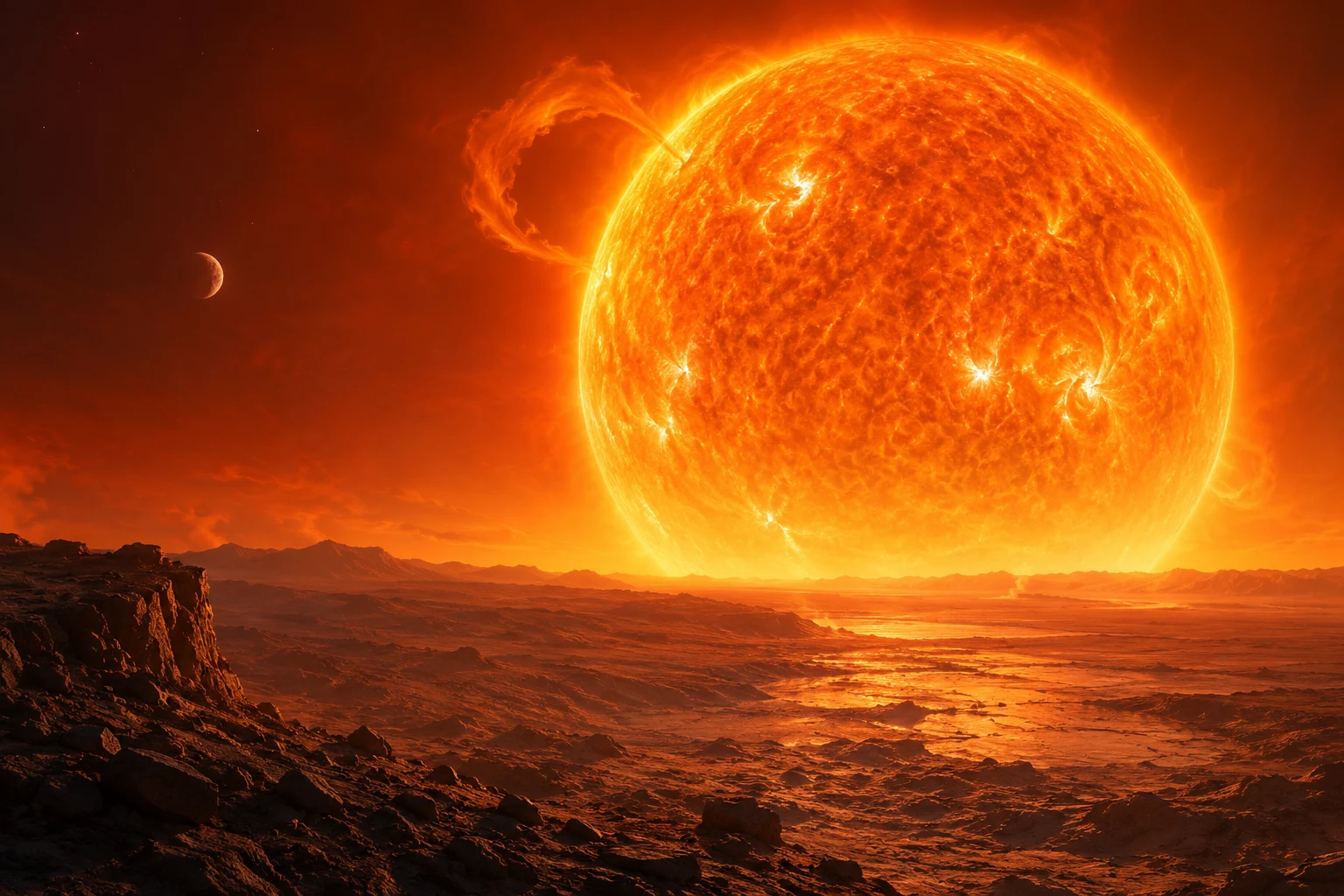
After the oceans go, the sun keeps brightening. Most accounts skip fairly quickly to the red giant, which is understandable. It is the dramatic part. But the hydrogen running out in the core is not the climax, it is the trigger. What it sets in motion is what matters. The core contracts and heats up, fusion migrates to a shell around it, and that internal reorganisation is what drives the outer layers outward. The surface cools and reddens even as total energy output climbs. This is the red giant phase, and it is not a brief transition. The sun will spend roughly a billion years in it.
Mercury and Venus are almost certainly consumed in the process, though what happens to Earth is less settled. "I am confident that the Sun will swallow Mercury and Venus, and not Mars. But the fate of the Earth, which resides in between, is less clear," said astronomer Dimitri Veras of the University of Warwick.
Can Earth Survive the Red Giant Phase?
The uncertainty over Earth's fate is genuine and not merely diplomatic hedging. The expanding sun may simply engulf us as its radius reaches or exceeds Earth's current orbit. Or something more complicated happens. As the sun loses mass, its gravitational grip weakens. Earth may migrate outward rather than being swallowed, which sounds almost hopeful until you think about what Earth would look like by then. A white dwarf sun has shed roughly half its original mass, and the weakened gravitational grip is what allows the planet to drift. An orbit twice the current size is possible. Scorched, airless, but intact.
Astronomers have actually found something that fits this description: a rocky planet some 4,000 light-years away, orbiting a white dwarf in exactly the kind of wide orbit that suggests it survived by moving rather than burning. Whether that constitutes survival is a question astronomers tend to hand back unanswered. It is more philosophy than physics at that point.
Orbiting an Ember
Eventually, the sun sheds its outer layers. Not quickly. This is evolution, not an explosion. What that process looks like from any surviving distance is a planetary nebula, a slow dispersal of gas and light into the surrounding space. What remains at the centre is a white dwarf. Carbon and oxygen packed into something roughly the size of Earth. No longer a star powered by fusion. A stellar remnant cooling in the dark. It cools. It fades. Over billions of years it dims toward darkness. The solar system, whatever remains of it, orbits an ember.
The Bigger Question
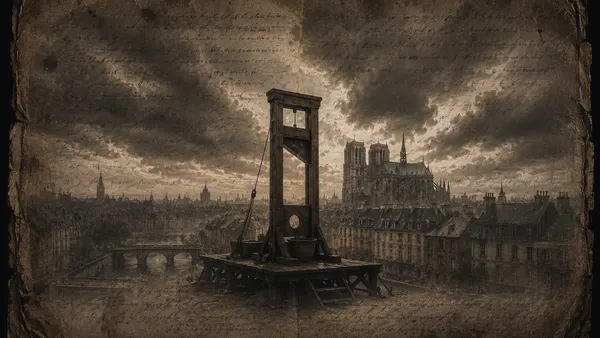
There is a school of thought that says none of this matters because we will be long dead by then from something more immediate, whether asteroid impact, pandemic, climate catastrophe or any number of other candidates that operate on timescales relevant to human planning. The argument has merit. A billion years is not a planning horizon any civilisation has ever had to work with.
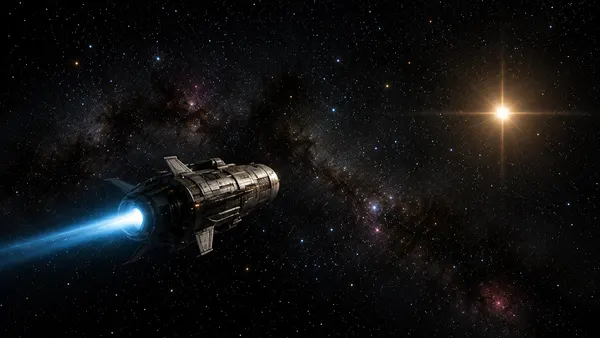
But there is another way to look at it. The sun's eventual death is the clearest possible statement that Earth is a temporary arrangement. The question it raises is not whether we will eventually need to leave but whether we will have developed the means to do so when the time comes. Five billion years sounds like enough. A billion years, which is when Earth becomes genuinely uninhabitable, cuts things a bit closer. And the gap between where we are now and being able to relocate a civilisation to another star system is still some distance away, if indeed we even get there.
It Was Always Going to End
The ancient sky-watchers who built their cosmologies around the sun understood it as eternal. On any timescale that mattered to them, they were right to think so. It is only modern science that tells the whole truth. The warmth they and we depend on turns out to have an expiry date. Nobody knew that for most of human history, and the people who eventually worked it out did so only by looking very carefully at stars that were already dying. It was always going to end.
Frequently Asked Questions
What happens to Earth when the sun dies?
Earth's fate depends on timing. The oceans begin evaporating in around a billion years as the sun brightens and the habitable zone expands past Earth's orbit. Long before the red giant phase, Earth becomes uninhabitable. When the red giant arrives, Earth may be swallowed outright, or it may migrate outward as the sun loses mass. Either way, what remains is not a planet that supports life.
How long does the sun have left?
The sun is roughly 4.6 billion years old and has around 4.5 to 5.5 billion years of hydrogen fuel remaining in its core. After that the balance between fusion and gravity breaks, and the red giant phase begins. On human timescales this is effectively infinite. On geological and biological timescales, the more relevant figure is the billion-year window before Earth loses its oceans.
Will the sun swallow the Earth?
Possibly, but it is not certain. Astronomer Dimitri Veras of the University of Warwick has said he is confident the sun will swallow Mercury and Venus but that Earth's fate is less clear. As the sun loses mass becoming a white dwarf, its gravitational grip weakens, and Earth may drift outward into a wider orbit rather than being consumed. A rocky planet some 4,000 light-years away has been found orbiting a white dwarf in exactly this kind of survivor orbit.
What is a white dwarf?
A white dwarf is what remains at the centre of a solar system after a star like the sun sheds its outer layers. It is composed mostly of carbon and oxygen, packed into something roughly the size of Earth, and generates no energy through fusion. It cools and fades over billions of years. The solar system, whatever remains of it, continues to orbit this dimming remnant.
◆ Also In The Stars
◆ Go Deeper
Recommended
Affiliate links — we may earn a small commission at no cost to you.