She burned six of nine books before the king paid full price for what was left. Five centuries on, the Roman Senate still consulted it, in secret, only in genuine crisis.
◆ In Summary
The Sibylline Books were among the most closely guarded texts in the Roman world. Sold to the last king of Rome by the Cumaean Sibyl, they were not predictions but ritual instructions, guidance on what the gods required when the state faced crisis. Only the Senate could authorise a consultation, and only a handful of priests were permitted to read them. They guided Roman policy for half a millennium before being destroyed, rebuilt from fragments gathered across the ancient world, then destroyed a second time. The general Stilicho was blamed for that final loss in 408 AD. Two years later, the Visigoths were inside the walls of Rome.
The Negotiation
The story of the Sibylline Books begins with a stranger. An old woman arrives unannounced at the court of Tarquinius Superbus, the last king of Rome, carrying nine mysterious books. Nobody knows who she is. She names her price. He refuses, as any king would when an unknown woman appears asking for more than seems reasonable for books whose contents she will not reveal.
She burns three on the spot and offers the remaining six at exactly the same price. He refuses again. Three more go into the fire. He is now looking at what remains, being asked to pay for nine books and receive only three, and something in him finally shifts. He pays.
She was not destroying them out of anger. Each book she burned was a demonstration. The price did not move because the value did not move. By the time she was down to three books he understood that whatever they contained was worth the original price, and that she was entirely prepared to reduce them to nothing if he said no again. Why she wanted to sell them, and why to Rome, the sources do not say. What they record is what it cost him to finally understand what he was looking at. It cost him the original price. All of it, for a third of the books.
The books became one of the most prized possessions in Rome's history. Only a handful of men could act on them, and only in moments of genuine crisis. For five centuries, that arrangement held. Most of what they contained is lost, and for Rome, that loss would eventually prove catastrophic.
Who Was the Cumaean Sibyl?
Sibyl was not a name but a title. Across the ancient world, prophetesses associated with particular places carried it: Cumae, Erythrae, Delphi, Tibur, Persia. There were said to be ten of them, though ancient sources disagree on the number. Each had her own tradition, her own gift, her own relationship with Apollo. The Cumaean Sibyl was the one who came to Rome.
Apollo had offered her anything she desired. She picked up a handful of sand and asked for as many years of life as there were grains in her fist. Apollo granted it on the spot, which should have been the warning. She had not thought to ask for youth alongside it. The sand ran to a thousand years. Her body endured every one of them. Over those centuries she recorded oracular verses, ritual guidance, instructions for what must be done when the gods turned their faces away. By the time she knocked on the king's door she had nine books of it.
What the Sibylline Books Actually Were
The books Tarquinius purchased were not predictions in the Nostradamus sense. They did not describe specific future events. They were ritual instructions, guidance about what religious ceremonies the Roman state needed to perform during a crisis, whether a plague, a military disaster, or a run of alarming omens. The books told the Senate what the gods required in response.
The Pythia at Delphi answered specific questions from specific people. Should we go to war? Will this harvest hold? Anyone who could afford the journey could put a question to her. The Sibylline Books worked nothing like that. Private, institutional, restricted to the Senate alone, they were less a prophetic service than a classified state instrument. Prophecy in Roman hands had become a matter of state power rather than religious accessibility.
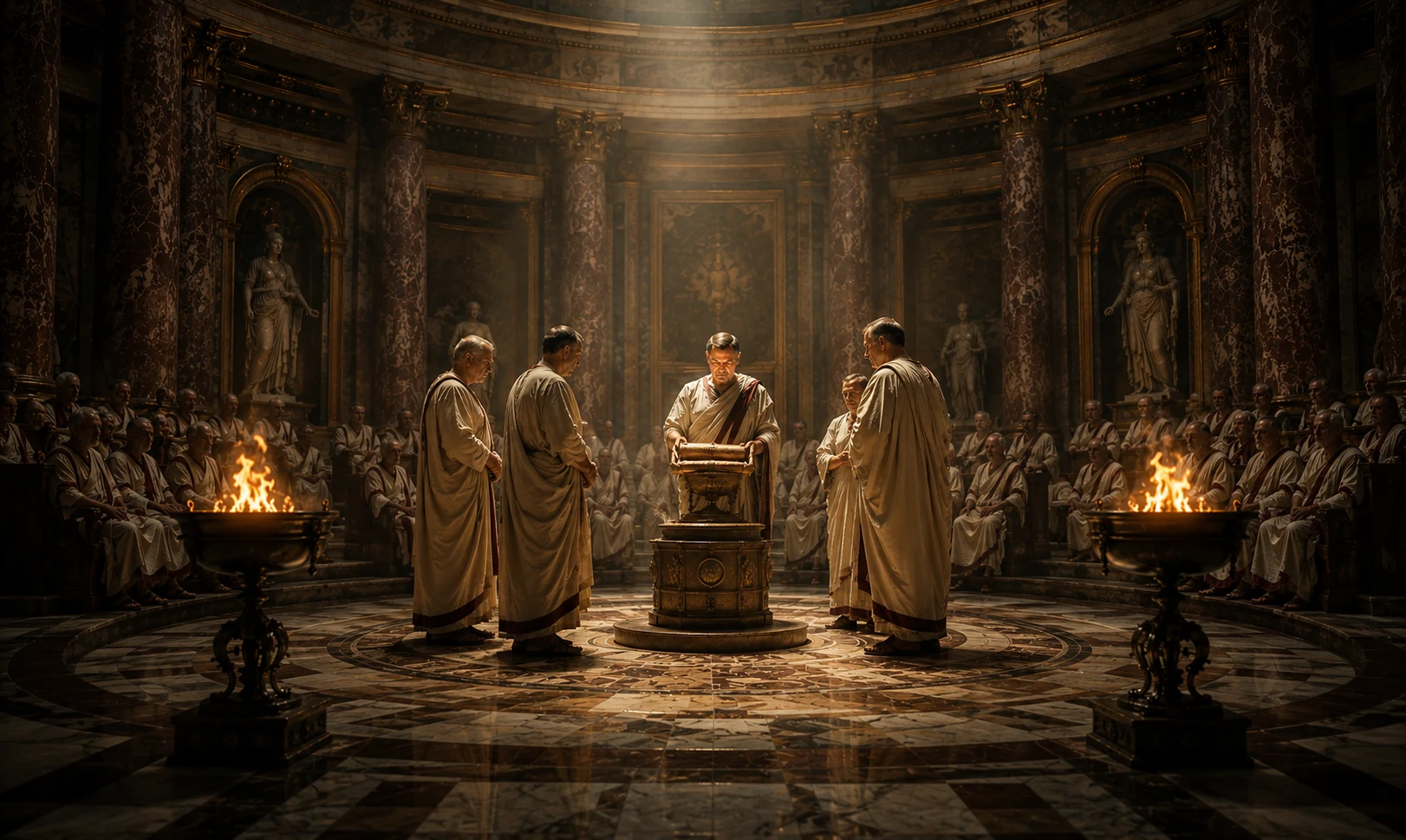
They were kept in the Temple of Jupiter on the Capitoline Hill, under lock and key, in a stone chest. A dedicated college of priests, the quindecimviri, fifteen men of senatorial rank, were the only people permitted to consult them. Ordinary Romans never saw them. The Senate could only authorise a consultation by formal decree, and only in circumstances of genuine crisis. The books were not a resource available to individuals, to private citizens seeking guidance about their lives. They were a state instrument, classified, controlled, consulted only when Rome itself was in danger.
The Crisis Consultations
The books were consulted at some of the most dangerous moments in Roman history. During the Second Punic War, when Hannibal was cutting through Italy and the Roman army had been destroyed at Cannae, the Senate authorised a consultation. The books prescribed a series of extraordinary measures, including the live burial of two Gauls and two Greeks in the Forum Boarium, a ritual so alien to Roman religious sensibility that Livy described it as "not at all in the Roman manner."
They were consulted during plagues, during famines, during years when the omens were particularly alarming. The response was never strategic. It was ritual, a temple built here, a cult introduced there, ceremonies performed until the priests judged the gods satisfied. The books did not tell Rome how to defeat Hannibal. They told Rome what the gods needed in order to be willing to let Rome defeat Hannibal. The distinction is subtle but it runs through everything.
The Fire and the Reconstruction
In 83 BC, the Capitoline Temple burned. The Sibylline Books burned with it. This was, by Roman reckoning, a catastrophe of the first order. The Senate's response was immediate and systematic: envoys were dispatched across the ancient world to collect replacement prophecies. They went to Erythrae in Asia Minor, to Ilium, to Sicily, to Africa, to anywhere that Sibylline prophecy might have been preserved or remembered. What they brought back was assembled into a new collection, which was then edited, organised and installed in a new temple.
What they ended up with may have been quite different from what they lost. The reconstruction was necessarily a collection of whatever could be gathered from various sources, some of genuine antiquity, others of more recent composition. The Romans knew this. They consulted the reconstructed books anyway, because the institution mattered as much as the content.
Ancient sources attribute their final destruction to Stilicho, a commander of Vandal descent serving the Western Roman Empire, around 408 AD, though the details remain disputed. What is not disputed is the timing: within two years, Rome was sacked by the Visigoths under Alaric. Many Romans drew the obvious conclusion. Stilicho had destroyed the one resource that might have told them what to do.
What Survives
The original Sibylline Books are gone. What survives under the name Sibylline Oracles is a different body of text: collections of Jewish and later Christian prophetic writing, containing early responses to Roman rule and apocalyptic material dressed in pagan prophetic clothing. The Byzantine tradition preserved them, and they survive today in manuscript collections including the Vatican Library. Serious scholarly study of the texts dates back to the nineteenth century. But they are not the books Tarquinius bought.
All we are left with is the story. The old woman burning her books on a king's doorstep, the price that never changed, the moment he finally understood. The books told Rome not what would happen, but what had to be done. Within two years of their destruction, the Visigoths were inside the walls. Whether that was the cause or merely the context depends on what you believe. The Romans who lived through it had no doubt.
The Literary Legacy
By the time Aeneas visits her in Virgil's Aeneid, written in the first century BC, she is already ancient beyond reckoning. Her body has shrunk with age while her voice remains strong. She guides Aeneas through the underworld, past the shades of the dead, to the place where his father shows him the future of Rome. It is, by any measure, a considerable piece of work for a woman who is already falling apart, and who has been alive long enough to have seen everything.
Virgil knew exactly what he was doing when he gave Aeneas the Sibyl rather than Tiresias. Homer had been there first. Odysseus in the underworld, a dead prophet, the same basic architecture. Virgil took it and made it Roman. Rome has its own prophetic tradition, its own relationship with Apollo, its own intermediary between the living and the dead. It does not need to borrow Greece's.
Ovid, writing in the generation after Virgil, has her describe her condition directly in the Metamorphoses. She has already lived seven hundred years. She will live for three hundred more. What remains of her will eventually be nothing but a voice. Petronius, writing later still, captured the same image from a different angle: the Sibyl of Cumae reduced by age to something so small she could be kept in a jar, asked by children what she wanted, replying only that she wanted to die. The Sibyl accepted Apollo's bargain, and spent a thousand years working out what she had actually signed up for.
She appears on the ceiling of the Sistine Chapel, painted by Michelangelo alongside the Hebrew prophets as a figure of equivalent authority. T.S. Eliot put her in the epigraph to The Waste Land, the same poem where Tiresias turns up as the unifying consciousness. Fifteen hundred years apart, two completely different literary traditions, and she turns up in both. Call it staying power.
Frequently Asked Questions
Were the Sibylline Books predictions of the future?
No. They were ritual instructions, not prophecies in the Nostradamus sense. They told the Senate what religious ceremonies the gods required when Rome faced a crisis such as plague, military disaster or alarming omens. They never described specific future events.
Who was allowed to read the Sibylline Books?
A college of fifteen priests called the quindecimviri, all of senatorial rank, were the only people permitted to consult them, and only after the Senate authorised it by formal decree. Ordinary Romans never saw the contents.
What happened to the original Sibylline Books?
The originals burned in the fire that destroyed the Capitoline Temple in 83 BC. The Senate sent envoys across the ancient world to gather replacement prophecies, and that reconstructed collection was destroyed a second time, attributed to the general Stilicho around 408 AD.
Did the destruction of the Sibylline Books cause the fall of Rome?
There is no causal proof, only timing that many Romans found impossible to ignore. The books were destroyed around 408 AD and Rome was sacked by the Visigoths under Alaric two years later, in 410 AD. Whether that is cause or coincidence is unresolved.
◆ Also In The Stars
◆ Go Deeper
Recommended
Affiliate links — we may earn a small commission at no cost to you.