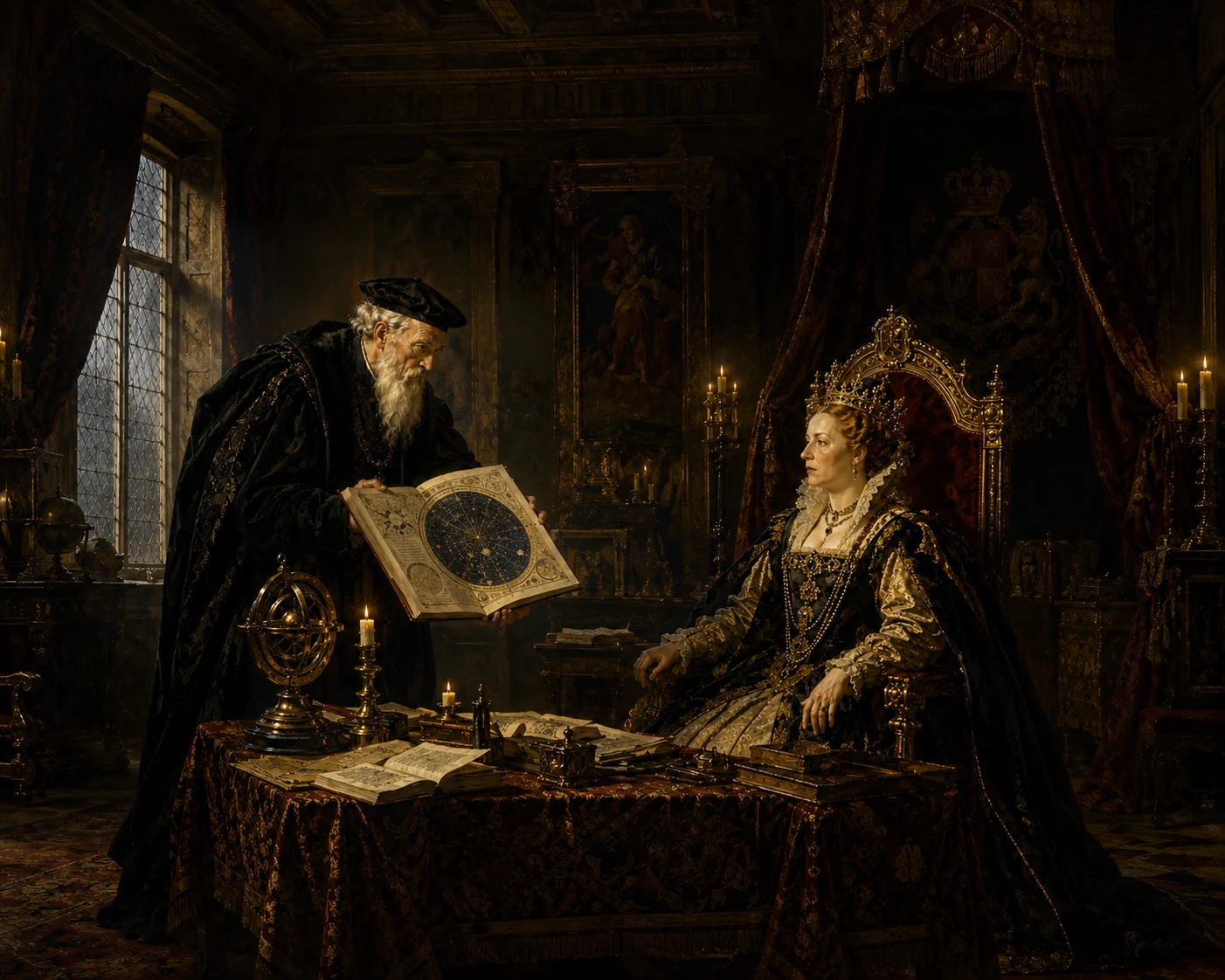
He picked the date of a queen's coronation, coined the phrase British Empire and tried to talk to angels. He died in poverty, remembered mainly as a wizard.
◆ In Summary
John Dee (1527–1608) was a mathematician, astrologer and adviser to Queen Elizabeth I, who selected the date of her coronation. He coined the phrase "British Empire" in 1577 and assembled the largest private library in Elizabethan England. From 1582 he worked with scryer Edward Kelley, conducting sessions they believed communicated with angels, producing the Enochian language. His Mortlake library was ransacked while he travelled in Europe. He died in poverty in 1608 or 1609, dismissed as a wizard despite being one of the most learned men of his century.
When I started researching articles for In The Stars, I had a rough idea of who I expected to find in the historical record of prophecy and prediction. Nostradamus was obvious. Mother Shipton, The Oracle at Delphi. What I did not expect was to keep running into a Tudor mathematician called John Dee who had apparently also been a spy, a cartographer, a librarian, a court astrologer and a man who spent years trying to establish radio contact with heaven. That last part is not quite how he would have put it. But it is broadly true.
John Dee was born in London on 13 July 1527 under the reign of Henry VIII, a time of great flux in English history. His father was a minor courtier in Henry VIII's household. His mother's family were Welsh, respectable enough, the kind of background that opens some doors and closes others. Nothing about his origins suggested what was coming. By the time he was fifteen he had secured a place at St John's College, Cambridge, where by his own account he studied for eighteen hours a day, sleeping four and eating two. He was, even by the standards of a period that produced some extraordinary minds, relentlessly, almost pathologically curious.
The making of John Dee
He went to Louvain after Cambridge, then to Paris, where his lectures on Euclid drew such audiences that students sat on windowsills to hear him. He was twenty-three, which is the sort of detail that is either impressive or faintly annoying depending on what you were doing at twenty-three. On his return to England, he brought with him instruments, manuscripts and a network of European contacts that would prove useful to a nation increasingly interested in maritime exploration and the politics of empire. Nobody had quite asked him to build this network. He built it anyway.
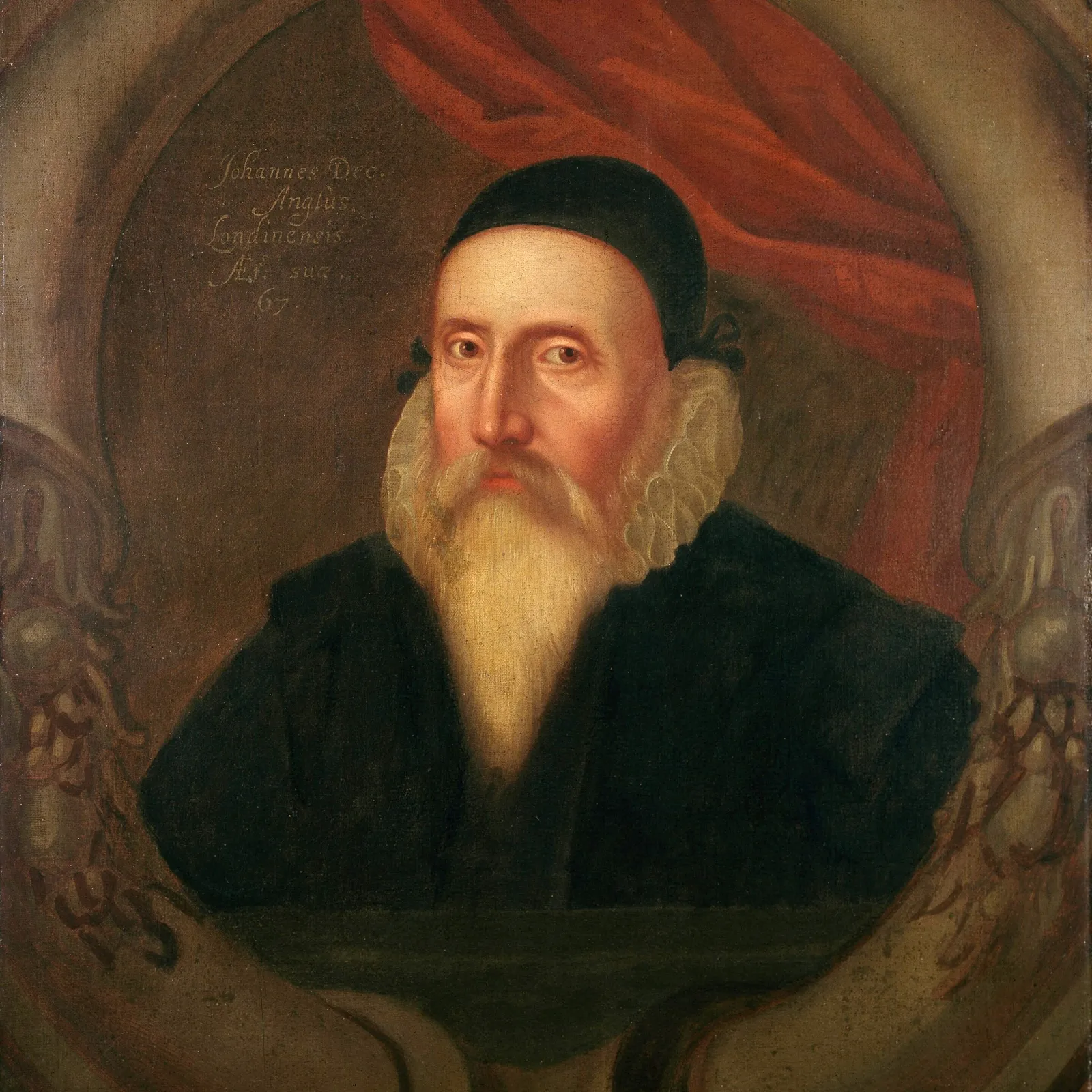
Dee was not, in the modern sense, a scientist or a mystic. He was both, simultaneously. The distinction between the two barely existed in the sixteenth century. Mathematics was considered by some a form of dark magic, which is part of why Dee was arrested in 1555 under Queen Mary, accused of casting horoscopes of the royal family. He was released after a few months, charges unproven. But the damage was done. To people who did not understand what he was doing, and most people did not, a man who studied the stars, cast horoscopes and filled his house with strange instruments was simply a wizard. They meant it as a pejorative, not a compliment. The same word that turned Merlin into a legend would, for Dee, eventually make him a target. To avoid future arrests, he took the precaution of becoming rather useful to the next monarch.
When Elizabeth came to the throne in 1558, Dee was ready. He selected the most astrologically auspicious date for her coronation, January 15th, chosen after careful calculation, and the relationship that followed was one of the stranger royal adviserships in English history. She called him "my philosopher." He called the arrangement the closest thing he had to security.
The idea of empire
Dee coined the phrase "British Empire" in a 1577 document making the legal and philosophical case for English maritime dominion. He argued, on grounds that blended medieval precedent with Renaissance scholarship, that Britain had historical sovereignty over northern waters and rights of trade and exploration that should be asserted against Spanish and Portuguese competition. It is a strange document to encounter. Dense, learned, occasionally bizarre, but recognisably the blueprint for something that would reshape the world over the following three centuries.
He had also, by the late 1570s, assembled what was almost certainly the largest private library in England. More than three thousand books and a thousand manuscripts, at a time when owning a hundred was considered a collection. He catalogued it meticulously. He annotated everything. His marginalia, researchers have found, tell you as much about him as his published work: impatient, precise, arguing with the text, occasionally delighted. He petitioned Queen Mary to establish a national library. The scheme went nowhere. He built his own instead, at his house by the Thames in Mortlake (a village a few miles upstream from London in Surrey) and opened it to scholars who could not otherwise access what he had gathered.
Kelley arrives
Trouble arrived in March 1582, in the form of a young man who knocked on Dee's door at Mortlake and introduced himself as Edward Talbot. That was not his real name. His name was Edward Kelley, a convicted forgerer. He had reportedly had his ears cropped as punishment for an earlier offence, which is why he wore a cap. Dee knew none of this when he opened the door.
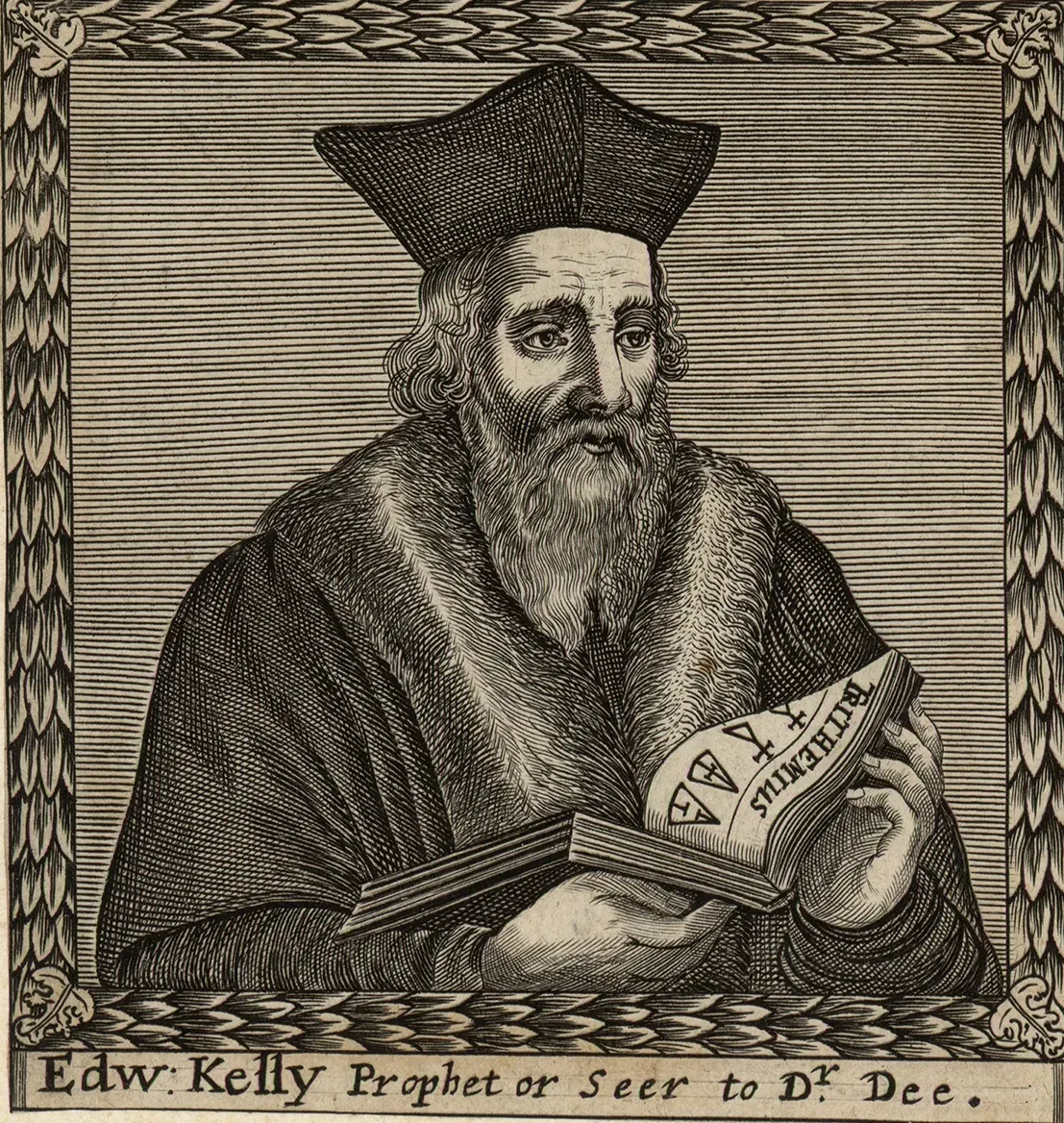
In the small world of Elizabethan occult practitioners, word travelled, and Kelley had done his homework. He knew Dee was looking for a scryer, knew what Dee wanted to hear, and arrived prepared to deliver it. The method was simple: the scryer stared into a crystal ball or obsidian mirror while Dee sat alongside with pen and paper, waiting. Previous scryers had given him nothing worth writing down. Within forty-five minutes of their first session together, Kelley was receiving transmissions. Kelley was describing figures, hearing names, relaying messages with a confidence none of his predecessors had managed. Dee transcribed everything. From where he was sitting, he had finally found his man.
What followed was one of the stranger intellectual partnerships in English history. For five years, the two men sat together daily. Kelley gazed into a crystal ball or a black obsidian mirror, relaying messages from beings who identified themselves as angels, Dee transcribing everything in his meticulous italic hand, page after page, session after session. The angels had names, Uriel, Ave, others, and they had things to say. They described the structure of the heavens. They warned of the state of Christendom. They told Dee he should present himself to the rulers of Europe as a bearer of divine knowledge. And they began dictating a language, delivered fragment by fragment across dozens of sessions, which Dee recorded phonetically and which would later become known as Enochian. It was, the angels explained, the tongue spoken before Babel.
Dee believed, genuinely and profoundly, that he was receiving revelation. He thought the angels were offering him knowledge, via the conduit Kelley. The sessions were attended with the same care Dee brought to his mathematical work. That belief was not stupid or credulous by the standards of his time, which is the part the wizard caricature tends to obscure. Communicating with angels was a respectable ambition in the sixteenth century. Dee had predecessors and peers who shared the project. What separated him was the rigour he brought to it, even if Kelley was taking advantage of him.
Kelley is harder to read. He arrived with a false name and a plan, almost certainly, and the plan worked. Dee took him into his household, paid him a good wage and eventually took him across Europe. The convicted forger who had knocked on the door in a cap to hide his missing ears would, within a few years, be knighted by the Holy Roman Emperor. But five years is a long time to sustain a performance, and some researchers think the line between fraud and belief blurred somewhere along the way. A man who starts by faking visions and sits with them daily for half a decade may eventually stop being entirely sure which is which.
Prague, Poland, ruin
In 1583, with the angel sessions still producing daily transmissions, Dee and Kelley left England for the continent. They attached themselves to a Polish nobleman named Albert Laski, who turned out to be considerably poorer and less politically useful than he had appeared (a pattern that would repeat). The two men moved through the courts of Europe regardless, eventually meeting King Stefan of Poland and Emperor Rudolf II in Prague. The Emperor was fascinated and wary in equal measure, suspecting Dee of being an English spy. Dee suspected the Emperor of not taking the angelic communications seriously enough. Both suspicions may have had some foundation.
While Dee was in Europe, the mob came to Mortlake. In September 1583, his house was broken into and ransacked by people who considered his reputation as a wizard sufficient justification. Books were stolen or burned. Instruments were broken. He would not return to find out the extent of the damage for six years.
The collaboration ended in 1587, though not immediately. That year Kelley produced what he claimed was an angelic message requiring both men to share all their possessions, including their wives. Dee recorded the moment in his diary with the same meticulous care he brought to everything else, noting the instruction, his anguish, his eventual compliance. His wife Jane, who despised Kelley, was unhappy with the arrangement. Nine months later she gave birth to a son whose paternity was not entirely certain. The angels, if they had an opinion on this, did not transmit it. The partnership collapsed two years after that, and in 1589 Dee returned to England alone.
The long decline
The Mortlake he found was not the house he had left. The library was largely gone, sold off in his absence to pay debts, scattered by theft, destroyed by the mob. In practice it meant the end of the intellectual project he had spent thirty years building. Some volumes survived and would eventually make their way to institutions like the Royal College of Physicians, where scholars have spent the last century reassembling the catalogue from annotations and records.
Elizabeth gave him the wardenship of Christ's College in Manchester in 1595. It was a kindness that did not work out. He was constantly at odds with the college fellows, who disliked him, and the north of England was far from the intellectual world he had built his life around. He wrote to a friend in 1597 that he could not see how his household of eighteen could survive on a daily stipend of four shillings, that he had never been forced to so thin a diet in all his life. The letter is painful to read.
Elizabeth died in 1603, and with her went whatever protection her affection had provided. James I, who did not share her tolerance for men with Dee's interests, provided nothing. Dee returned to London in 1605 and spent his last years selling off whatever remained to cover costs. He died in 1608 or 1609. The record is not precise about the date, but he was buried at St Mary the Virgin in Mortlake, a short walk from the house where the library had been.
What remains
Shakespeare may have based Prospero on him. Ben Jonson certainly drew on him and Kelley for the con men in The Alchemist. The 19th-century painter Henry Gillard Glindoni produced a famous image of Dee performing before the Queen. X-rays of the painting later revealed that the original composition had Dee standing inside a circle of skulls, painted over at some point, apparently on the grounds that it was a bit much.
I find I keep coming back to the gap between what Dee was and what he became. He was one of the most genuinely learned men of his century. He helped lay the conceptual groundwork for English global power and built a library that other scholars could not otherwise have accessed. The final twenty years of his life he spent dismissed as a wizard, dying of something close to poverty. A man who spoke to angels, excelled in mathematics, advised a queen and died selling his books. A remarkable life, by any measure.
Frequently Asked Questions
Who was John Dee?
John Dee (1527–1608) was an English mathematician, astronomer, astrologer and adviser to Queen Elizabeth I. He coined the phrase "British Empire," assembled the largest private library in Elizabethan England and spent years attempting to communicate with angels through a scryer named Edward Kelley.
What did John Dee do for Queen Elizabeth I?
Dee selected the astrologically auspicious date for Elizabeth's coronation in 1558 and served as her court astrologer and philosophical adviser throughout much of her reign. She referred to him as "my philosopher."
Did John Dee really speak to angels?
Dee believed he did. From 1582 he conducted daily sessions with scryer Edward Kelley, who gazed into a crystal ball or obsidian mirror and relayed messages from beings identifying themselves as angels. Dee transcribed everything meticulously. The sessions produced the Enochian language, which the angels claimed was the tongue spoken before the Tower of Babel. Most historians consider Kelley a fraud, though how much Dee was deceived remains debated.
What happened to John Dee's library?
Dee assembled more than three thousand books and a thousand manuscripts at his home in Mortlake. While he was travelling in Europe in the 1580s, the library was ransacked and largely destroyed or stolen. Around a hundred volumes survive at the Royal College of Physicians, identifiable by Dee's marginal annotations.
How did John Dee die?
Dee died in poverty in 1608 or 1609, the precise date unrecorded. After Elizabeth's death in 1603, royal patronage ended. He spent his final years in London selling off remaining possessions to cover costs and was buried at St Mary the Virgin in Mortlake.
◆ Also In The Stars

◆ Go Deeper
Recommended
Affiliate links — we may earn a small commission at no cost to you.