The best evidence for alien life we've ever had came from a single gas signature on a planet 124 light-years away. Then five other teams looked at the same data.
◆ In Summary
In April 2025, astronomers announced a possible biosignature gas, dimethyl sulfide, in the atmosphere of the exoplanet K2-18b. The claim was reported at roughly three-sigma confidence, well short of the five-sigma standard required for a scientific discovery. At least five independent research teams have since re-examined the same data and found no significant evidence of the gas. DMS has also been detected in a comet and in interstellar gas, neither of which hosts life, which undermines the idea that the gas is an unambiguous sign of biology. The case isn't fully closed: the Extremely Large Telescope's ANDES spectrograph may be able to settle the question once it comes online.
In April 2025, Nikku Madhusudhan and his team at the University of Cambridge announced something big: the strongest evidence yet for life beyond the solar system. Almost nobody had heard of the planet before that week. Within days, K2-18b was everywhere. By the following year, most of the scientific community had quietly concluded the DMS signal probably wasn't there.
Here's how the strongest claim for alien life in decades slowly came apart.
What Is K2-18b?
The Kepler space telescope found K2-18b back in 2015, orbiting a red dwarf star in the constellation Leo. It's roughly 8.6 times Earth's mass and about 2.6 times its size. That puts it in an awkward category we have nothing like in our own solar system. It's bigger than any rocky planet we know, but smaller than a proper gas giant like Neptune. Astronomers call these sub-Neptunes, and K2-18b has become the poster child for a specific explanation about what they might be made of.
This is where the Hycean world theory comes in, a portmanteau of "hydrogen" and "ocean." Picture a thick hydrogen atmosphere sitting over a deep liquid water ocean, with no solid surface anywhere near the top. Certainly an alien world, but if liquid water really exists there, it's easy to see why astronomers became excited.
However, the Hycean idea isn't universally accepted. Some researchers argue that at K2-18b's likely temperature and pressure, any water present could exist as a supercritical fluid (a state where high heat and pressure blur the line between liquid and gas, so it's neither truly one nor the other) rather than an actual liquid ocean, meaning it would still be water chemically, just not the kind capable of hosting life as we understand it. Others argue the planet might just be a smaller version of a gas giant with no ocean layer at all.
The First Hints, 2023
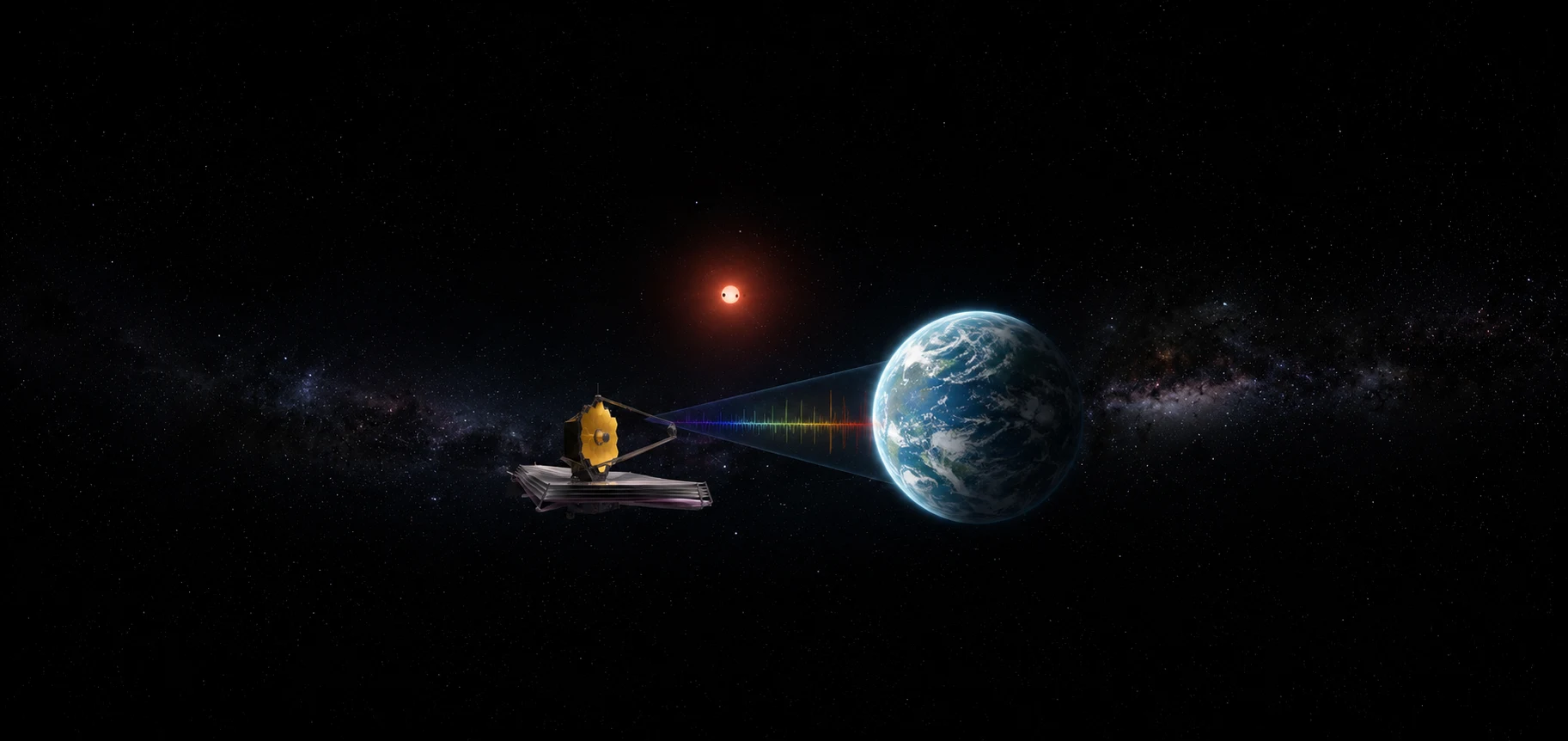
Regardless of its nature, Madhusudhan's team pointed two instruments on the James Webb Space Telescope (JWST) at K2-18b's atmosphere in 2023, watching it pass in front of its star. Methane turned up. So did carbon dioxide. Nobody had confirmed carbon-based molecules in a habitable-zone exoplanet's atmosphere before this. There was also something else in that same paper, easy to miss: a very low-confidence hint of dimethyl sulfide, or DMS. Almost nobody outside the field noticed it at the time.
Is There Life on K2-18b? The 2025 Announcement
Two years later, the same team pointed Webb's MIRI instrument back at the planet and got a stronger read on that same signal. DMS and its close relative DMDS, they said, showed up at roughly three-sigma confidence, a statistical measure of how likely a signal is real rather than a random fluctuation, and three-sigma still leaves meaningful room for doubt. Madhusudhan called it a "revolutionary moment" at the press briefing. The framing was blunt: on Earth, DMS comes from marine life and essentially nothing else.
Scientists didn't directly detect DMS. They detected a pattern of starlight that computer models attempted to explain. The Cambridge team's models fit the data better when DMS was included, while other teams built different models and reached different conclusions.
Why the Claim Faced Scepticism Immediately
Three-sigma corresponds to roughly a 1-in-370 chance the pattern is random noise. Five-sigma, the actual bar the field requires before calling something a discovery, corresponds to roughly a 1-in-3.5-million chance. One in 370 against one in 3.5 million. That's not a rounding difference.
Scientists outside the Cambridge team flagged it almost immediately, and a few pointed out something more specific: DMS breaking down in a real atmosphere should leave ethane behind as a byproduct, and the ethane simply wasn't there. Either their atmospheric model was missing something, or the DMS signal itself wasn't really there.
The Reanalyses
Over the following year, at least five separate research groups took the same publicly available JWST data and tried to reproduce the claim. Schmidt's team (sixteen researchers led by Johns Hopkins planetary scientist Stephen Schmidt) confirmed the methane but found no significant evidence for CO2 or DMS. Welbanks and colleagues (Luis Welbanks, an Arizona State University astronomer and, notably, a former PhD student of Madhusudhan) reached a similar conclusion, describing the whole thing, not unreasonably, as a false alarm. Taylor's independent analysis (Jake Taylor of the University of Oxford, using a method that didn't assume DMS from the start) of the same MIRI data found no statistically significant feature at all.
Kevin Stevenson, another Johns Hopkins astronomer, led a fifth team to the same conclusion, in a paper bluntly titled "K2-18b Does Not Meet the Standards of Evidence for Life." Rafael Luque at the University of Chicago found the same data simply "noisy."
By March 2026, a paper in Astronomy & Astrophysics summarised the state of the evidence (see Go Deeper section below): the claim had been, in its words, robustly discussed and subsequently dismissed.
That's not a single knockout result. It's five separate teams checking the same numbers and none of them finding what the original team found, which in this field is close to as convincing as it gets.
DMS Isn't Only Made By Life
Real or not, the DMS signal on its own was never going to settle the question. DMS has since been found in a comet and separately in the cold gas of the interstellar medium, places nobody thinks host life, which means DMS has at least one confirmed way of forming with no biology involved. That doesn't tell us whether K2-18b's atmosphere has life in it. What it tells us is that DMS alone was never going to be an unambiguous answer either way, even before anyone re-examined the original data.
NASA's Own Verdict
Not every response was a flat rejection. A JPL-led study headed by Renyu Hu took a more careful route, combining new JWST observations with the original data and letting three separate teams build their own independent atmospheric composition models from the same raw data, rather than relying on one team's single interpretation. Their answer for DMS landed at around 2.7-sigma, below the original team's already-uncertain 3-sigma, and far short of the 5-sigma bar the field requires. NASA's own public statement afterwards set the bar plainly: proving something like this needs converging evidence from multiple missions and extensive modelling, not one team's best read of one dataset.
What Would Actually Settle This
This isn't quite a closed case, which is worth saying plainly. The Extremely Large Telescope, once its ANDES spectrograph is operational, should have the resolution to tell DMS apart from the handful of similar molecules that could be mimicking it. If the signal is real, that instrument should be able to confirm it properly. If it isn't, that should become clear too. Either way, K2-18b will probably be one of the first things pointed at once ANDES comes online.
For now, the honest answer is that the best evidence we've had for alien life in years didn't survive contact with scrutiny. Which fits a pattern that keeps showing up in the search for extraterrestrial life: the universe looks like it should be loud, and every time something looks like it's finally answering back, the signal tends to quieten the closer you look at it.
Frequently Asked Questions
Is there life on K2-18b?
There is no confirmed evidence of life on K2-18b. A 2025 announcement of a possible biosignature gas, dimethyl sulfide, was reported at low statistical confidence, and at least five independent research teams have since re-examined the same data and failed to find significant evidence of the gas.
What is the K2-18b biosignature controversy about?
In April 2025, astronomers led by Nikku Madhusudhan reported a possible detection of dimethyl sulfide (DMS) in K2-18b's atmosphere, a gas produced on Earth almost exclusively by marine life. The claim was reported at roughly three-sigma confidence, well short of the five-sigma standard normally required for a scientific discovery, and several independent teams have since failed to reproduce it.
What is a Hycean world?
A Hycean world is a hypothesised type of exoplanet with a thick hydrogen atmosphere over a deep liquid water ocean, with no solid surface. K2-18b has been proposed as a candidate, though some researchers argue that at its likely temperature and pressure, any water present might exist as a supercritical fluid rather than a true liquid ocean.
Could future telescopes settle the K2-18b debate?
Possibly. The Extremely Large Telescope's ANDES spectrograph, once operational, should have enough resolution to distinguish dimethyl sulfide from similar molecules that could be mimicking its spectral signature, potentially confirming or ruling out the original claim.
◆ Also In The Stars

◆ Go Deeper
Recommended
Affiliate links — we may earn a small commission at no cost to you.