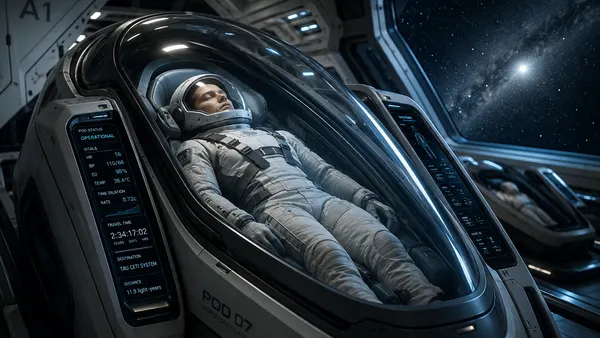
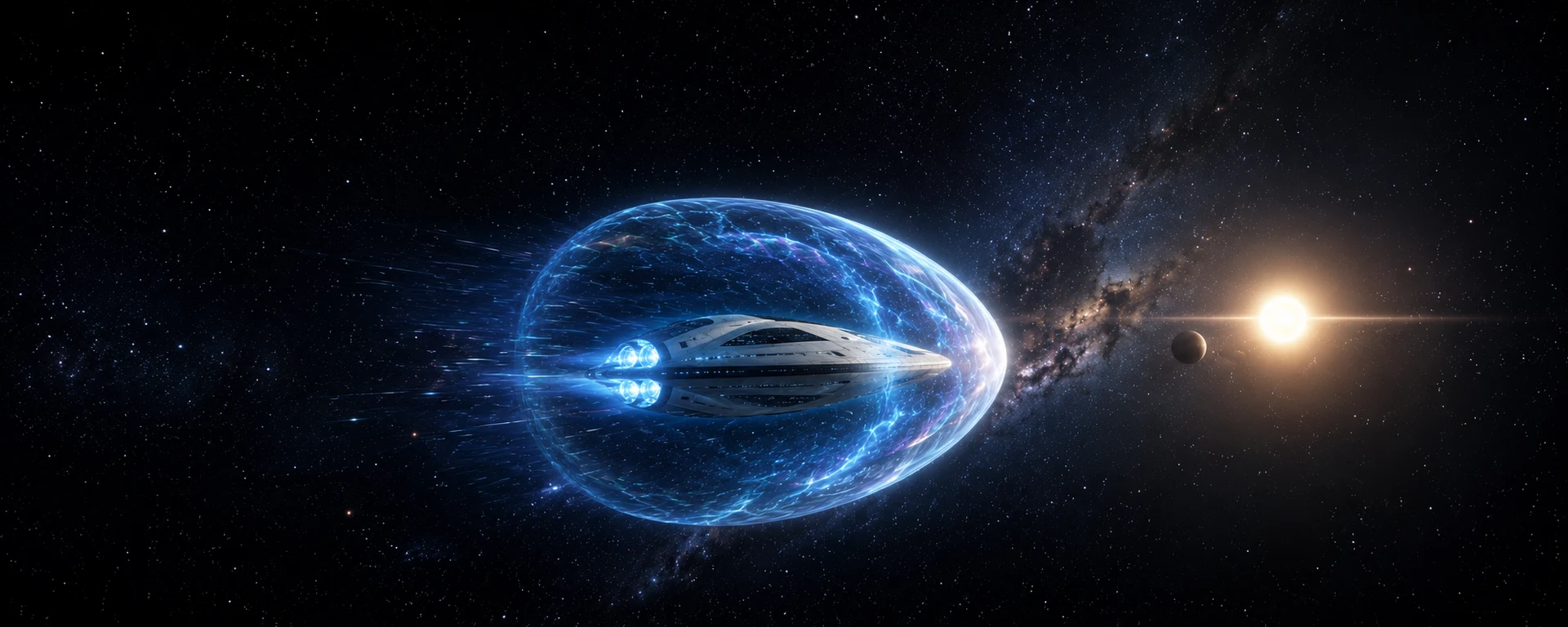
A warp drive doesn't make a ship go faster. It bends the space around the ship instead, carrying it along like a bubble rather than pushing it through the void.
Could the Alcubierre Warp Drive Achieve Interstellar Travel?
◆ In Summary
The Alcubierre warp drive is real physics, a 1994 solution to Einstein's equations that lets a ship reach any speed relative to a distant observer by warping spacetime rather than moving through it. The original version needs exotic negative-energy matter in quantities nobody has ever found. Since 2021, physicists have shown a subluminal warp bubble can be built entirely from ordinary matter, with refinements published as recently as April 2024. The catch is that a subluminal shell loses the self-propelling advantage that made warp drives interesting in the first place, and needs the same conventional rocket propulsion as any other spacecraft. What it does still offer is a way to shield a crew from acceleration entirely, since only the bubble moves, not the passengers inside it. True faster-than-light travel remains exactly where Alcubierre left it: permitted by the mathematics, dependent on matter that has never been shown to exist in usable amounts.
The Speed Problem
I've already gone through why getting a human to another star is hard, and most of that difficulty comes down to one number: even our fastest spacecraft crawl compared to light speed, and chemical or even fusion rockets don't close that gap by nearly enough. If you're not willing to accept a multi-century voyage, whether that means raising generations aboard a ship or keeping the original crew in some kind of stasis, there's really only one other option left on the table. You go faster. Properly, dramatically faster, fast enough that a journey measured in centuries becomes one measured in years. That's the pitch behind the warp drive, and it's the one interstellar propulsion idea most people have actually heard of, mostly from television rather than physics journals. So is it real, or is it just a name borrowed for something that was never going to work?
Could the Alcubierre Warp Drive Achieve Interstellar Travel?
It's real physics, which surprises people. In 1994, Mexican physicist Miguel Alcubierre found a solution to Einstein's equations of general relativity that allows a ship to reach any speed at all relative to a distant observer, with no theoretical upper limit, without ever locally breaking the speed of light. The trick is that the ship itself doesn't move fast at all. Instead, spacetime around it does the moving: the metric compresses space in front of the ship and expands it behind, carrying a flat, motionless bubble of ordinary space along like a wave. From inside, you're stationary. From outside, you've crossed the galaxy. Crucially, the ship doesn't need an engine to do any of this. Spacetime itself carries the bubble, with no reaction mass required. A rocket only ever gets faster by throwing something out the back. A warp bubble doesn't throw anything anywhere.
The Exotic Matter Problem
Alcubierre's solution came with a catch built into the same equations that made it work. Sustaining that kind of spacetime distortion requires exotic matter (matter with negative energy density), the opposite of everything we've ever actually measured, which violates what physicists call the null energy condition. This isn't merely an engineering problem, something a better-built engine could eventually solve. It's a direct requirement of Alcubierre's own equations. Early calculations put the amount of exotic matter needed at more than the mass-energy of the observable universe, which is the kind of number that ends the conversation. The only real-world source of negative energy we've ever measured, the Casimir effect, produces amounts too small to be relevant by many, many orders of magnitude. For most of the concept's history, that's where it stayed: mathematically permitted, physically absurd.
What's Actually Changed
This is where the story stops being "just sci-fi" and gets genuinely interesting. Harold White's 2011 work reshaped the bubble's geometry and brought the exotic matter requirement down substantially. It was still exotic, still theoretical, still nothing anyone could build. The bigger shift came in 2021, when physicists Alexey Bobrick and Gianni Martire showed that a warp bubble doesn't need exotic matter at all, as long as it stays below the speed of light. Built entirely from ordinary, positive-energy matter, a subluminal warp drive turns out to be permitted by general relativity in a way the original faster-than-light version never was.
By April 2024, a joint team from the University of Alabama in Huntsville and Applied Physics (a New York-based propulsion research company) had extended this into a concrete, constant-velocity, purely positive-energy subluminal design. White's team followed up in December 2025 with a refined design distributing the remaining exotic energy requirement into separate engine-like pods rather than one large ring, keeping the interior of the bubble flat and free of tidal forces.
The Catch That Remains
Fixing one problem opened up another. The original appeal of the Alcubierre drive was that the ship doesn't need an engine at all. Spacetime itself carries the bubble along, with no reaction mass required, which is what made it a genuine alternative to rockets rather than just a more efficient one. Bobrick and Martire's subluminal, positive-energy version gives up exactly that property. Their own paper is explicit that a subluminal warp shell moves inertially and still needs external propulsion, the same as any ordinary spacecraft.
So building it from ordinary matter didn't just cap its speed below light, it handed the acceleration problem straight back to conventional rocketry, the same propulsion wall every interstellar concept in this series keeps running into. Whatever speed the shell reaches is entirely down to whatever engine is pushing it, and nothing about being wrapped in a warp bubble makes that engine more powerful or the fuel problem any smaller. The version that kept the self-propelling advantage, true faster-than-light warp travel, is exactly where it always was: mathematically permitted, physically dependent on exotic matter nobody has ever found in usable quantities.
Why Bother, Then?
None of this makes the research pointless, and it's worth being clear about where this all leads us. A conventional rocket can't safely accelerate a human to a meaningful fraction of light speed, because the crew has to endure that acceleration directly, gradually or not. A warp shell sidesteps that specific problem, since the passengers inside a flat, locally stationary bubble never feel the acceleration at all, only the shell does. White's team specifically found no tidal forces and no g-forces acting on the interior, regardless of how the bubble moves outside. It solves the human tolerance problem. Propulsion is still the fundamental one.
Whether true faster-than-light travel is closed off entirely is a separate, still-open question. Physicist Erik Lentz has separately claimed a different kind of solution, a soliton (a self-contained, stable wave of distorted spacetime, rather than Alcubierre's bubble shape), built entirely from positive energy, in 2020. Other physicists dispute the claim on energy-condition grounds, but it suggests the search for a positive-energy FTL drive isn't dead, just contested.
The Verdict
So could the Alcubierre warp drive get a human to another star? A subluminal version, built from ordinary matter, is genuinely no longer science fiction in the sense that it violates no known physics. But it also isn't the shortcut warp drives are famous for, since it needs the same conventional propulsion as any other spacecraft to actually get moving, just wrapped in a more exotic geometry. What it does offer is a way to survive the acceleration a fast conventional trip would otherwise require, which is a real and useful thing, just not the thing most people picture when they hear the word warp.
The version that would actually change the timescale, true faster-than-light travel, still needs matter that exists only in mathematics and, as far as we can tell, in vanishingly small amounts in reality. I think that's a more interesting answer than either "warp drives are pure fiction" or "warp drives are basically solved." It's closer to this: we solved one problem by taking us right back to square one. The exotic matter is gone. So is the shortcut. What's left is the same propulsion wall every interstellar concept in this series keeps running into.
Frequently Asked Questions
Is the Alcubierre warp drive real physics?
Yes. It is a valid solution to Einstein's equations of general relativity, first found by physicist Miguel Alcubierre in 1994. It describes a bubble of spacetime that can move at any speed relative to a distant observer without locally exceeding light speed, though building one is a separate and much harder question.
Does the Alcubierre warp drive need exotic matter?
The original faster-than-light version does, requiring matter with negative energy density in quantities never observed in nature. Since 2021, physicists have shown that a subluminal version, travelling below light speed, can in principle be built entirely from ordinary positive-energy matter.
Would a warp drive make interstellar travel faster?
Only the faster-than-light version would, and that version still requires exotic matter nobody has found. The subluminal version that avoids exotic matter needs the same conventional propulsion as any other spacecraft to reach speed, so it does not solve the timescale problem on its own.
What is the actual benefit of a subluminal warp drive?
It could shield a crew from acceleration forces entirely, since passengers inside the bubble stay in a locally flat, stationary region of spacetime while the bubble itself moves. This could allow safer high-speed travel than a conventional rocket, even though it does not increase the ship's underlying speed.
◆ Also In The Stars

◆ Go Deeper
Recommended
The Physics of Star Trek
Amazon ↗
Affiliate links — we may earn a small commission at no cost to you.