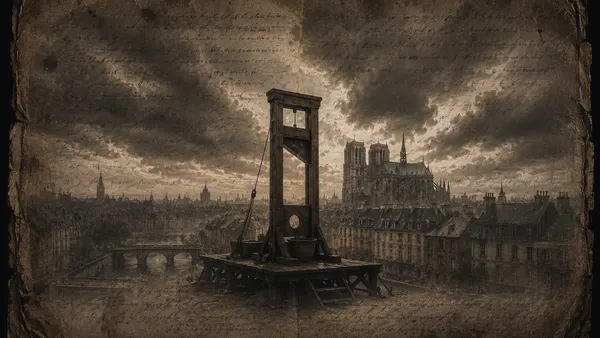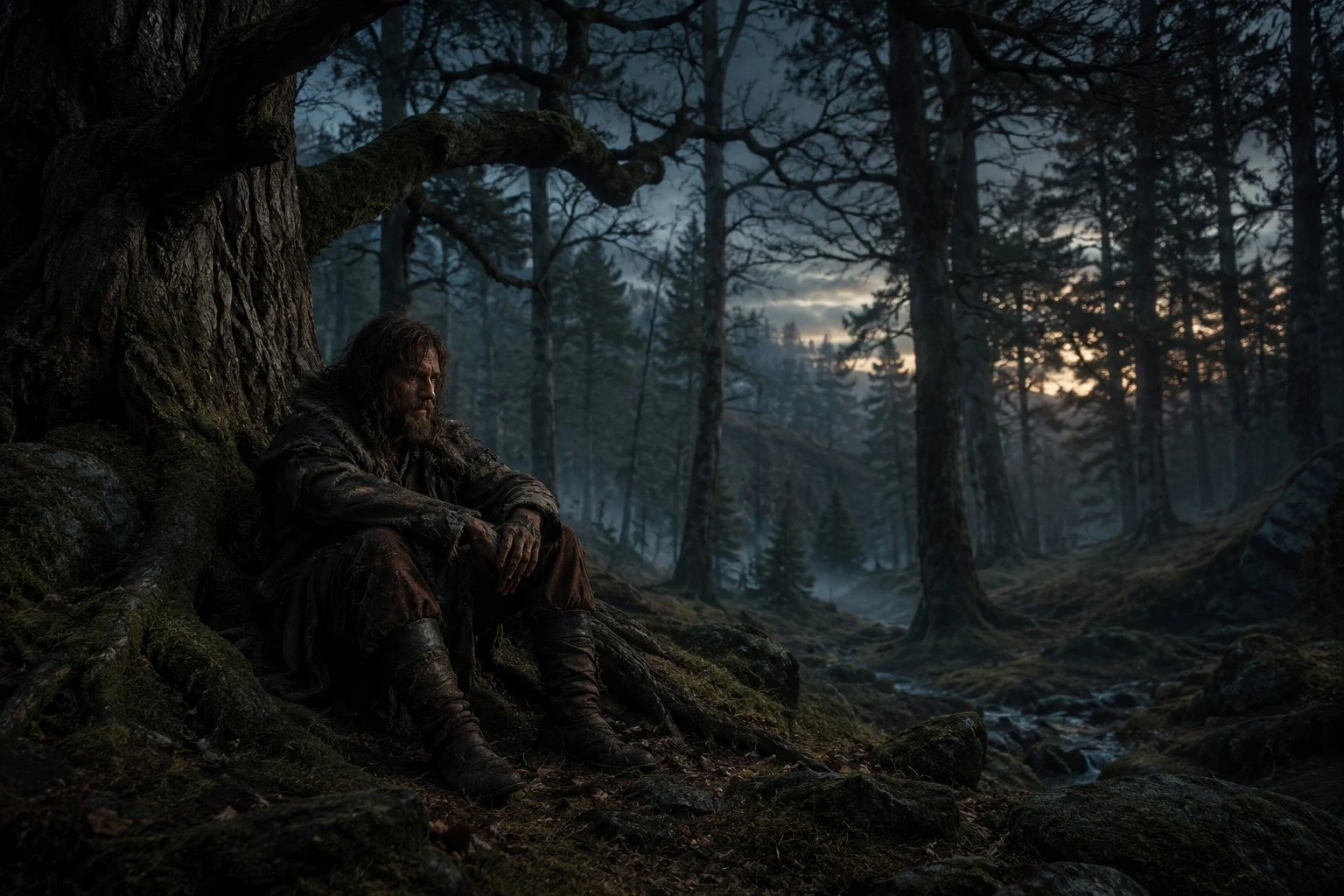
A warrior survives a battle, loses his mind, retreats into the forest and begins to see the future. Centuries later, he returns as Merlin, the wizard of King Arthur's court.
◆ In Summary
Geoffrey of Monmouth invented the Merlin most people recognise in 1136. The figure he drew on was older, Welsh, and had nothing to do with Arthur. Myrddin Wyllt was a warrior who lost his mind at a battle in 573 AD and spent decades alone in a forest making prophecies. Geoffrey's version became a political document used by the Tudors and Welsh resistance movements for centuries.
Saturday evenings in Britain used to belong to Merlin. The BBC series that ran from 2008 to 2012 pulled in audiences of ten million at its peak, a young warlock bumbling around Camelot with Colin Morgan's eyebrows doing most of the dramatic work. Before that there was Disney's The Sword in the Stone, Merlin as a bumbling academic with an owl on his shoulder, turning young Arthur into fish. Most British people have grown up with some version of him. I certainly did. He is part of the furniture. But the "real Merlin," if such a person existed, was a very different figure from any of those versions.
A Welsh cleric called Geoffrey of Monmouth is responsible for creating the Merlin story familiar to us now, presenting the fictional tale in his Historia Regum Britanniae completed around 1136. It chronicles the supposed kings of Britain, tracing their lineage back to Troy, translated he said from a very ancient book in the British language that a friend had given him. That source almost certainly didn't exist. But the framing appeared serious, the Latin was authoritative. Merlin was introduced as the architect of a reign that almost certainly never happened, adviser and enabler to a king whose historical existence remains, at best, a matter of educated guesswork.
At the time of publication, some readers were sceptical, not about Merlin specifically, but about the history surrounding him. William of Newburgh called the whole chronicle a tissue of fictions. For the period, that is a fairly withering verdict. But it didn't matter. The Historia spread anyway, copied and recopied across Europe until it became one of the most widely read chronicles of the medieval period. The story of Merlin had taken hold. More than two hundred manuscripts of the Historia survive today, which by medieval standards is close to saturation.
Who Was the Real Merlin?
Geoffrey did not invent the story of Merlin entirely. He created a composite character, assembled from at least three separate figures that had no connection to each other in the older tradition. One came from the Dinas Emrys legend, a story about a fatherless boy whose blood was sought to stabilise a collapsing tower. Another came from the northern wild man stories, the homo sylvestris figure common to several Celtic traditions.
The third and most significant source, and the closest thing we have to a historical Merlin, was one that may have circulated in Welsh oral tradition for generations before being written down. Myrddin Wyllt was a warrior who survived the battle of Arfderydd in around 573 AD, fought somewhere in what is now southern Scotland between two rival kings. Myrddin watched his lord Gwenddoleu killed in the fighting and, according to the Welsh tradition, then fled to the Caledonian Forest and lived among the animals. It was here, driven mad by what he had witnessed, that Myrddin is said to have begun prophesying. Grief recorded in verse, and inside the grief, something that looked like foresight.
The Prophecies Behind Merlin
What Myrddin actually said, or was said to have said, is worth considering. The verses attributed to him in the Welsh tradition are not the grand prophetic declarations most people would expect. They are stranger than that, and considerably more unsettling.
In one poem he addresses an apple tree directly, telling it that it will not be harvested this year because the men who would pick its fruit are dead, killed at Arfderydd. The grief is right there on the surface, barely coded at all. In another he speaks to his pig, his only companion in the forest, and ranges between lament and prophecy without any clear boundary between the two. These are not the utterances of a court seer. They read like a man who has lost his mind and found something else in its place.
The political prophecies sit alongside this personal material. He predicts that the Britons will eventually reclaim their island from the Saxons, that a great king will come, that the eagle will return to its mountain. These were the passages that later readers latched onto. They were vague enough to be applied to almost any conflict, specific enough to feel like genuine foresight. Welsh resistance movements across several centuries read them as promises. The Normans, having replaced the Saxons as the occupying power, fitted the prophecies neatly enough that nobody needed to update them.
The Myrddin tradition meant something specific to the Welsh. These weren't curiosities or entertainment. They were prophecies of resistance, circulating in a culture that had been under sustained pressure for centuries, first from the Saxons, then from the Normans after 1066. A figure who had allegedly seen the future conflicts of his people, whose words had survived in oral tradition for generations, functioned as something close to evidence that Welsh suffering was not permanent. That it had been anticipated. That it would end.
How Geoffrey of Monmouth Created Merlin
Geoffrey understood the weight of what he was handling. He had grown up in a Britain where the Norman conquest was within living memory and Welsh identity was a live and contested thing. When versions of the prophetic material began circulating separately in the 1130s, before the full Historia appeared, he wasn't simply publishing a curiosity. He was releasing something that already carried enormous cultural charge, now dressed in Latin and aimed at a European audience that had never encountered it before. He kept the prophecy and discarded everything that explained it, the madness, the grief, the broken warrior in the forest. What remained was portable, authoritative, and entirely detached from its origins.
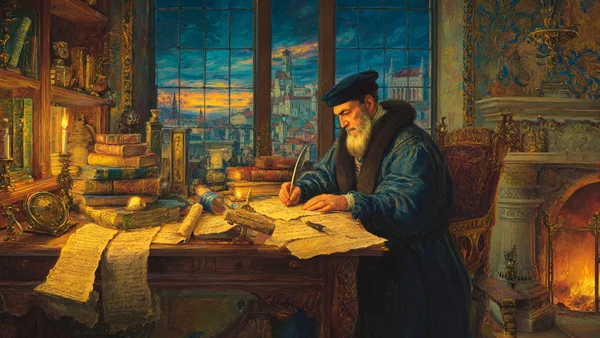
The consequences took centuries to fully unfold. The Tudors invoked the prophecies to legitimise their claim to power. Welsh resistance movements reached for them across centuries of English occupation. What had started as a sixth-century warrior's grief recorded in verse became a political instrument, and it stayed one for a very long time. Centuries later, Nostradamus would acquire a similarly enduring reputation. Different tradition, same mechanism: prophecy that outlived its origins and kept being useful to people who needed it.
A Latin Toilet Joke
The naming of the court wizard contains a small, revealing detail. Geoffrey needed to Latinise Myrddin for his chronicle, and the phonetically obvious rendering was Merdinus. He did not use it. The nineteenth-century medievalist Gaston Paris suggested why. The original form sat too close to the Latin merda, meaning faeces, for anyone's comfort. A small act of editorial judgement, but consequential. It is worth pausing on the fact, and I do find myself pausing on it, that the name most people associate with wisdom, mystery and the deep magic of Britain was changed to avoid a Latin toilet joke. The figure we have inherited was shaped at every stage by decisions like that one.
What Each Era Kept
Each generation takes what it needs from a legend and quietly disposes of the rest. Merlin has been through more of that process than most. Thomas Malory compiled Le Morte D'Arthur in 1469, and by then the figure had accumulated things Geoffrey never put there. The imprisonment by Nimue. The love story that made it possible. The final vanishing, which Geoffrey himself had not included. Disney turned him into comedy. The BBC gave him youth and made the magic a secret he had to hide. Every adaptation documents what its moment wanted him to be. What none of them wanted, apparently, and I include the BBC in this, was the original: a broken warrior in the Caledonian wilderness, talking to trees, whose capacity for prophecy came directly from what he had lost.
Was Merlin a Real Person?
Whether there was a real person at the root of any of this is, in the end, unknowable. Some sources place Myrddin Wyllt's life from around 540 to 584 AD, a bard of some standing who ended his days as a madman and prophet somewhere in the forests of what is now the Scottish Borders. The dates are plausible. The geography fits the Arfderydd story. But the historical record is thin, and certainty is not available. A tradition reaching back to the sixth century has passed through too many hands to be disentangled cleanly now. The next part of this series will look at what those hands actually did with it.
Frequently Asked Questions
Who was the real Merlin?
The historical figure behind Merlin is most likely Myrddin Wyllt, a sixth-century Welsh warrior and bard who lost his sanity at the Battle of Arfderydd in around 573 AD. He is recorded in Welsh poetry as a wild man living in the Caledonian Forest, where he is said to have developed prophetic powers through his madness.
Was Merlin a Real Person?
Geoffrey of Monmouth invented the Merlin of popular legend in his Historia Regum Britanniae, completed around 1136. He drew on older Welsh material about a figure called Myrddin, but combined it with other sources and attached the character to King Arthur, which had no basis in the earlier tradition.
What is the Black Book of Carmarthen?
The Black Book of Carmarthen is a thirteenth-century Welsh manuscript held by the National Library of Wales. It contains some of the oldest surviving poetry associated with Myrddin Wyllt, including verses in which he addresses an apple tree and a pig while making prophecies from his forest exile.
Why was Merlin's name changed from Myrddin?
When Geoffrey of Monmouth Latinised the name Myrddin for his chronicle, the phonetically obvious rendering would have been Merdinus. He chose Merlinus instead to avoid the resemblance to the Latin merda, meaning faeces. The medievalist Gaston Paris identified this as the reason the name was altered.
◆ Also In The Stars

◆ Go Deeper
Recommended
Affiliate links — we may earn a small commission at no cost to you.