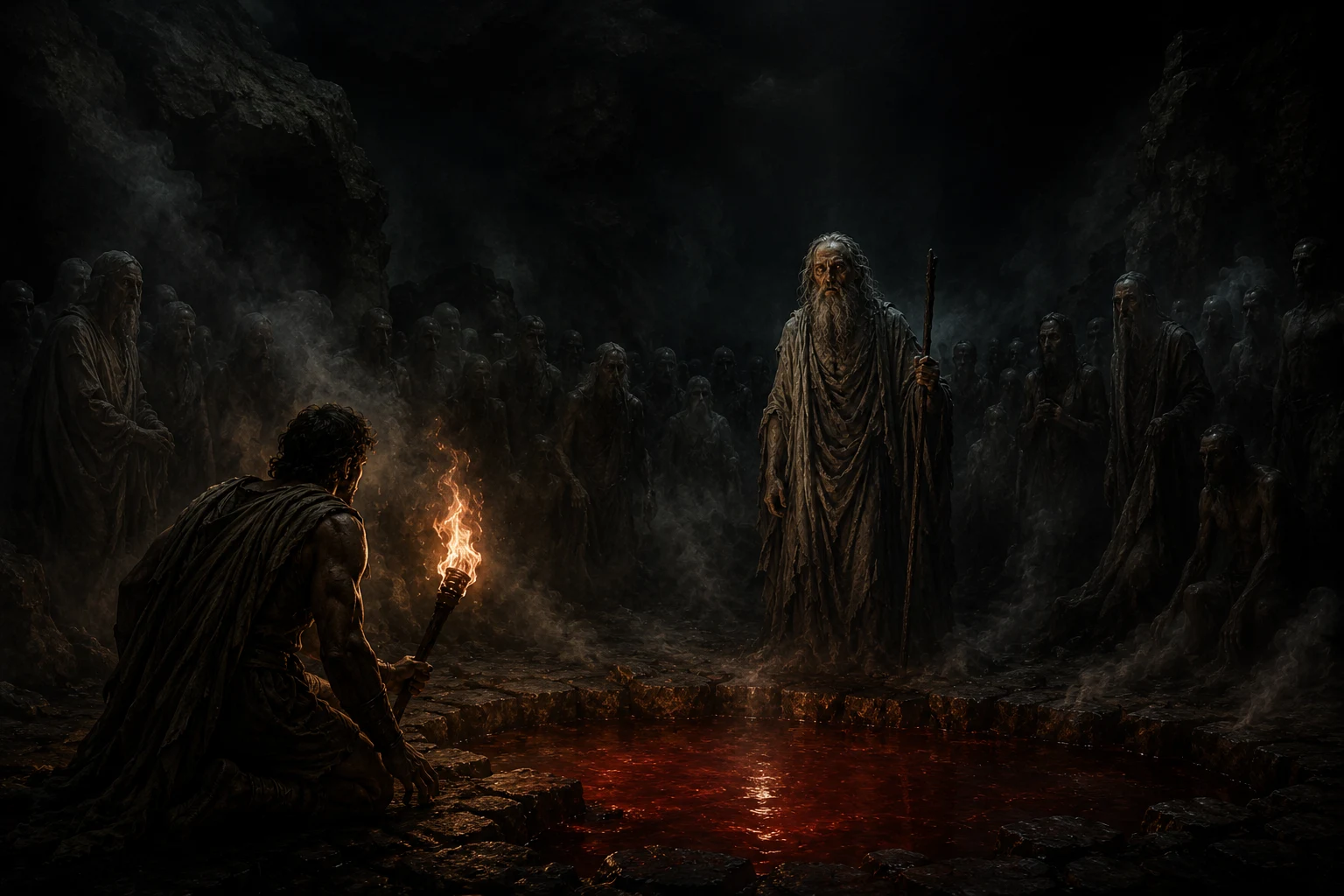
Blinded by the gods and granted sight into the future in exchange, the seer of Thebes told three kings exactly what was coming. None of them listened.
◆ In Summary
Tiresias was the blind prophet of ancient Greek mythology, appearing in Homer's Odyssey, Sophocles's Oedipus Rex and Antigone, and Euripides's Bacchae. Blinded by the gods and granted the gift of prophecy as compensation, he served as seer to the city of Thebes for seven generations. He warned Oedipus, Creon and Pentheus about what was coming. All three ignored him. All three were destroyed. T.S. Eliot later placed him at the centre of The Waste Land as the only figure who had lived long enough, and suffered enough, to witness everything.
Christopher Nolan's adaptation of Homer's Odyssey opens in cinemas on 17 July. As I write this, the specific scenes of the film aren't known yet, but I'm hoping he decides to cover the events in Book 11. At this point of the story, Odysseus is at the edge of the world, trying to find a blind prophet. He has been lost for years, and the sorceress Circe has told him that the one person who can help him return home is Tiresias. The complication is that Tiresias has been dead for some time. I won't spoil any of the plot points, but suffice to say, Tiresias delivers what Odysseus came for: an accurate account of what lies ahead, including a warning his men will ignore with fatal consequences.
Who Was Tiresias?
By the time Homer was writing, Tiresias required no introduction. He appears in the Odyssey already dead, already the obvious person to consult, with no explanation of who he is or why he matters. That's how you know a character is truly embedded in a culture, when the poet assumes the audience already knows.
Tiresias was a Theban, which is worth pondering. Not an Athenian, which gets the philosophers and the democracy story. Not a Spartan, which gets the military one. Thebes was the third great power of classical Greece, and the city the Greeks chose to set their most devastating myths in. Oedipus tearing his own eyes out. Antigone buried alive. Pentheus torn apart by his own mother who does not recognise him. There is a pattern there, and it is not accidental. Cadmus founded it, according to the myth, by following a divine cow until it lay down and stopped. The Greeks chose that city as the place where those in power faced the severest of consequences for their actions.
The Myth of Tiresias
The son of a shepherd and a nymph named Chariclo who served the goddess Athena, Tiresias was no ordinary Theban. Destiny had marked him for a power that came at a considerable personal price. Quite how he came by that power, though, depends on which ancient source you consult.
The more widely known version is the one that involves snakes. As a young man, walking on Mount Cyllene, Tiresias encountered two snakes mating. Pehaps through disgust or a simple reflex action (the sources differ on why he intervened), he struck them with his staff. Whatever the reason, he was immediately transformed into a woman. Ovid, writing in the Metamorphoses, says he lived that way for seven years, married, and even gave birth. His daughter Manto became a prophetess herself. In the eighth year, Tiresias came across mating snakes again, struck the male this time, and was restored to his original form.
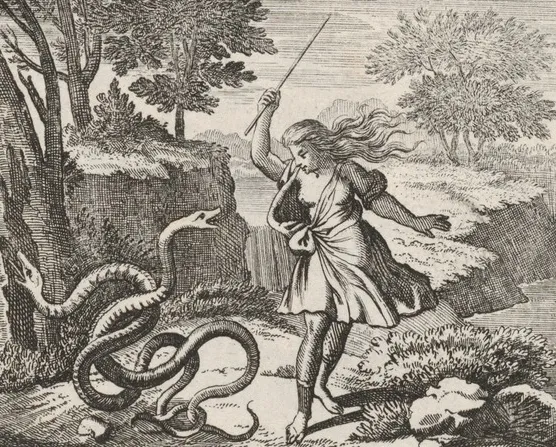
This made him, in the logic of the ancient world, uniquely qualified to answer a question nobody else could. Zeus and Hera were mid-argument about which sex derives greater pleasure from love. Unable to settle it between themselves, they summoned Tiresias, the only living person who could answer from experience rather than opinion. He told them women do, by a considerable margin. Hera, apparently deciding this particular truth should have stayed private, struck him blind on the spot.
There is something almost comic in that sequence that the Greeks built in deliberately. The king and queen of the gods having a domestic dispute, dragging in a mortal to adjudicate, and then one of them blinding him for giving the honest answer. Zeus could not undo what another Olympian had done. That was not the done thing. Instead, he chose to compensate Tiresias in another way, giving him the gift of prophecy and a lifespan long enough to make the most of it.
The alternative pathway to prophetic powers, preserved in Callimachus's Hymn to Athena, arrives at the same destination by a completely different route. Here, there are no snakes and no divine argument. Tiresias is a young man walking on Mount Helicon with his mother Chariclo, who accompanies the goddess Athena. He wanders from her side and stumbles upon Athena bathing. The encounter is entirely accidental. Divine nakedness is divine nakedness, regardless of intent. Athena blinds him on the spot.
Chariclo begs the goddess to reverse it. She cannot but, similarly to Zeus in the other version, offers compensation instead: Tiresias will understand the language of birds, a legitimate form of divination in the ancient world, and will have a staff to guide him through his blindness. He will live far longer than any man has a right to expect. And when he dies he will keep his mind. That is what allows him to receive Odysseus in the underworld centuries later and provide his prophecy.
Two contradictory stories, two different goddesses, one outcome. What both versions agree on is the underlying logic: blindness as the price of knowledge, prophecy as the compensation. You lose the ability to see the world as it is, you gain the ability to see it as it will be. The Greeks returned to this trade repeatedly because they found something true in it.
Ovid and Callimachus tell us how Tiresias acquired his gift. The playwrights are where you see what he actually did with it.
Tiresias in Greek Tragedy
In Sophocles's Oedipus Rex, Tiresias walks on stage knowing the full truth of Oedipus's parentage, that Oedipus killed his own father and married his own mother Jocasta, and that the plague destroying Thebes is a direct consequence. Oedipus calls him a liar and a fraud, accuses him of conspiring with Creon, Jocasta's brother, and works himself into a considerable rage. None of it is surprising. Tiresias has been delivering unwelcome truths to people who don't want them for seven generations, and the reaction is always roughly the same. He leaves without pressing the point. The truth arrives anyway, through other means, and by the time it does Oedipus has blinded himself with the brooches from his dead mother's dress.
Antigone, also by Sophocles, is the next chapter in the same story, with Creon now on the throne of Thebes. Tiresias comes to tell Creon that the gods are displeased. Creon has left a body unburied as a political statement, which to the Greek religious sensibility was roughly equivalent to desecrating a temple. Creon calls him a mercenary prophet and sends him away. He comes back to his senses eventually, but not before his son and wife are both dead.
In the Bacchae, set before the time of the Oedipus plays, Euripides dramatises an existential threat to Thebes. In the Sophocles plays, ignoring Tiresias leads to human tragedy, Oedipus destroys himself, Creon loses his family. In the Bacchae, the consequences are divine and immediate. Tiresias warns King Pentheus that the stranger he has imprisoned is actually the god Dionysus. Pentheus doesn't believe him. Dionysus drives the women of Thebes into a frenzy on the mountainside, and Pentheus ends up dismembered by his own mother who does not recognise him.
Tiresias and the Oracle at Delphi
Three plays, three rulers, three warnings ignored. The pattern holds in every one of them. Tiresias does not appear to prevent disaster. He appears so that when disaster arrives, nobody can claim the warning was not given. Prophecy as record, not just prediction. The tragedy is never that the future was hidden. It is that the future was stated plainly and dismissed by the person who most needed to hear it.
That idea ran well beyond Thebes. When pilgrims made the journey to the Oracle of Delphi to consult the Pythia, the most important oracle in the ancient Greek world, what they were participating in was a set of beliefs the Tiresias myths had already given shape to: that foreknowledge is real, that it reaches the living through a chosen intermediary, and that even when the words are accurate the person receiving them will probably find a way to get it wrong. The Pythia channelled Apollo and delivered her answers in verse. Her questioners left satisfied and went on to misread them. Tiresias did not found Delphi or inspire it in any documented sense. He is a fictional character. What he reveals is what the Greeks already believed about prophecy before any institution existed to organise it.
Tiresias in Homer's Odyssey
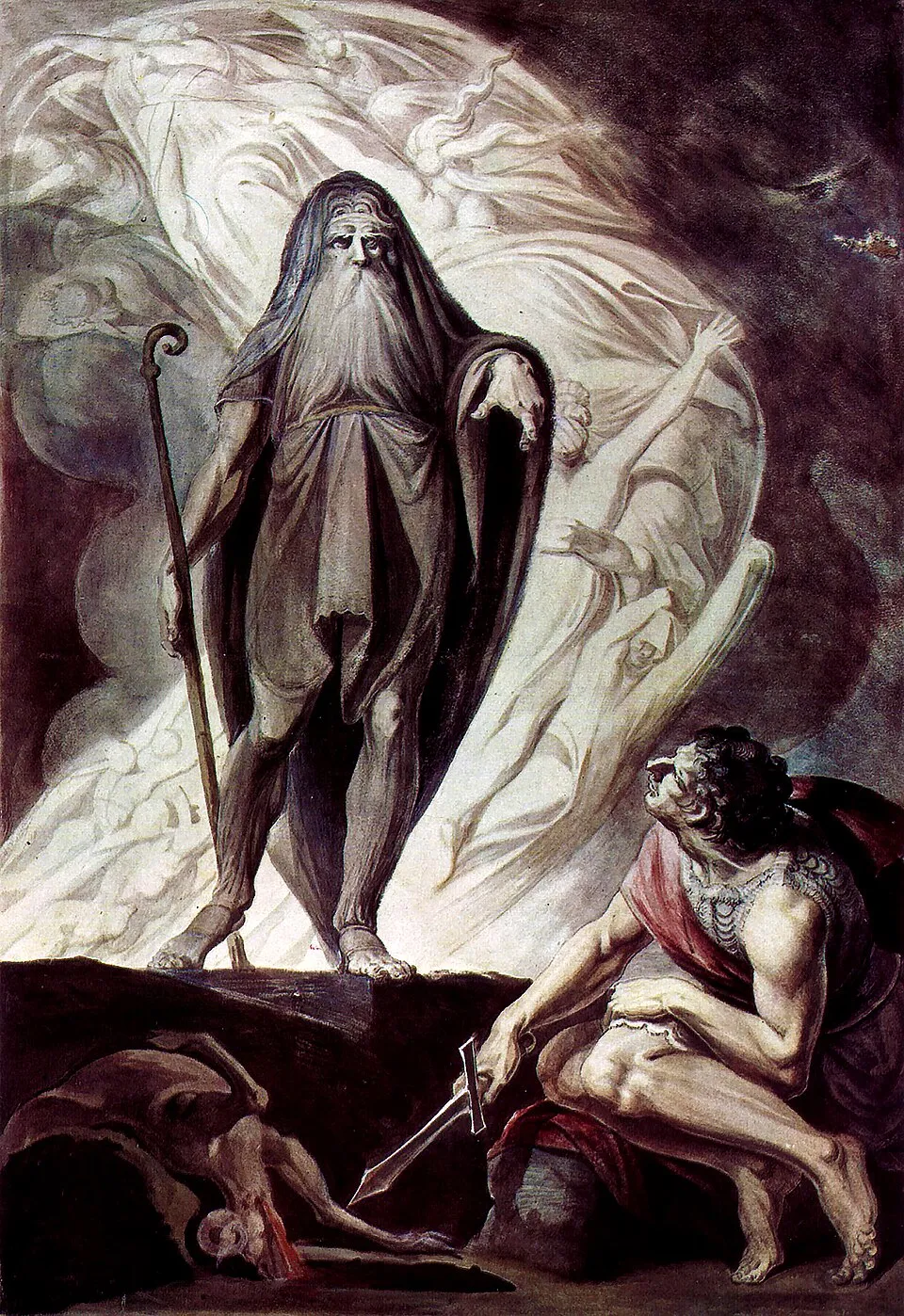
The Odyssey appearance, which is where Nolan's film may or may not be heading, is the oldest surviving literary source for the character. Homer composed the poem somewhere around 725 to 675 BC, and what is telling is that Tiresias requires no introduction. He is already dead, already resident in the underworld, already the obvious person to consult when a hero cannot find his way home. Odysseus is sent there by the sorceress Circe, performs the blood sacrifice at the edge of the world, and waits.
Among the shades that gather, the other dead have lost everything: memory, recognition, the ability to think. Tiresias alone still has his mind. He finds Odysseus, tells him Poseidon's anger will follow him home, and is extremely clear about the cattle of Helios on the island of Thrinacia. Do not touch them. The men touch them. Odysseus arrives in Ithaca alone.
Prophesying from beyond death is a device Homer uses only once, and Tiresias is the only figure in the Greek tradition who does it. Every other shade in the underworld has lost their mind along with their life. Tiresias alone retains his gift. Whether Homer found that detail waiting for him in the oral tradition or invented it to solve a narrative problem is genuinely unclear. Odysseus needs reliable information, and a dead prophet who still works is considerably more useful than a living one he would have to travel back to find. What we can say is that Homer treats it as though the audience already knows it, which either means it was established, or that he was confident enough to present his invention as fact.
Tiresias in The Waste Land
T.S. Eliot put Tiresias at the centre of The Waste Land and identified him in the notes as the poem's unifying consciousness. "Old man with wrinkled female breasts," the note reads, which is not a flattering description but is a precise one. Eliot needed someone who had been both things, who remembered everything, who watched the modern world from a position of complete temporal detachment. There was only one candidate in the tradition and Eliot knew it.
The Greeks were not sentimental about what they had built into this character. Tiresias is right about everything, for three thousand years of story, and it makes very little practical difference. The warning gets given. The warning gets ignored. Whether Nolan finds a place for him on screen this summer or not, that part has been running since before any of us arrived.
Frequently Asked Questions
Who was Tiresias in Greek mythology?
Tiresias was a blind prophet from Thebes who appears across Greek mythology and literature spanning roughly three thousand years of story. Blinded by the gods and granted prophecy as compensation, he served as seer to the city of Thebes and appears in Homer, Sophocles and Euripides among others.
How did Tiresias become blind?
There are two versions. In the more widely known account, preserved by Ovid, Tiresias was blinded by Hera after settling a divine argument between her and Zeus. In the alternative version from Callimachus, he accidentally saw the goddess Athena bathing and was blinded on the spot. Both versions end the same way: blindness exchanged for the gift of prophecy.
What did Tiresias predict?
Tiresias warned Oedipus that he had killed his own father and married his own mother, warned Creon in Antigone that leaving a body unburied would bring divine punishment, and warned King Pentheus in the Bacchae that the stranger he had imprisoned was the god Dionysus. All three ignored him. All three were destroyed.
Why does Tiresias appear in T.S. Eliot's The Waste Land?
Eliot identified Tiresias in his notes as the most important personage in the poem and its unifying consciousness. He needed a figure who had lived as both man and woman, remembered everything, and could observe the modern world from a position of complete temporal detachment. Tiresias was the only candidate in the tradition who fitted.
◆ Also In The Stars

◆ Go Deeper
Recommended
Affiliate links — we may earn a small commission at no cost to you.