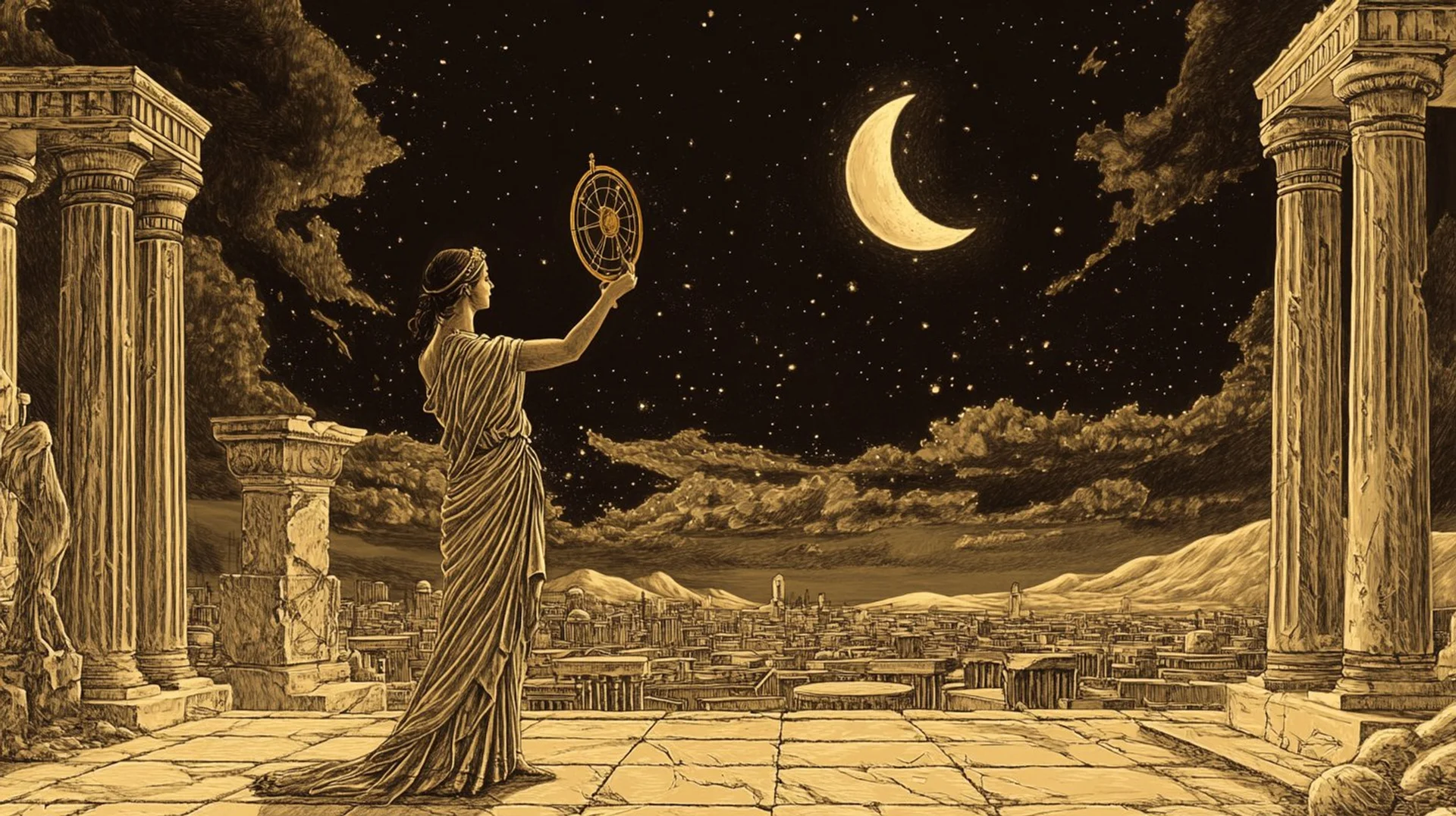
Hypatia of Alexandria was a mathematician, astronomer and philosopher murdered in 415 AD. Almost none of her work survives, yet few figures from the ancient world have been claimed, reinvented and argued over more fiercely.
◆ In Summary
Hypatia of Alexandria was a mathematician, astronomer and philosopher murdered by a mob in 415 AD. Almost none of her writing survives. What has survived is a story that every subsequent century has rewritten to suit itself. Whether that is a tribute to her significance or a measure of how little anyone has bothered to find out who she actually was is a question worth sitting with.
◆ At a Glance
| Born | c. 360 AD, Alexandria |
| Died | March 415 AD, Alexandria |
| Father | Theon of Alexandria |
| Field | Mathematics, astronomy, philosophy |
| Notable student | Synesius of Cyrene (later Bishop of Ptolemais) |
| Killed By | Mob, widely associated with the parabalani |
| Surviving works | None confirmed as solely hers |
Who Was Hypatia of Alexandria?
In March 415 AD, a woman was pulled from her chariot on the streets of Alexandria and murdered by a mob.
Hypatia was the daughter of Theon of Alexandria. Most accounts of her life start there and, frankly, don't get much further. Theon spent his career editing Euclid and correcting the astronomical tables of his day, the kind of work that keeps the lights on in mathematics without anyone particularly noticing. Theon was independently significant, but Hypatia's reputation has done his no harm. The distinction matters. She worked on Diophantus's algebra and Apollonius's conic sections, and what she produced appears to have gone beyond summary, though the evidence is frustratingly incomplete.
Hypatia as a Public Intellectual
She was also, unusually, a public intellectual. She wore the philosopher's cloak and lectured openly, which in a Roman province in the early fifth century was not a neutral act for a woman. She moved publicly through the city, and ancient sources describe her travelling by chariot, which in context was not a neutral image. Her students came from across the empire, Christian and pagan alike, which in fifth century Alexandria was a more complicated arrangement than it sounds. Synesius of Cyrene is the one we know most about, mainly because he kept writing to her long after he left. He became a bishop eventually. His letters to Hypatia read less like a former student's gratitude and more like genuine intellectual dependence.
The Politics of Fifth Century Alexandria
Alexandria in the early fifth century was not a good city to be conspicuous in. Nobody was really in charge, which suited some people considerably better than others. Orestes, the Roman prefect, was trying to maintain civil order in a place that had more competing factions than it could manage. Cyril had recently been appointed Bishop and was moving fast. Socrates Scholasticus reports that he expelled the Jewish community from Alexandria, consolidated religious authority, and made clear he was not interested in rivals. Hypatia advised Orestes. Her association with him was, by most accounts, a significant factor in what followed.
How Did Hypatia Die?
The murder was carried out by a mob often identified as the parabalani, a group that modern historians tend to describe as a Christian paramilitary organisation, nominally set up around hospital work. They pulled her from her chariot, dragged her to the Caesareum, and killed her. The ancient sources are vague on the method, which is either an oversight or a deliberate one. Roof tiles or potsherds, depending on which account you read. Her remains were burned. Whatever the centuries since have made of it, this is best understood not primarily as a confrontation between science and religion. It was a power struggle in a failing provincial city, and Hypatia was caught in the middle of it.
What Survives of Hypatia's Work?
Almost none of her actual writing survives. What we have are her father's texts, which later tradition often credits her with improving, and the letters of Synesius. The void has been filled repeatedly by whoever needed her most. The Enlightenment made her a martyr for reason. The nineteenth century turned her into a romantic heroine. Twentieth century feminism recovered her as an erased genius. None of these versions are entirely dishonest, but none of them are particularly interested in Hypatia either. They are about the people doing the reading.
The Woman Behind the Symbol
The actual woman, what she thought, what she was working on, what she made of the city disintegrating around her, is almost entirely out of reach. That is the real loss. It is less convenient as a symbol than her death, which is probably why nobody talks about it.
Frequently Asked Questions
How did Hypatia of Alexandria die?
Hypatia was pulled from her chariot by a mob in Alexandria in March 415 AD and killed. Her remains were burned. The murder is best understood as a consequence of a political power struggle between the Roman prefect Orestes and Bishop Cyril rather than a simple conflict between science and religion.
What did Hypatia of Alexandria work on?
She produced commentaries on major mathematical texts including Diophantus's Arithmetica and Apollonius's Conics. Her contributions appear to have gone beyond summary, though almost none of her writing survives independently.
Who was Hypatia's father?
Theon of Alexandria, a mathematician and astronomer who edited Euclid and corrected astronomical tables. Hypatia was educated by him and collaborated on several of his works.
Was Hypatia a pagan or a Christian?
She was a Neoplatonist philosopher in the pagan intellectual tradition. Her students included both pagans and Christians, which was unusual for the period and contributed to the political tensions surrounding her death.
Why is Hypatia of Alexandria still famous?
She is one of the few named women mathematicians and philosophers of the ancient world, and her death has been claimed and reshaped by successive movements. The Enlightenment made her a martyr for reason. Romanticism turned her into a tragic heroine. Twentieth century feminism recovered her as an erased genius. Each found in her story what it needed.
What happened to Alexandria after Hypatia's death?
The city never recovered its former standing. Alexandria had been the dominant seat of learning in the Mediterranean world for centuries, and the decades following Hypatia's murder marked the end of that. Other cities had philosophers. None replaced what Alexandria had been: a living tradition of teaching and enquiry that connected students directly across generations. Her death did not cause that decline on its own, but it is the moment historians tend to reach for when they need to mark where it ended.
◆ Also In The Stars



◆ Go Deeper
Recommended
Affiliate links — we may earn a small commission at no cost to you.