NASA proved it can knock an asteroid off course. Everything needed to actually use that fact, detection, funding, coordination, is still years behind the technology.
◆ In Summary
NASA's DART mission proved that humanity can deflect an asteroid. What it didn't prove is that the problem is solved. Detection is incomplete, funding is inadequate, and the international governance needed to coordinate a real response has never been tested. The technology works. Everything around it is still catching up.
◆ At a Glance
| DART impact date | 26 September 2022 |
| Target | Dimorphos, a 160-metre asteroid |
| Result | Orbital period shortened by 33 minutes |
| Near-Earth objects in the 140-metre range found so far | Fewer than 50% |
| Vera Rubin Observatory | Began science operations 2025 |
| ESA Hera mission | Currently en route to survey the DART impact site |
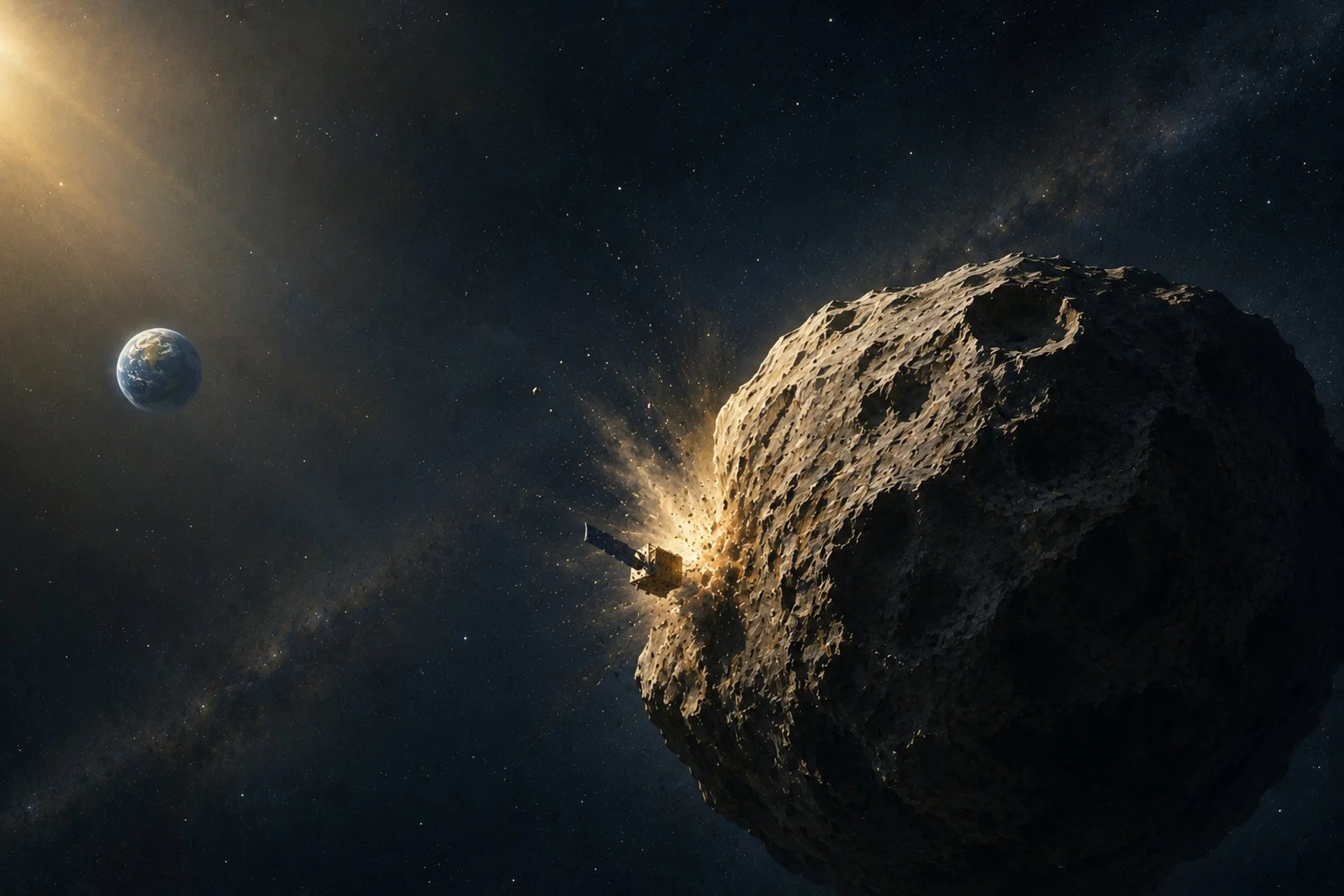
In September 2022, NASA deliberately crashed a spacecraft into an asteroid. Not because the asteroid was heading for Earth (it wasn't). Nobody had ever tried redirecting one before and it seemed, frankly, like the responsible thing to do before the situation became urgent. The results were not what the cautious end of the room had predicted.
The DART mission is the most visible thing planetary defence has produced in decades of trying to get taken seriously. It is worth understanding what it actually proved and what it didn't, because the gap between those two things is where most of the hard problems still live.
What the DART Mission Actually Proved About Planetary Defence
What DART proved is that a kinetic impactor, essentially a very expensive battering ram, can alter the orbit of a small asteroid. Dimorphos was roughly 160 metres across, city-killer scale in the language planetary defence researchers use when they want a politician's attention, and its orbital period around the larger asteroid Didymos shortened by 33 minutes after impact. Which sounds modest until you consider that any change at all was the question being tested. The result exceeded NASA's minimum threshold for mission success by a margin that surprised people who had quietly expected something messier.
ESA's Hera mission is now en route to survey what the impact actually did to the rock's interior, and that data will be considerably more useful than the headline figure. An asteroid's response to being hit depends heavily on composition and internal structure, and those things vary enormously. A loose rubble pile behaves nothing like solid rock.
What It Didn't Prove
What DART didn't prove is that the problem is solved. Dimorphos was not on a collision course with anything. The test was conducted under controlled conditions, with years of preparation, against a target selected partly because it was convenient. A real deflection scenario looks rather different. It requires finding the object early enough, meaning years or decades of advance warning at minimum, then characterising it well enough to know what kind of intervention might work. Getting something into space in time is the third problem, and each of those steps has complications the others don't.
The Detection Problem
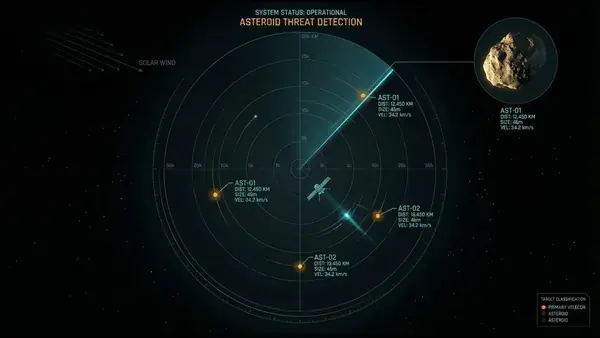
Detection is where the money gap shows up most clearly. NASA's current survey programmes have catalogued the vast majority of near-Earth objects larger than a kilometre, the ones capable of civilisation-ending impacts, but the smaller objects are a different matter. Objects in the 140-metre range are thought to number in the tens of thousands, and fewer than half are thought to have been identified. That is the kind of statistic that tends to get buried in technical reports rather than read aloud in congressional hearings, for reasons that probably say more about politics than science. The Vera Rubin Observatory in Chile, which began commissioning observations in 2025 and is expected to transform asteroid detection efforts, should accelerate detection significantly. But it will take years, and detection is where the problem starts, not where it ends.
Could DART Stop a Real Asteroid Threat?
The honest answer is: possibly, under the right conditions. A kinetic impactor works, as DART demonstrated. But the conditions matter enormously. The object needs to be found early enough, characterised well enough, and the mission needs to reach it with sufficient lead time for the change in trajectory to accumulate. Deflecting an asteroid years before a predicted impact requires a much smaller nudge than deflecting one with only months to spare. The difference between those two scenarios is not engineering, it is time, and time depends entirely on detection. DART proved the nudge works. Whether humanity will ever have the warning it needs to use that knowledge is a different question.
The Politics Nobody Wants to Talk About
The politics are harder to fix than the technology, which is saying something. Planetary defence requires international coordination at a level that most other scientific endeavours do not. An asteroid on a collision course does not respect national jurisdictions, and the decision about how and whether to deflect it involves consequences that fall unevenly across different parts of the world. A deflection attempt that slightly miscalculates the change in trajectory could shift an impact from one country to another. These are not hypothetical edge cases, they are precisely the scenarios that the UN-backed International Asteroid Warning Network and Space Mission Planning Advisory Group exist to address, and their authority to actually compel action in a real emergency remains, to put it gently, untested.
Where Planetary Defence Actually Stands
Where planetary defence actually stands in 2026 is somewhere between encouraging and deeply insufficient. The technology works, under favourable conditions. The detection picture is improving but nowhere near complete, and the governance structures that exist on paper have never been tested against anything real. NASA has been asking Congress for additional planetary defence funding for years (Congress has, predictably, had other priorities). ESA's budget for the area is similarly constrained.
None of this means an impact is coming. The probability of a significant strike in any given human lifetime is low. That is worth saying plainly. But low is not zero. At the upper end of the impact scale, the consequences are severe enough that even a small probability starts to look like a reason to lose sleep, and the frustrating part is that the solution is both technically feasible and, relative to the potential cost of getting it wrong, genuinely affordable. Nobody has a satisfying explanation for why that has not made the argument easier to win.
Frequently Asked Questions
What did the DART mission actually prove about asteroid deflection?
DART proved that a kinetic impactor can measurably alter the orbit of a real asteroid. Dimorphos's orbital period shortened by 33 minutes after impact — exceeding NASA's minimum success threshold. It was the first time humanity had deliberately changed the motion of a celestial body.
Why isn't planetary defence considered a solved problem after DART?
Because deflection is only one part of the challenge. Detection is incomplete — fewer than half of near-Earth objects in the city-killer size range have been identified. The international governance needed to coordinate a real response has never been tested, and funding remains inadequate.
How much warning would we need to deflect an asteroid?
Years, ideally decades. A kinetic impactor works by nudging the asteroid onto a slightly different trajectory, and that nudge needs time to accumulate into a meaningful course change. An object found with only months to spare presents a very different — and much harder — problem.
What is the ESA Hera mission and what is it trying to find out?
Hera is a European Space Agency spacecraft currently en route to Dimorphos to survey the aftermath of the DART impact. It will examine what the collision actually did to the asteroid's interior — data that matters because an asteroid's response to being hit depends heavily on its composition and internal structure.
◆ Also In The Stars


◆ Go Deeper
Recommended
Affiliate links — we may earn a small commission at no cost to you.