Tarot began as a fifteenth-century Italian card game with no occult purpose at all. The mystical reputation was invented three centuries later, by a Frenchman with no evidence to back it up.
◆ In Summary
Tarot started as a fifteenth-century Italian card game called tarocchi, not a tool for divination. The Visconti-Sforza deck, made for the Milanese aristocracy around 1450, is the earliest surviving example, and its trump cards became the Major Arcana still used today. The occult reputation came three centuries later, when a French clergyman named Antoine Court de Gebelin invented a claim that the cards were ancient Egyptian wisdom, with no evidence behind it. Pamela Colman Smith's fully illustrated 1909 deck, made under Arthur Edward Waite's direction, became the visual template nearly every modern deck still follows.
◆ At a Glance
| Earliest surviving decks | 1440s, Milan |
| Original game | Tarocchi, a trick-taking game |
| Standard deck size | 78 cards |
| Egyptian origin myth published | 1781, Antoine Court de Gebelin |
| First divination instructions | Etteilla, late 1780s |
| Rider-Waite-Smith deck published | 1909, London |
| Illustrator | Pamela Colman Smith |
The History of Tarot: A Card Game, Not a Fortune-Telling Deck
Right, personal stake in this one, so let's get it out of the way early rather than pretending I'm coming at this cold. My mother reads tarot. Has done for as long as I can remember, and I've sat across from her more times than I could count while she worked through a spread. I don't necessarily believe the cards predict anything. What I do think is that the process does something useful, forcing you to describe a problem in someone else's symbolic language tends to change how you see it. That's a separate claim from where the cards actually came from, and it's the second one this article is about.
Astrology and tarot get lumped together constantly, though on this site they're kept separate; I've already covered The History of Astrology on its own terms, and this one's just about the cards.
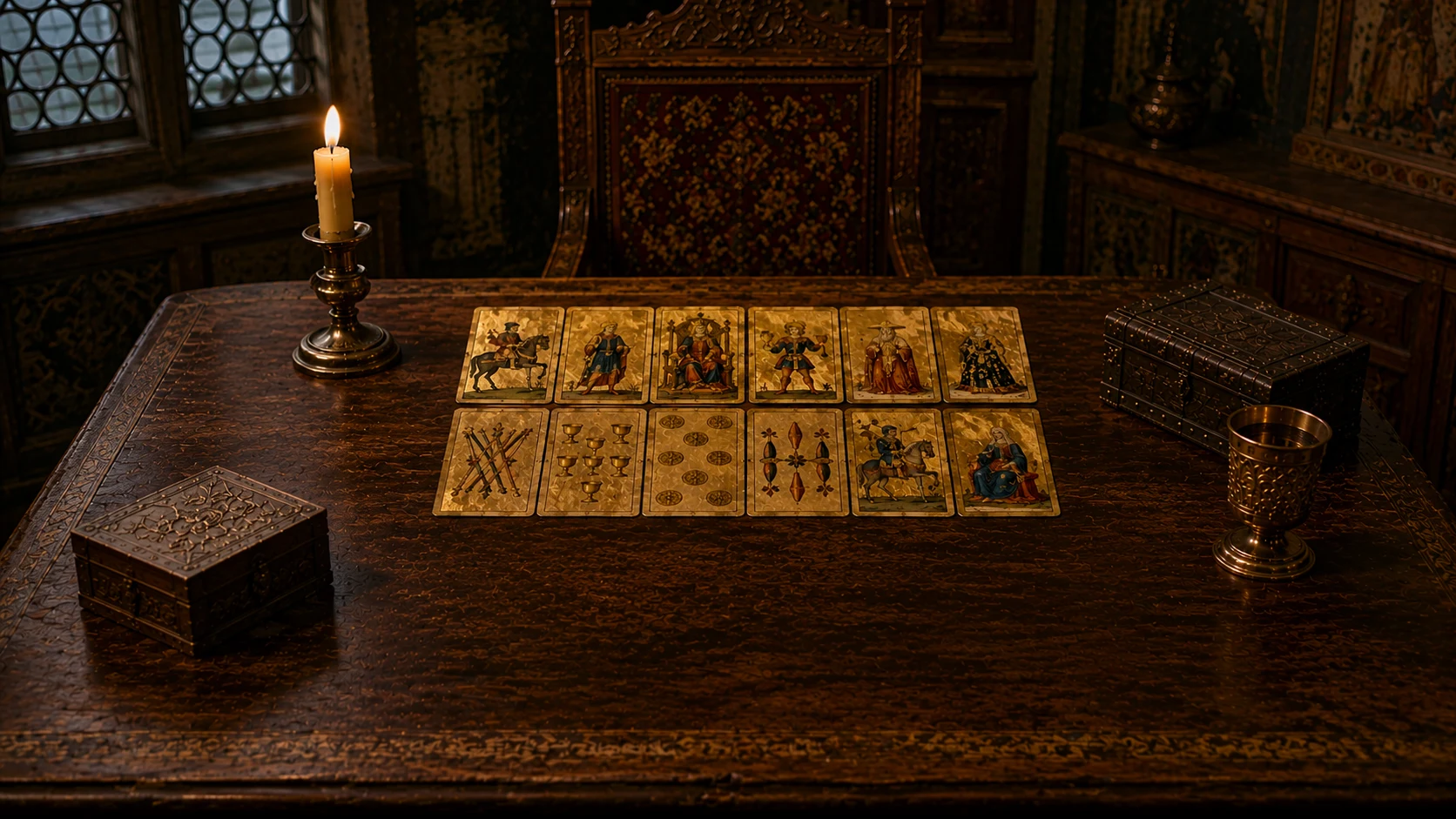
Tarot did not start life as a spiritual practice. The earliest confirmed decks date to the 1440s, commissioned by the Visconti and Sforza families of Milan, and the most complete survivor, the Visconti-Sforza deck, is a genuine luxury object. Hand-painted, gilded, made for people with money to spend on a pack of cards rather than a working household one. The game played with it, tarocchi, ran like a trick-taking game similar to bridge, with one addition: a permanent trump suit, the twenty-two cards now known as the Major Arcana.
How the Tarot Deck Was Built
Before tarocchi came along, Italy already had a suited deck that looked more or less like the ones used today, four suits of fourteen cards (ten numbered cards plus King, Queen, Knight and Jack), running cups against coins against swords against batons. What tarocchi did was bolt twenty-two trumps on top, a whole extra suit that outranked the rest. The suits themselves carried across mostly untouched in picture, if not in name. Swords stayed swords, still drawn as swords. Cups stayed cups. Coins are where it changes: the disc became a pentacle, a five-pointed star standing in for money entirely. Batons went the same way, turned into wands, a slender rod replacing what had been a heavy staff. None of it touched the actual logic of the game underneath.
The trumps are what give the deck its reputation. The Fool. The Magician. The Wheel of Fortune. Death. Even stripped of any divinatory meaning, these were striking, morally loaded images for a fifteenth-century buyer, drawing on the same visual grammar as church frescoes and moral allegory paintings of the period. A Milanese card player looking at Death in 1450 would have recognised the same imagery a churchgoer saw in a fresco. The deck was doing what most Renaissance art was already doing.
Where the Occult Meaning Actually Came From
The shift from game to divination tool happened at a specific place and a specific moment, and it traces back to one man deciding it was true and saying so. Antoine Court de Gebelin was a French clergyman and writer, and in 1781 he made a claim that stuck for the next two centuries: tarot cards were surviving fragments of the Egyptian Book of Thoth, smuggled out of a burning library and hidden inside a card game. Nobody could have checked him even if they'd wanted to. Hieroglyphs were still unreadable, decades before the Rosetta Stone turned up, so there wasn't a document on earth he could be tested against. What he had instead of evidence was total conviction, delivered without a flicker of doubt, and that turned out to carry further than evidence usually does.
A contemporary calling himself Etteilla ran with it. He published the first dedicated instructions for cartomancy with tarot, then went further and built his own deck from scratch, designed for fortune-telling rather than card games. Somewhere in the space of about ten years, a parlour game acquired a four-thousand-year pedigree that nobody had actually checked.
The Deck Most People Picture
One of the most iconic images in tarot, a woman kneeling by water under a sky full of stars, isn't from the Renaissance original at all. That's the Rider-Waite-Smith deck, published in London in 1909. Waite directed it, Pamela Colman Smith illustrated it, and both were Golden Dawn members (the Hermetic Order of the Golden Dawn, a secretive Victorian occult society that also counted W.B. Yeats among its ranks). Earlier decks never bothered illustrating the minor arcana beyond plain suit-and-number cards.
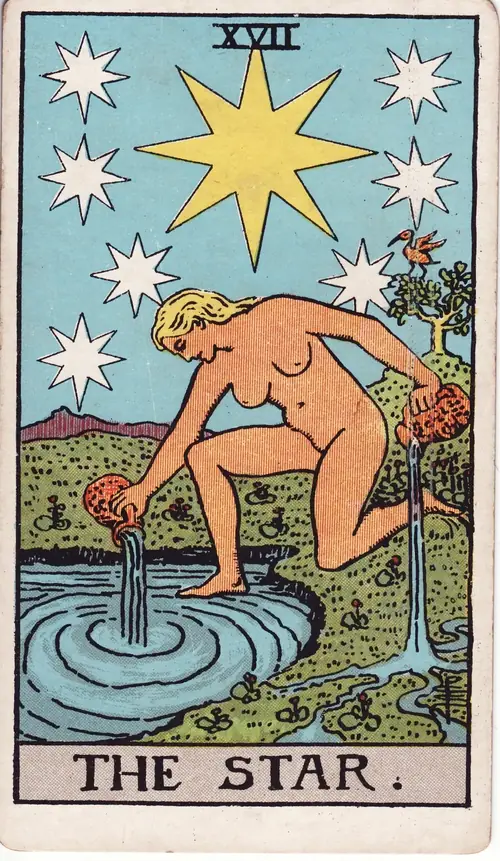
Smith gave every one of them a scene. That's most of why this deck is still the template everyone reaches for, and honestly it's a strange thing to owe so much to: not the symbolism, just someone finally bothering to draw the rest of the cards.
What Actually Survived
None of this settles whether tarot reading does anything useful. I've watched it work for my mother in some sense I still can't fully account for, and I'm not going to pretend that observation doesn't complicate my own views on tarot. What the cards are not is an unbroken four-thousand-year Egyptian tradition. They started as a fifteenth-century Italian card game. A Parisian clergyman gave them a mystical backstory three hundred years later that he had no way of proving, and somehow that's the version that stuck.
Frequently Asked Questions
Is tarot originally Egyptian?
No. The claim was invented in 1781 by Antoine Court de Gebelin, who had no evidence for it and could not have checked it against Egyptian sources, since hieroglyphs weren't deciphered until decades later.
When was tarot invented?
The earliest surviving tarot decks date to the 1440s, commissioned by the Visconti and Sforza families in Milan for a trick-taking game called tarocchi.
Who created the modern tarot deck people usually picture?
The Rider-Waite-Smith deck, published in 1909 and illustrated by Pamela Colman Smith, is the design most modern decks are based on.
Was tarot always used for fortune-telling?
No. It was played as a card game for roughly three centuries before Antoine Court de Gebelin and the occultist Etteilla reframed it as a divination tool in Paris in the 1780s.
◆ Also In The Stars
◆ Go Deeper
Recommended
Affiliate links — we may earn a small commission at no cost to you.