She corresponded with kings, emperors and powerful churchman as though they answered to her. Mostly, they did. She spent her first thirty years walled inside a monastery cell.
◆ In Summary
Hildegard of Bingen was a twelfth-century Benedictine abbess who spent her first thirty years walled inside a monastery cell and the next fifty corresponding with kings, emperors and popes as though they answered to her. She composed over seventy chants, wrote two medical texts, preached publicly when women were forbidden to, and produced Scivias, a book of visions endorsed at the highest levels of the church. She is not a prophet of dates and disasters in the Nostradamus sense. Her visions describe what the universe is, not what is coming. Pope Benedict XVI named her a Doctor of the Church in 2012, only the fourth woman ever given that title.
I came to Hildegard of Bingen sideways, the way most people do. She turned up in a conversation about medieval music. Someone mentioned, almost as an aside, that she had also written a book of visions endorsed by the Pope. She sounded like a subject for the website. But there was more. She practised medicine. Composed an entirely new musical language. Preached publicly when women were not permitted to. Wrote letters of rebuke to the most powerful churchmen in Europe and seemingly got away with it. Call her a Renaissance woman and you'd still be three hundred years early.
She is not a prophet of dates and disasters, the way Nostradamus or Mother Shipton are remembered here. Her visions describe what the universe is, not what is coming. Born in 1098 in the Rhineland, she lived to eighty-one, and seems to have spent most of those years doing something nobody had done before her.
Hildegard von Bermersheim was the tenth child of a minor Rhineland noble family. As the tenth child, she was owed to the church as a tithe under medieval custom, the same logic that saw families give a tenth of their harvest to God. She was handed over at eight, placed with a young anchoress, Jutta of Sponheim (a woman who had vowed to be sealed inside a cell for life, in a ceremony that mirrored a funeral rite).
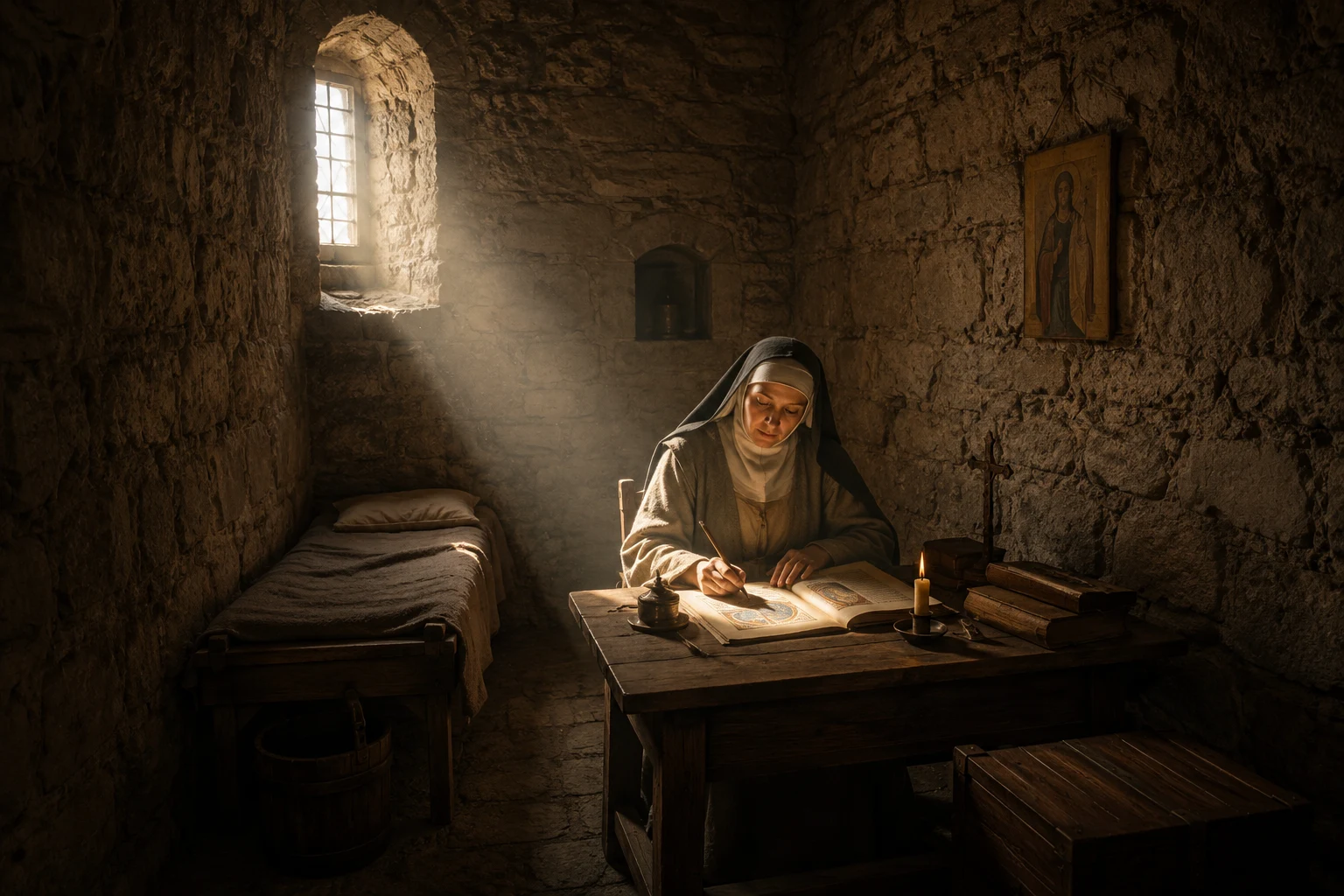
These enclosures (anchorholds) sometimes doubled as a kind of school, and noble families would place daughters there to be raised within them. Hildegard was sent to Jutta's at Disibodenberg, a Benedictine monastery on the Nahe river. She was eight years old. Calling it a cell gets closer to the truth than calling it a convent. It was walled in, with a single window through which food passed one way and prayers the other. Hildegard stayed there for thirty years.
The Visions
Before she was sent to Jutta, Hildegard had already begun perceiving visions, around the age of three, and somehow understood even then that what she saw was not something other children saw. She later described a living light, perceived fully awake, carrying knowledge she could not account for through ordinary means. For decades she told nobody, not out of fear alone but because she seemed to be waiting. An unsanctioned claim of revelation could make a woman a celebrated mystic or a suspected heretic, depending entirely on who judged it and when, and somehow, even as a child, she understood the difference well enough to bide her time until it could be the former.
Hildegard of Bingen: The Visions of Scivias
Jutta died in 1136. The small community that had formed around her enclosure elected Hildegard to lead it. She was thirty-eight, and within a few years she received what she took to be an explicit instruction: write it down. Perhaps this was what she had been waiting for, permission at last to share what she had been seeing. What followed, over the next decade, with a monk named Volmar acting as secretary and Latin editor, was Scivias, Know the Ways. Thirty-five visions, described with a precision unusual even by the standards of medieval mysticism, paired with illuminations she personally oversaw. Some of those images are still among the strangest things to come out of the twelfth century, which is saying something.
Scivias is not light reading. It is divided into three books covering God and creation, the fall of Lucifer, the nature of the Church, and finally an apocalyptic account of how the world ends. The most reproduced image is the Universe Egg, the cosmos as a vast egg-shaped structure, the earth at its centre, rings of fire and wind and water wrapped around it. It looks like nothing else from the period.
The Endorsement
Elsewhere she pictures the church as Ecclesia, an enormous female figure, and the faithful are not members of it so much as held inside it, carried within her body like something living. Scholars have noted what sets her egg apart from similar medieval cosmologies: where other versions render the universe as static, ordered spheres, Hildegard's surges and empties and fills itself, generative rather than fixed, closer to a womb than a machine.
What happened next was not the obvious outcome. Hildegard's work eventually reached Bernard of Clairvaux. He was, at that point, the most powerful churchman in Europe, which made the timing of what happened next matter. At the Synod of Trier in 1147, he read it. He endorsed it. Pope Eugenius III, who was also present, gave it formal approval. A woman's prophetic writing, sanctioned at the very top of the church, in 1147. The endorsement did not so much make her famous as make her official. She had been writing privately for years. Now she had permission to be heard, and she used it without much restraint.
The Letters
The letters went out for decades after that, to popes, emperors, kings, abbots. Frederick Barbarossa got one. So did Henry II of England. So did Thomas Becket, not long before his murder. None of them read as deferential. She wrote to the most powerful people in Europe as though she had information they needed and they, by and large, wrote back. Over three hundred of those letters survive.
In 1150 she did something that took real nerve. She moved her entire community. The abbot of Disibodenberg objected (he was, after all, about to lose his most celebrated resident, and said so), but Hildegard relocated her nuns to a new site at Rupertsberg, near Bingen on the Rhine, and built a convent there from nothing. She raised the money. She managed the construction. She handled the politics of getting an abbot to agree to lose her. That kind of administrative competence rarely gets mentioned in the same breath as her visions, but it belongs there.
The Music
She composed over seventy chants, which is not remarkable for a medieval abbess. What is remarkable is how they sound. So does a liturgical drama, Ordo Virtutum, the earliest surviving morality play with a known composer attached. What is strange about the music, even now, is the range. Her melodies span an unusually wide range, reaching further than the flatter plainchant her contemporaries were producing at the time. She never called it composing. She called it transcription, what she heard rather than what she made, and that distinction probably did some useful work for her in a world where a woman claiming authorship of her own liturgical music would have needed defending.
She also wrote two scientific and medical texts, Physica and Causae et Curae, covering plants, stones, the human body and the treatment of illness. Underneath both sits her idea of viriditas, greenness, vitality, a divine animating force she believed ran through everything living. Mystical in origin, yes, but it sharpened how closely she looked, and some of what she recorded about plants and the body turns out to have been genuinely useful knowledge.
The Preaching
She preached in public four times, travelling through the Rhineland to address clergy and laypeople directly. Women did not do this. Nobody on record made a serious attempt to stop her, which says more about the authority she had built by her sixties than any formal title could.
The Legacy of Hildegard of Bingen
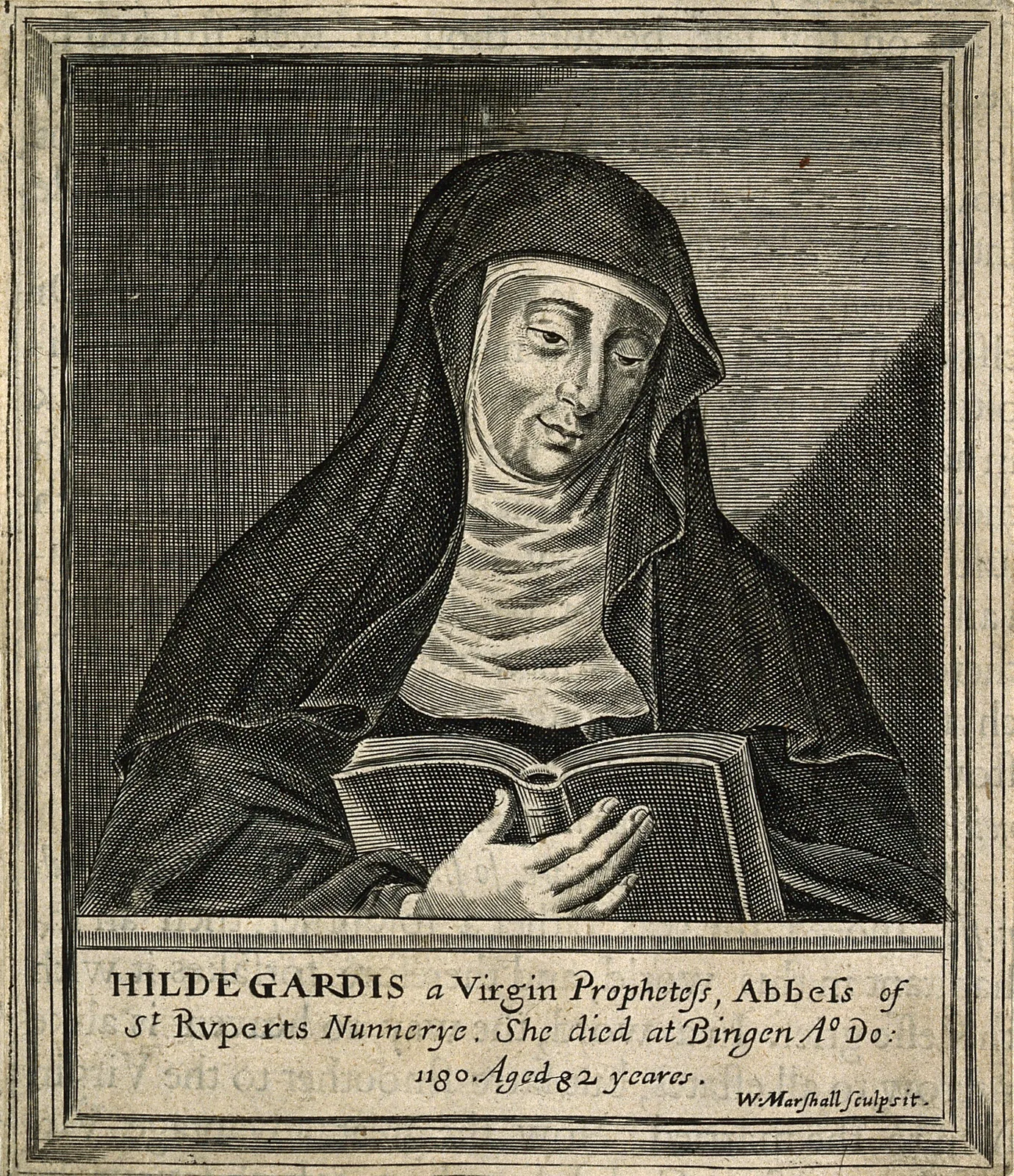
She died in 1179 at Rupertsberg, around eighty-one. The formal canonisation took until 2012. Pope Benedict XVI named her a Doctor of the Church that year, only the fourth woman ever given the title, and the gap between those two dates is not really about Hildegard.
What makes Hildegard difficult to reduce to a single label is that she was all of these things simultaneously, and none of them cancel the others out. The visions she described in old age closely resembled those she had reported as a young woman, a consistency that has invited explanations ranging from the divine to the neurological. Eight centuries later, neither theology nor medicine has produced an answer that satisfies everyone. The music still gets performed, still gets recorded, and still sounds strange in a way that has not worn off. The science holds up too, in its own fashion, the observation careful even where the conclusions were not. Prophet, composer, physician, abbess, administrator. Not five people sharing a name. One person.
Frequently Asked Questions
Who was Hildegard of Bingen?
Hildegard of Bingen was a twelfth-century German abbess, mystic, composer, physician and writer. Born in 1098, she became famous for her visions, extensive correspondence with rulers and church leaders, and her contributions to music, medicine and theology.
What was Scivias?
Scivias was Hildegard of Bingen's most famous work, a collection of thirty-five visions written between 1141 and 1151. The book explores creation, the nature of the Church, salvation and the end of the world, accompanied by striking illustrations based on her visions.
Why is Hildegard of Bingen important?
Hildegard of Bingen was one of the most influential women of the Middle Ages. She composed music, wrote medical texts, advised kings and emperors, and became one of the few women whose visionary writings received formal approval from the medieval Church.
Was Hildegard of Bingen a prophet?
Hildegard is often described as a prophet because of her reported visions and revelations. Unlike figures such as Nostradamus, however, she did not focus on predicting specific future events. Her writings were primarily concerned with God, creation, morality and humanity's place in the universe.
◆ Also In The Stars



◆ Go Deeper
Recommended
Affiliate links — we may earn a small commission at no cost to you.