A political forecasting system for Babylonian kings somehow survived Rome's suspicion, Newton's physics and its own university syllabus to end up squeezed between the crossword and the sports pages.
◆ In Summary
Astrology started in Babylon as a political and meteorological system, reading omens for kings and nations rather than individuals. The Greeks added the individual birth chart around 410 BC, and Stoic philosophy gave it a genuine claim to being taken seriously as physics rather than superstition. It survived Roman ambivalence, was preserved and sharpened by Islamic scholars, and sat alongside medicine as a university subject at Oxford, Paris and Bologna. Newton's mechanics eventually stripped away its physical basis, but the practice never actually stopped, it just shrank down to the horoscope column millions still read today.
◆ At a Glance
| Origin | Babylon, 2nd millennium BC |
| Key text | Enuma Anu Enlil, ~70 tablets |
| First individual horoscopes | Hellenistic world, c. 410 BC |
| Taught at | Oxford, Paris, Bologna (medieval period) |
| Heliocentric model published | 1543, Copernicus |
| Modern horoscope column began | 1930, R.H. Naylor, Sunday Express |
How the History of Astrology Begins in Babylon
I have a complicated relationship with astrology. My mother uses tarot cards as a way of thinking through uncertainty, which I touch upon in a History of Tarot article, and I am aware that this puts me in an awkward position when it comes to assessing systems of belief that most scientists would dismiss without a second glance. So let me be clear about what this article is and is not. It is not a defence of astrology as a predictive system. It is a history of one of the oldest intellectual traditions in human civilisation. The more interesting question is why it survived everything that should have finished it off.
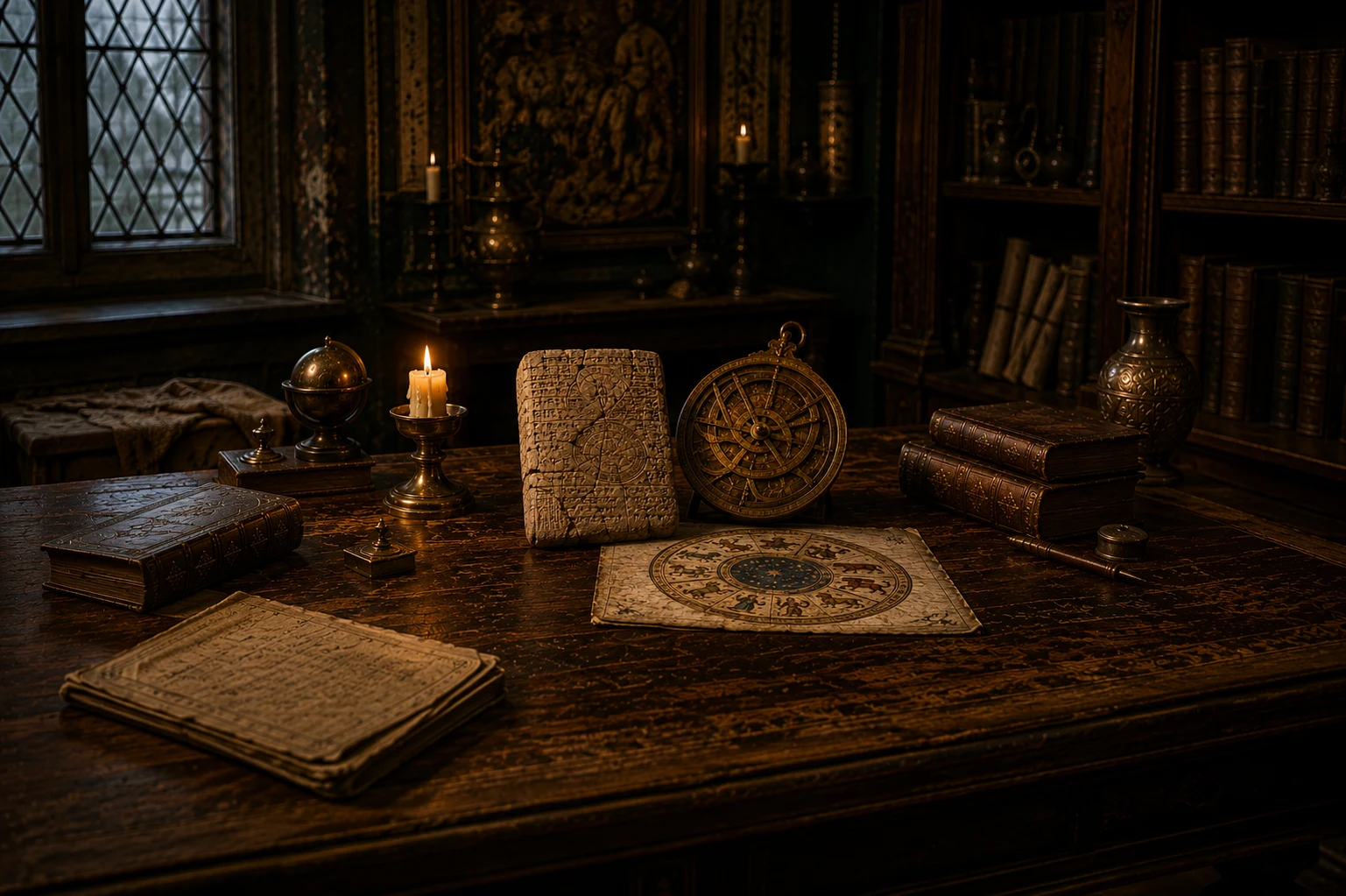
Babylon is where it starts, in the second millennium BC. What made the Babylonians unusual was not that they watched the sky, most ancient peoples did, but that they wrote everything down. Planetary movements, eclipses, the heliacal risings of Venus, none of it casual observation. Every entry cross-referenced, kept, added to over generations. The results went into texts called omen series. The most famous, the Enuma Anu Enlil, runs to around seventy tablets, each linking a celestial event to an earthly outcome, a lunar eclipse meaning one thing for the king, a comet in a particular part of the sky meaning something else entirely. The system was not personal. It was political and meteorological. The stars spoke to the fate of nations, not individuals.
The Greeks Turn Astrology Into the Horoscope
The Greeks changed that. When Babylonian astronomical knowledge reached the Hellenistic world, somewhere around the fourth and third centuries BC, it encountered a philosophical tradition that was interested in the individual soul and its relationship to the cosmos. The result was the horoscope, the birth chart calculated for a specific person at a specific moment, which appears in recognisable form by around 410 BC. The idea that the position of the planets at the moment of your birth shapes your character and your fate is a Greek addition to a Babylonian foundation. The same civilisation also produced remarkable astronomical achievements such as the Antikythera Mechanism, the most sophisticated astronomical device known from the ancient Greek world.
The philosophical framework that made all of this seem not just plausible but rational was Stoicism. The logos, as the Stoics understood it, was a governing principle threaded through the entire cosmos, not a metaphor for order but the actual mechanism of it. Which meant the heavens and a human life weren't two separate things with a mysterious connection. They were one thing. Astrology was not superstition in the Stoic worldview. It was physics.
Rome's Uneasy Relationship With Astrologers
Rome inherited Greek astrology along with most of the rest of Hellenistic culture, and the results were complicated. The Roman state periodically expelled astrologers from the city, concerned about the political implications of people predicting the deaths of emperors. The emperors themselves consulted astrologers constantly. Augustus put Capricorn on his coins. Tiberius had Thrasyllus at his side for decades, an astrologer consulted on matters of genuine political consequence. The same government that kept these men close periodically expelled astrologers from the city as a public danger. Rome believed in what they could do. It just didn't trust them with a wider audience that could be turned against the leadership.
The Islamic World Keeps Astrology Alive
The Islamic world kept the tradition alive through the early medieval period, when much of it had gone missing in Western Europe. Baghdad's scholars translated the Greek astrological texts into Arabic and sharpened the mathematics in the process. The results came back into Latin eventually and European astrology for the next several centuries was built on that foundation. The algebra in the calculations is an Arabic word and some of the most well-known stars carry arabic names including Aldebaran, Betelgeuse, Fomalhaut.
A University Subject at Oxford, Paris and Bologna
Astrology was a university subject in medieval Europe, which still surprises people. It sat alongside medicine in the curriculum, on the grounds that planetary positions affected the body's humours and a physician needed to account for that. Bologna taught it. So did Paris and Oxford. Nostradamus trained as a physician at Montpellier, one of the great medieval medical schools, where astrology was part of the standard curriculum. Chaucer didn't use astrology decoratively. He used it structurally, as a scaffolding his readers were expected to follow. Dante did something similar in the Divine Comedy. Both men knew the system in detail, and both assumed their audiences did too.
The Renaissance Undermines Its Own Astrology
The Renaissance complicated things further. On the one hand, the revival of classical learning brought a renewed enthusiasm for Neoplatonic philosophy, which was highly sympathetic to astrology. The new astronomy was meanwhile doing quiet damage to the cosmological model astrology depended on. Copernicus published his heliocentric model in 1543. Kepler, who cast horoscopes for a living while privately doubting whether any of it meant anything, worked out the actual mathematics of planetary motion and in doing so helped dismantle the framework he was being paid to operate within. The physical basis for astrology was eroding even as its practice continued. Galileo's telescope showed that the heavens were not the perfect crystalline spheres of Aristotelian cosmology. Thomas Harriot had pointed a telescope at the moon months before Galileo did, in 1609, and drawn what he saw. Neither man's observations left much room for the celestial perfection on which astrological theory depended.
The Enlightenment and the Slow Death of Respectability
The eighteenth century's Enlightenment is usually given as the moment when astrology lost its intellectual respectability. That is broadly true, but it overstates the speed of the change. Newton's mechanics provided a complete account of planetary motion that left no room for astrological influence, and the educated classes in Europe largely abandoned it as a serious intellectual pursuit over the course of the eighteenth and nineteenth centuries. What they did not do was stop being interested in it. Popular almanacs containing astrological predictions continued to sell in enormous numbers throughout the period of its supposed intellectual death.
How Astrology Became the Modern Horoscope Column
The modern horoscope column arrived in 1930, when R.H. Naylor cast a chart for the newly born Princess Margaret in the Sunday Express and the column proved popular enough to become a regular feature. What Naylor had done, whether he knew it or not, was create astrology's McDonald's moment: a complex system reduced to twelve categories, consistent, accessible, requiring no particular knowledge to consume. The full birth chart is the restaurant with the proper menu. The horoscope column is the drive-through. Millions of people use it daily. The majority do not believe it is literally true. They read it anyway.
Astrology has managed something most competing systems haven't: it feels specific enough to be useful without ever being precise enough to be falsified. Three thousand years is a long time to hold that balance, and most of what has tried to occupy the same territory hasn't come close. It also does something organised religion used to do more reliably: it connects a single life to something larger, to cycles and patterns that were running long before the person was born and will keep running after they're gone.
What Actually Survived
None of that is a defence of astrology as a predictive system. The controlled studies that have tested its claims have not supported them. The history of astrology is not a history of error being slowly corrected. It shaped astronomy and mathematics, it occupied some of the finest minds in recorded history, and it persists in the twenty-first century in forms its Babylonian originators wouldn't recognise. Though they might, if you explained it to them, understand why it was still there.
Frequently Asked Questions
When did astrology begin?
Astrology originated in Babylon during the second millennium BC, initially as a system for reading omens about kings and nations rather than individuals.
When was the individual horoscope invented?
The birth chart calculated for a specific person appears in recognisable form by around 410 BC, after Babylonian astronomy reached the Hellenistic Greek world.
Was astrology taught at universities?
Yes. Astrology was a standard subject alongside medicine at medieval universities including Oxford, Paris and Bologna, since planetary positions were believed to affect the body's humours.
When did the modern horoscope column start?
The modern newspaper horoscope column began in 1930, when R.H. Naylor cast a chart for Princess Margaret in the Sunday Express.
◆ Also In The Stars


◆ Go Deeper
Recommended
Affiliate links — we may earn a small commission at no cost to you.