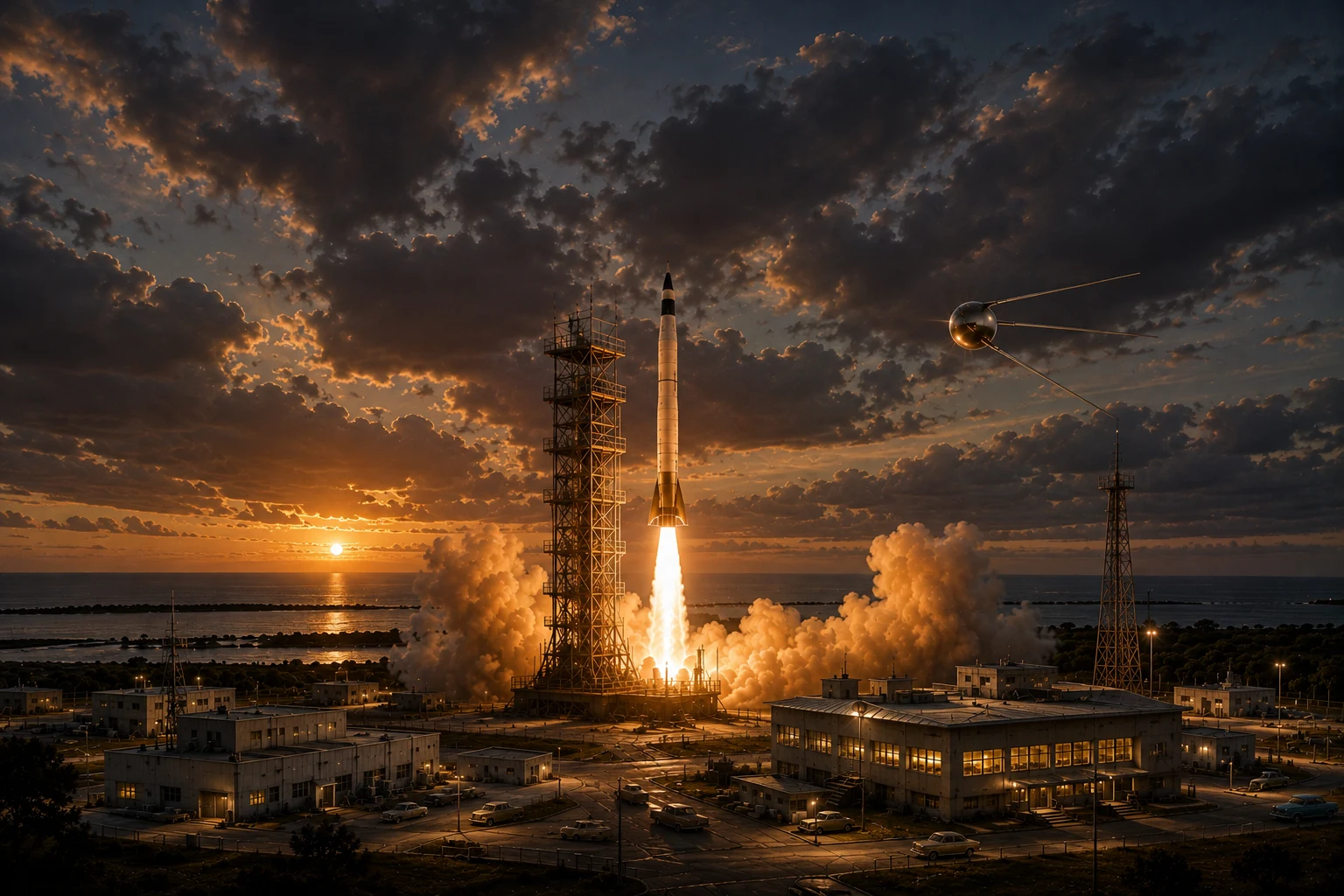
In 1958, with the Soviets already in orbit, the White House had to decide who would run America's space programme, and chose, against real pressure, not to hand it to the military.
◆ In Summary
NASA exists because of a decision, not just a launch. When Sputnik humiliated America in 1957, the obvious response was to fold the country's fledgling space effort into the Pentagon. Eisenhower chose otherwise, building a civilian agency out of an obscure 1915 aeronautics committee instead, even while the civilian programme also helped establish principles of free passage through space that America needed for its developing reconnaissance satellites. Congress, led by a young Lyndon Johnson, fought Eisenhower over how much power the new agency's board should hold, and settled it by making Eisenhower chair the board himself. What emerged on 1 October 1958 has since landed on the Moon, sent probes past the edge of the solar system, and is still arguing, nearly seventy years on, over how much of a civilian agency America is willing to fund.
◆ At a Glance
| Created | 29 July 1958 |
| Began operations | 1 October 1958 |
| Headquarters | Washington, D.C. |
| Annual budget (FY2026) | $24.4 billion |
| Employees | Around 17,000 |
| First Administrator | T. Keith Glennan |
| Field centres | 10, including Kennedy, Johnson and Marshall |
What Is NASA Today?
NASA (the National Aeronautics and Space Administration) doesn't really need any introduction. One of the most instantly recognisable organisations on the planet, it employs around 17,000 people and has a staggering annual budget of $24.4 billion in 2026. It is technically an independent civilian federal agency, not a part of the US Government's Department of Defense. It has ten field centres, including Kennedy, the site of famous launches in Florida, and Johnson in Houston, where astronauts are trained. As you surely know, its activities revolve around space, with four distinct areas of focus: space operations, science, aeronautics and space technology. Whenever a project is given the green light, in practice it tends to benefit one or more of these mission directorates.
When Was NASA Founded?
It was created by the National Aeronautics and Space Act on the 16th July 1958, which Eisenhower made law on the 29th July 1958 (Public Law 85-568). It subsequently began operations on the 1st October 1958, and incorporated the already existing NACA (National Advisory Committee for Aeronautics) which had three field centres located at Langley, Ames and Lewis. Interestingly, one option suggested was to expand NACA, but its internal structure as an advisory committee was deemed ineffective for what they wanted from the new organisation. More on that later. T. Keith Glennan was chosen as the first administrator, with Hugh Dryden (the former NACA head) his deputy.
Why Was NASA Created?
So, those are the details of NASA, the current state of its operations and the circumstances of its formation. The question we haven't yet answered is the why. Why was NASA created in the first place?
Well, it involves geopolitics, envy and a large dose of national pride.
The Sputnik Crisis
The 1950s were framed by increasing hostility between the Soviet Union and the United States, with nuclear weapons and missile technology at the heart of their rivalry. Space became a key part of that enmity.
The Soviet Union made its move into space with the launch of Sputnik 1. While both countries were working towards a satellite launch, the fact that the Americans were beaten to the punch was a humiliating realisation.
Another body blow came with the launch of Sputnik 2 on the 3rd November 1957. The US Navy attempted a launch on the 6th December that same year but the rocket Vanguard TV-3 failed to even leave the launchpad at Cape Canaveral, exploding after ignition. The payload, an aluminium sphere about 1.5kg in weight, nicknamed "the grapefruit", was hurled from the launch site into nearby bushes, still transmitting its beacon signal. Cue headlines like "Flopnik" and "Kaputnik".
Put yourself for a moment in the seats of the government officials in America at this time. They were failing, a laughing stock almost. Something needed to be done and done fast.
NACA had already begun thinking about what should be done to enable a better approach to space exploration. There was a feeling that even if it meant dissolving their own organisation, that might be a price worth paying to get things moving in the right direction.
There's an interesting backstory that is worth mentioning here. The Army would perhaps have been the logical choice for a rocket launch but in 1955 Eisenhower chose to use Vanguard instead. His thinking boiled down to a desire to deliver America's first satellite into space by what was considered a more civilian piece of hardware rather than the Army's repurposed missile.
While serious discussions were taking place in the background, the US finally had a successful launch in early 1958, on the 31st January. Explorer 1 reached space thanks to the Army's Jupiter-C rocket.
To be fair to the US Navy, on 17th March 1958, they did successfully launch a satellite from Vanguard with the aptly named Vanguard 1 reaching low Earth orbit. It's still up there today, the oldest human-made object still orbiting Earth. Explorer 1 decayed and burned up in 1970.
Civilian Control Versus Military Control
We've already discussed NACA's internal dialogue vis-à-vis its own future. There were also other voices involved in the discussions, each with their own priorities and demands. James Killian was an important part of the process. In his role as science advisor to Eisenhower, he chaired the influential President's Science Advisory Committee. He felt NACA could be "strengthened and redesignated" to better meet the needs of the government in their pursuit of space exploration.
Killian in turn formally proposed the idea of a reorganisation, and clearly Eisenhower was receptive to the idea.
Eisenhower, as President, would ultimately have the final decision as to how to proceed. He felt the new organisation, be it a reorganised NACA or something else, would benefit from being a civilian entity rather than a military one. He was mindful of the optics abroad, and wanted to present the change as something peaceful and scientific rather than adversarial.
Now, the reality was somewhat murkier. It's true that he didn't want to escalate tensions and wanted to encourage a worldwide legal framework for access to space. But at this time, the Americans were also keen to launch spy satellites and they didn't want anything to get in the way of this. While sending spy planes over foreign countries was seen as an infringement on a country's rights, at this point it wasn't clear if space would be treated in the same way. Eisenhower was keen for it to be treated differently, so their spy satellites could ultimately spy on the notoriously closed Soviet Union.
Congress was the final stakeholder. Lyndon Johnson, who would become president in 1963 after the assassination of JFK, was chosen to chair the Special Committee on Space and Aeronautics. Johnson reportedly was keen to find out why the Soviets had beaten America into space and favoured a more robust, muscular organisation to replace NACA and help America fight back in the race. He also wanted a strong, civilian oversight board to keep everything in check. This put him in direct conflict with Eisenhower, who feared he would lose control over the process going forward.
After the toing and froing, the House bill was passed on 2nd June 1958, and the Senate version passed on 16th June. Johnson then chaired the bipartisan panel so the two bills could then be reconciled into one joint bill.
To resolve his impasse with Eisenhower, Johnson cleverly suggested that the President chair this new board himself.
Eisenhower accepted the compromise and Congress passed the reconciled Act on the 16th July 1958. NASA was now the means by which the United States of America would explore space.
NASA's Biggest Successes
Fast forward to 2026 and we are able to look back on what NASA have achieved in the intervening years. While this is only my opinion, I would suggest that those involved in the formation of the organisation would be pleasantly surprised with the results. The highlight beyond any shadow of doubt is the moon landing in 1969. The Apollo missions were a stunning feat of engineering, ingenuity, perseverance, doggedness, bravery and ambition. They lasted from 1969 to 1972 and no humans have been back to the moon since.
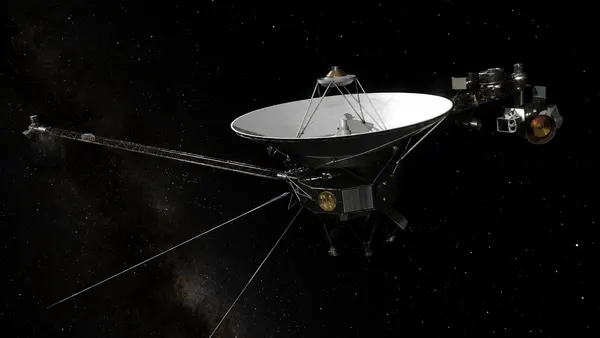
The Voyager programme must rank among NASA's next greatest successes. Launched in 1977, the two probes went on a grand tour of the solar system and are currently travelling through interstellar space. Other highlights include the Space Shuttle which introduced the notion of partially reusable space vehicles, and the space telescopes Hubble and JWST that revolutionised astronomy. Then there are the rovers Curiosity and Perseverance exploring Mars and the current Artemis programme which promises to bring humans back onto the surface of the moon. Quite a list of achievements.
What's Next For NASA?
What next for NASA? Well, it certainly feels like things are starting to heat up in the space arena. The Artemis missions are the main focus for the next few years and this increased interest in the moon has echoes of the founding of NASA. While it was the Soviet Union then, now it is China and a potential battle over lunar resources. There are also increasingly sophisticated private enterprises getting involved in the space industry, such as SpaceX and Blue Origin. While it is not clear how this will play out in the future, for now NASA is welcoming their input and using their expertise where appropriate.
As with all governmental organisations, NASA will also have to contend with funding cuts and job losses. Throughout its history, political will has ebbed and flowed, sometimes in NASA's favour, sometimes against it. Hopefully, whatever the future, NASA will still be able to explore the solar system and beyond and keep producing stunning moments that broaden humanity's horizons.
Frequently Asked Questions
Why was NASA created?
NASA was created in response to the Soviet Union's launch of Sputnik 1 in October 1957, which triggered a national crisis of confidence in the United States. President Eisenhower chose to build a new, independent civilian space agency rather than fold the effort into the Department of Defense, partly to present American space activity as peaceful and scientific, and partly because a prominent civilian programme helped establish the legal principle that orbiting over another nation's territory was not a violation of its sovereignty, groundwork the US also needed for its developing reconnaissance satellite programme.
When was NASA founded?
Congress passed the National Aeronautics and Space Act on 16 July 1958, and President Eisenhower signed it into law on 29 July 1958. NASA officially began operations on 1 October 1958, absorbing the National Advisory Committee for Aeronautics (NACA) and its three research centres at Langley, Ames and Lewis.
Was NASA originally supposed to be a military organisation?
There was serious pressure to place America's space programme under the Department of Defense, especially given that Sputnik had flown on a converted Soviet ICBM. Eisenhower rejected this, choosing a civilian agency instead. Lyndon Johnson, chairing the Senate's Special Committee on Space and Aeronautics, favoured a more powerful independent oversight board than Eisenhower wanted, and the dispute was resolved when Johnson suggested Eisenhower chair the board himself.
What was Explorer 1?
Explorer 1 was America's first successful satellite, launched on 31 January 1958 on the Army's Jupiter-C rocket, 84 days after Sputnik 1. It was built by Wernher von Braun's Army team, whose earlier satellite proposal had been passed over in favour of the US Navy's Vanguard programme in 1955. Explorer 1 carried an instrument that led to the discovery of the Van Allen radiation belts.
◆ Also In The Stars

◆ Go Deeper
Recommended
Affiliate links — we may earn a small commission at no cost to you.