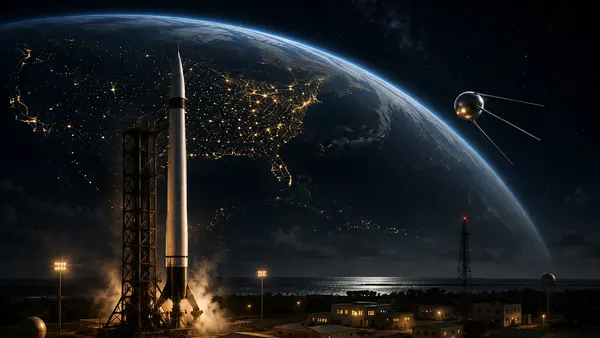
In 1978, a NASA scientist worked out that low Earth orbit could eventually become too crowded to use, and nobody needed to fire a missile to make it happen.
◆ In Summary
Kessler Syndrome is the theory that orbital debris density could cross a threshold where collisions generate enough fragments to cause further collisions on their own, with no new launches required. NASA scientist Donald Kessler proposed it in a 1978 paper, applying mathematics from his own research on asteroid belt collisions to satellites in low Earth orbit. Around 46,000 objects are currently tracked in orbit, most of it dead hardware, with statistical models estimating millions more fragments too small to track. Two real events, in 2007 and 2009, have already shown how much debris a single collision can generate. The proposed solutions remain largely voluntary, leaving the growing risk mostly unmanaged.
What Is Kessler Syndrome?
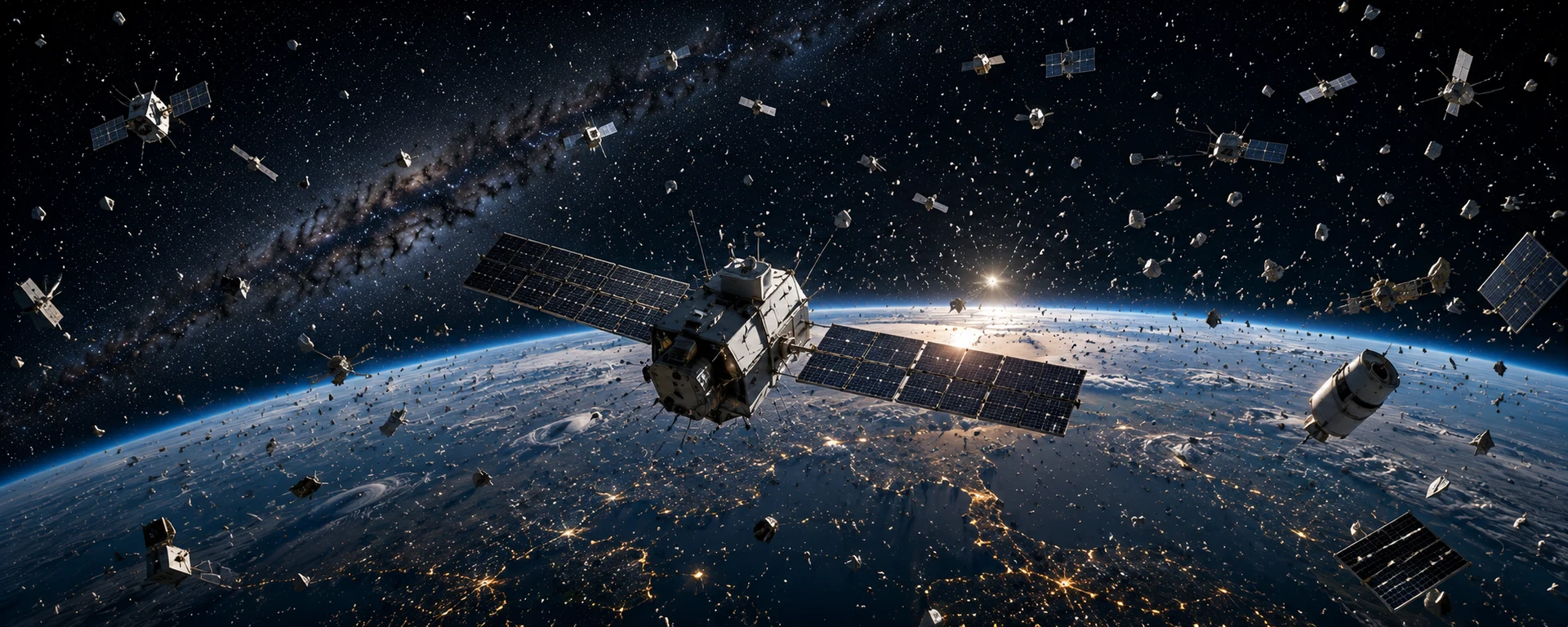
The space above Earth is crowded. Satellites and other man-made tech have been put there for over seventy years now. Sometimes, these objects collide with each other, breaking off fragments that then pose a risk to other satellites and equipment and any humans currently in orbit.
A particular concern some scientists have is what happens if these collisions become more frequent, to the point that a cascade effect takes place.
This is known as the Kessler Syndrome, named after Donald Kessler, who published the idea in a paper in 1978 called "Collision Frequency of Artificial Satellites: The Creation of a Debris Belt".
Who Was Donald Kessler?
Kessler was a NASA scientist in the Environmental Effects Project Office at the Johnson Space Center in Houston. He was 38 at the time he wrote the paper, which was co-authored by Burton G. Cour-Palais.
While working at NASA, Kessler had been studying asteroid belts and the mathematics behind how they formed. Part of his studies involved collisional evolution and how asteroids gradually grind each other down after countless interactions.
It occurred to Kessler that his findings might be applicable to the satellites in low Earth orbit, concluding that what happens to asteroids over billions of years could equally happen to man-made objects in orbit in mere decades.
In an interview in Aerospace America, Kessler says that it seemed clear to him that this could be quite a serious problem, but wanted to make sure his calculations were correct before saying anything. After further investigation, Kessler felt his theory justified and the paper soon followed; Cour-Palais brought hypervelocity impact specialism to the piece.
Part of Kessler's calculations involved predicting what the threshold might be for a devastating cascade effect. He knew that atmospheric drag naturally pulls down some debris from low Earth orbit. This is why low Earth orbit doesn't just fill up as a matter of course over time.
Kessler's concern was that this mechanism can't keep control of the objects once they reach too great a density. At this point, the number of pieces keeps growing via collisions, even if there aren't any more launches.
In his paper, Kessler predicted that by the year 2000, collision-generated fragments would become the main danger to spacecraft rather than micrometeoroids, the tiny natural particles from asteroids or comets that exist naturally in orbit around Earth.
NASA's Response to the Paper
In response to the paper, NASA established the Orbital Debris Program Office around a year later in October 1979. Funds were also set aside for orbital debris investigations and Kessler himself was made the head of the new department.
Over the next seventeen years, the team made it their mission to build infrastructure to enable the accurate tracking and modelling of what was actually up there. This included ground-based radar and telescopes that could measure the pieces of debris. They also devised practical guidelines for how future missions into space could actually reduce the amount of debris and junk released into space and released them in 1995. NASA was the first space agency to do so and led international efforts to address the problem.
Was Kessler Right? The Numbers Today
As mentioned earlier, Kessler predicted that collision-generated fragments would overtake micrometeoroids as the biggest danger to spacecraft by 2000. While the evidence isn't clear-cut, it seems the general consensus is that he was largely vindicated, as evidenced by comparing NASA's ORDEM model measuring human-made debris with ESA's MASTER model that measures micrometeoroids. It's worth stating, however, that man-made debris dominates mid-orbit (i.e where most satellites orbit) while very low and very high orbit is dominated by micrometeoroids.
According to ESA's Space Debris Office, around 46,000 objects are regularly tracked and catalogued. But statistical models estimate there are around 54,000 objects larger than 10cm in orbit, including approximately 9,300 active payloads. Between 1cm and 10cm, there are an estimated 1.2 million pieces of debris, and between 1mm and 1cm, around 140 million. Even fragments this small can smash into satellites at orbital velocities, potentially creating more debris and contributing to the cascade Kessler predicted.
Two Warning Shots: Fengyun-1C and Iridium-Cosmos
Fortunately, no cascade has occurred yet. But two events have provided stark demonstrations of how quickly a single incident can increase the debris population. The first happened in 2007 during China's Fengyun-1C anti-satellite missile test. An obsolete weather satellite was destroyed, causing the largest single debris cloud tracked in history. Many of those fragments are still in orbit today.
The second was in 2009 when two satellites collided. Iridium 33 and Cosmos 2251, both intact, broke into thousands of fragments upon impact.
What Would a Kessler Syndrome Cascade Actually Look Like?
Well, according to the predictions, it wouldn't result in a particularly dramatic event as far as we are concerned on earth. There wouldn't be an explosion in the sky or a sudden blackout. Instead, we would experience the failures of satellites, particularly those between 700-1,000km from the ground. On top of that, it would make some replacement satellites unviable economically, the insurance cost being too great to justify the expense. This impasse could last for decades.
We may get a sense of an impending cascade with the increase of close-approach warnings. These are issued when the tracking systems believe two objects will pass unusually close to each other. In normal times, operators with this information can then move their satellite or tech to another position, providing there is enough fuel.
Can Anything Be Done About It?
Given the warnings given by Kessler and his colleagues at NASA, one might think that something would have been done by now to eliminate the problem. Unfortunately, removing the vast amount of debris already in orbit remains an enormous technical and financial challenge.
Some possible solutions include ESA's ClearSpace-1 mission, currently planned for 2029, which aims to capture the defunct PROBA-1 satellite and bring it down for atmospheric re-entry. Astroscale's ELSA-d has already shown magnets could be used to capture debris.
Regulations seem to be evolving to deal with the issue, admittedly slowly. The FCC (Federal Communications Commission) has introduced a 5-year deorbit rule, which requires satellites licensed in the US to be brought down within five years of the end of their working life. ESA has also introduced a voluntary pledge, the Zero Debris Charter, to encourage zero debris space operations by 2030.
Why Hasn't Anything Been Done?
Whether any of these policies or ideas will affect any positive change remains to be seen. One of the fundamental problems is that the satellite operators bear no responsibility for the debris that is left behind. While the space agencies are trying to some extent to put pressure on the operators to be mindful of debris and its removal, these will only be voluntary measures. The problem of debris could even get worse in quick order: Starlink and China's Qianfan are building their satellite constellations at breakneck speed and it's going to get even more crowded up there. The odds of a cascade as predicted by Kessler have perhaps shortened.
Frequently Asked Questions
What is Kessler Syndrome?
Kessler Syndrome is the theory that low Earth orbit could become so crowded with satellites and debris that collisions start generating debris faster than atmospheric drag can clear it. Past that density, one collision creates fragments that go on to cause the next collision, and the process can sustain itself even without any new satellites being launched.
Who was Donald Kessler?
Donald Kessler was a NASA scientist at the Johnson Space Center's Environmental Effects Project Office. In 1978, he and co-author Burton G. Cour-Palais published the paper that first described the collisional cascade effect that now carries his name. He went on to head NASA's Orbital Debris Program Office until his retirement in 1996.
Has Kessler Syndrome already started?
There's no consensus that a full cascade is underway, but two events, the 2007 Fengyun-1C anti-satellite test and the 2009 Iridium 33 and Cosmos 2251 collision, showed that a single event can generate an enormous amount of debris very quickly. Some experts argue these were early warning signs of the process Kessler described.
What is being done about the risk of a debris cascade?
Active debris removal missions are in progress. ESA's ClearSpace-1 is currently planned for 2029, aiming to capture and deorbit the defunct PROBA-1 satellite, while Astroscale's ELSA-d has already demonstrated magnetic capture technology in orbit. Regulation remains largely voluntary, including the FCC's 5-year deorbit rule for US-licensed satellites and ESA's Zero Debris Charter, which targets debris-neutral operations by 2030.
◆ Also In The Stars
◆ Go Deeper
Recommended
Affiliate links — we may earn a small commission at no cost to you.